How to Accept Payments as an iGaming Operator: PSPs, Acquirers, MCC 7995 and Onboarding Order

An iGaming operator accepts payments by signing with a processor that takes gambling, coding card payments as MCC 7995, and then adding local methods, payouts and routing on top. Five facts shape the whole process:
- MCC 7995 is the card code for betting and casino gambling, and Visa classes card-absent gambling as a top-tier integrity risk,
- Not every big processor takes gambling: Adyen lists legal gambling as Restricted for merchants and Prohibited for platform and partner models,
- A PSP, an acquirer, a gateway and an orchestration layer do different jobs, and you may need one, two or all four,
- Your acquirer must register you with Visa before you process, so the application is slow and detailed,
- The right order is licence first, then processor, then methods, then payouts
None of the providers we reviewed publishes a rate card for gambling merchants, so every route ends in a quote. This guide explains who does what and what to prepare.
- The four layers: acquirer, PSP, gateway and orchestration
- What MCC 7995 is and why gambling is high risk
- Which processors take gambling
- What the merchant application needs
- Onboarding steps in the right order
- Market rules that change the plan
- Common mistakes
- FAQ
The four layers: acquirer, PSP, gateway and orchestration
These terms get mixed up, so here is the plain version.
An acquirer is the bank-side company that settles card payments to you. A payment service provider (PSP) sits in front of one or more acquirers and gives you one contract, one integration and a set of methods. A gateway is the technical connection that passes the payment from your cashier to the processor. An orchestration layer sits above several processors and routes each payment to the best one.
Real companies blur these lines. Nuvei says operators connect to a network of 200+ acquirers plus its own direct acquiring under one integration and one contract. Worldpay is a large acquirer and gateway that says it works with over 200 gaming operators.
Orchestration is a separate product. Praxis Tech describes itself as an orchestration platform for iGaming, and says its services do not include transaction processing or handling client funds, so you still need licensed PSPs behind it. PaymentIQ’s CEO says building direct provider connections can take 6 to 12 months, and that customers have launched in new markets in as little as a day through an orchestration layer. That comes from a promoted article, so treat it as a sales claim.
A small operator usually starts with one PSP. A bigger one adds orchestration once it needs several processors and fallback routes. Our payment providers ranking groups providers by these types.
What MCC 7995 is and why gambling is high risk
MCC 7995 is the merchant category code for betting and casino gambling. Rapyd describes it as assigned to casinos, betting shops, lottery outlets and horse racing tracks. Issuing banks decide whether to allow or block it, which matters for declines (see our guide on why casino deposits get declined).
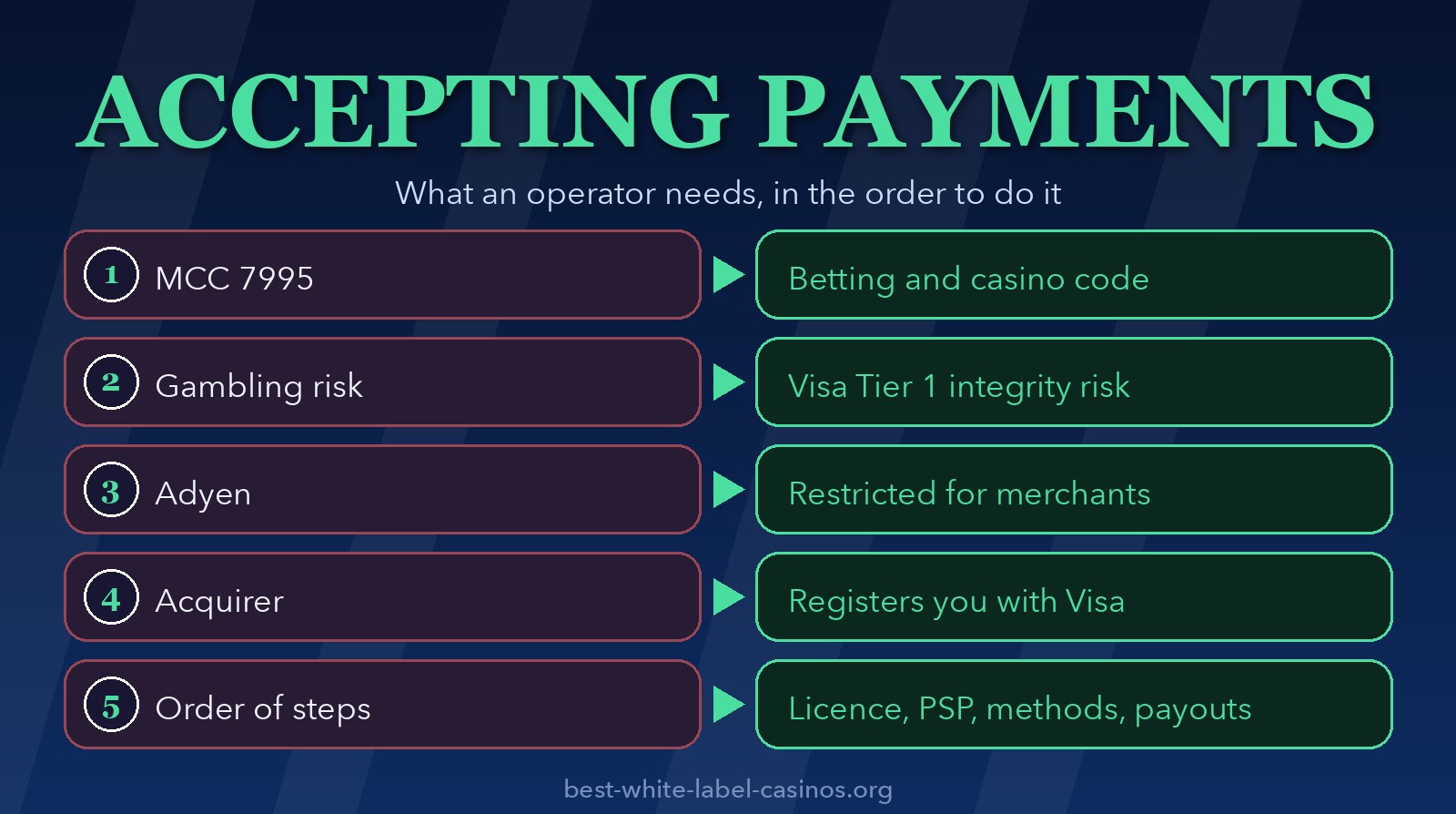 The order of steps for taking payments as a licensed casino or sportsbook.
Card networks treat the code as high risk. Visa’s Integrity Risk Program guide for Latin America and the Caribbean, dated 6 April 2023, lists card-absent gambling under MCC 7995 as a Tier 1 High Integrity Risk merchant type. Visa describes Tier 1 as businesses where illegal activity is more likely without proper controls. This is a regional document from 2023, so ask your acquirer for the current rule text.
Money risk adds to this. Stripe lists gambling among sectors with higher chargeback rates, and Checkout.com names gambling as an example of a high-risk industry for rolling reserves. That is why processors ask for reserves, which we cover in the fees and reserves guide.
Which processors take gambling
Some do not, and the list matters before you sign anything.
Adyen’s published list marks legal gambling as Restricted for merchants, which means extra documentation before onboarding. It marks gambling as Prohibited for platform and partner business models, so an aggregator cannot simply resell Adyen to gambling sub-merchants. Any US-based gambling services are Prohibited. Adyen says restrictions depend on local, national and international law, card network rules and assessed risk.
Processors that publicly serve gambling operators, from our research:
- Nuvei names bet365, FanDuel, Entain, DraftKings, BetMGM and 888 as customers on its gaming page.
- Worldpay shows bet365, DraftKings, Entain, FanDuel and Flutter logos and lists fraud prevention, dispute management, currency conversion and dynamic routing. Global Payments completed its acquisition of Worldpay on 12 January 2026.
- Paysafe owns Skrill, NETELLER and paysafecard. Its 2019 iGaming launch offered one API, a hosted checkout and a business portal with reporting and reconciliation.
- Praxis lists Stake, Playtech, Codere Online and Thrill on its site, and PaymentIQ offers routing across acquirers. Both are orchestration or cashier tools.
These are public statements, not our tests. Nuvei and Praxis have live gambling pages or client lists, but the dated news we found for them is older, so confirm current coverage with each.
What the merchant application needs
Visa’s guide says an acquirer must hold High Integrity Risk Acquirer Registration before it contracts with or processes for a gambling merchant. For Tier 1 categories it needs separate extra approval from Visa. Before onboarding, the acquirer must carry out enhanced due diligence on your control environment, tell Visa you passed, and register you with Visa before you submit transactions. It also has to update the registration when your details change, such as your website addresses.
The sources we read do not publish a single document checklist, and each acquirer sets its own. Plan for questions on:
- Your gambling licence and the markets it allows.
- Who owns and runs the company.
- Your websites and apps, since the registration lists URLs.
- Your player checks, age verification and responsible gambling tools.
- Expected volume, average deposit and refund and chargeback handling.
Have the answers ready before the first call. If you do not hold a licence yet, see what you need to launch an online casino and our comparison of MGA and Curaçao licences.
This is not legal or financial advice. Your licensing lawyer and your acquirer decide what applies to you.
Onboarding steps in the right order
- Secure the licence and company structure. Acquirers ask about them first.
- Open a business bank account for settlement. Banks can be hard to find for gambling, so read how to open a bank account for an iGaming company.
- Choose the main processor and ask for a written offer. Include deposit and payout fees, reserve terms and chargeback fees.
- Complete the application and wait for the acquirer’s registration with Visa. Do not promise a launch date until this is done.
- Integrate the cashier. Test deposits, declines, refunds and withdrawals in a sandbox.
- Add methods by market: local bank payments, wallets, and pay by bank where it exists (see our open banking guide).
- Add a second processor or orchestration once volume justifies it.
- Set up payout reserves and reconciliation. Our guide to payout reserves and operator cash flow shows what cash to hold.
Some white label platforms pre-connect payments. Whitelabels.com says it connects 250+ payment providers and charges a $99 one-time setup fee plus 20% of GGR with no separate monthly platform fee. Check which methods work in your target countries either way.
Market rules that change the plan
Local law can decide your payment mix before you choose a vendor.
In Great Britain, licence conditions bar online casinos from accepting credit cards for gambling, per the UK Gambling Commission. In Brazil, regulated betting requires transaction services to licensed operators to come from a payment institution authorised by the Central Bank of Brazil. Nuvei agreed in 2024 to buy Pay2All, a licensed Brazilian payment institution, for this reason. We have not confirmed that the deal closed.
Brazil’s ordinance SPA/MF 615/2024 also allows Pix, TED, debit or prepaid cards and book transfers for betting, and bans credit cards, cash, cryptocurrencies, cheques and payment slips. Our country localization guide and the Brazil payment methods brief go deeper.
Common mistakes
- Applying to a processor that excludes gambling and losing weeks. Check its restricted list first.
- Treating the licence as a later step. Acquirers will ask about it up front.
- Looking only at the headline rate. Reserves, chargeback fees and payout fees change the real cost.
- Using one processor for everything. A single failure then stops all deposits.
- Forgetting payouts. A processor that handles deposits may not handle withdrawals to your players’ cards or wallets.
For a wider launch plan, see how to launch a white label casino in 2026 and the iGaming supplier hub.
FAQ
What is MCC 7995?
It is the merchant category code for betting and casino gambling. Rapyd describes it as assigned to casinos, betting shops, lottery outlets and horse racing tracks. Card networks treat it as high risk, and issuing banks decide whether to allow or block it.
Can I use Stripe or Adyen for an online casino?
Check each company’s policy first. Adyen marks legal gambling as Restricted for merchants, so it asks for extra documents, and as Prohibited for platform and partner models and for any US-based gambling services. Policies change, so ask the provider in writing before building on it.
What is the difference between a PSP and an acquirer?
An acquirer is the bank-side company that settles card payments to you. A PSP sits in front of one or more acquirers and gives you one integration and contract, plus extra methods. Nuvei, for example, says it offers a network of 200+ acquirers under one contract.
How long does it take to get a gambling merchant account?
We found no sourced timing. The process involves enhanced due diligence and registration with Visa before you process, so confirm timing with your acquirer and do not set a launch date until approval arrives. PaymentIQ’s CEO says direct provider connections can take 6 to 12 months to build.
Do I need a licence before I apply?
In practice, yes. Acquirers must register gambling merchants and carry out due diligence on them, and they will ask about your licence and markets. Have it issued first. This is not legal advice, so confirm with your licensing lawyer.
Next, compare processors in our ranking of the best payment providers for iGaming, then request written quotes that show reserves and fees. If you are still choosing a platform, the white label casino ranking shows which ones include payments.
About the Author

Founder, best-white-label-casinos.org
iGaming operator and B2B software evaluator with 20 years of experience launching and reviewing online casino platforms across MGA, Curaçao, and crypto-native environments. Ratings are based on cost transparency, feature depth, regulatory compliance, and operator support quality.
Looking for the best white label casino platform?
Compare 12 providers by cost, launch time, licensing support and game library. Independent editorial, no paid placements.
Compare All Platforms →
← Previous
How Game Aggregators Charge: Revenue Share and Fees
No game aggregator publishes a rate card. See how revenue share, minimums and setup fees work, how stacking adds up, and what all-in should mean.

Next →
How to Add Crash Games to an Online Casino (2026)
Three ways to add crash games to your casino: aggregator, direct studio or your own build. Covers provably fair, certification and responsible gambling.