How to Open a Bank Account for an iGaming Company in 2026

You open an iGaming bank account by choosing a provider that publicly accepts gambling, filing a document pack that proves your controls already exist, and starting while your licence application is still running. In short:
- Pick a bank or an electronic money institution (EMI) that states a gambling policy, because consumer fintech apps such as Wise ban it,
- Prepare proof of controls, not plans: licence, flow diagrams, AML and responsible gaming policies,
- Match your licence scope to the countries you really serve,
- Start onboarding during the licence application, because review takes weeks,
- Expect higher fees and ongoing monitoring, and never count on one provider
No regulator publishes a list of gambling-friendly banks, so every answer below rests on what providers and law firms say in public. Licence, jurisdiction and due diligence decide each case, and no provider is guaranteed to accept you. Our banking ranking compares the providers that state a gambling policy.
- Why an iGaming bank account is hard to get
- Bank or EMI: which account fits
- The documents banks ask for
- Step by step: from licence to live account
- What a refusal looks like and why it happens
- Red flags that waste months
- Who this guide is not for
- FAQ
Why an iGaming bank account is hard to get
Banks treat gambling as a high-risk client type. A January 2026 Legal 500 commentary from a Cyprus law firm puts it this way: banking decisions on iGaming are “cautious by design, not arbitrary”. Banks look at your whole risk profile, not only your licence.
The same commentary lists the worries banks cite: high transaction volumes, cross-border payments, fraud and chargeback exposure, and sensitivity to regulatory enforcement and reputation. You cannot remove those worries. You can only show that you manage them.
Genome, a Lithuanian EMI, says the same thing in plain terms. In its guide on gambling accounts, it says gambling is a high-risk status, which means higher fees, more business information and more complex onboarding and monitoring.
Plan for that from day one. If you treat banking as a form to fill in the week before launch, you will lose months. Our guide to what you need to launch an online casino shows where banking sits in the full launch plan.
Bank or EMI: which account fits
A bank takes deposits and is supervised as a bank. An EMI issues electronic money and holds your balance in safeguarded accounts. EMIs in our research offer IBANs, payout tools and several currencies. Banks can offer a wider relationship but usually ask more of you.
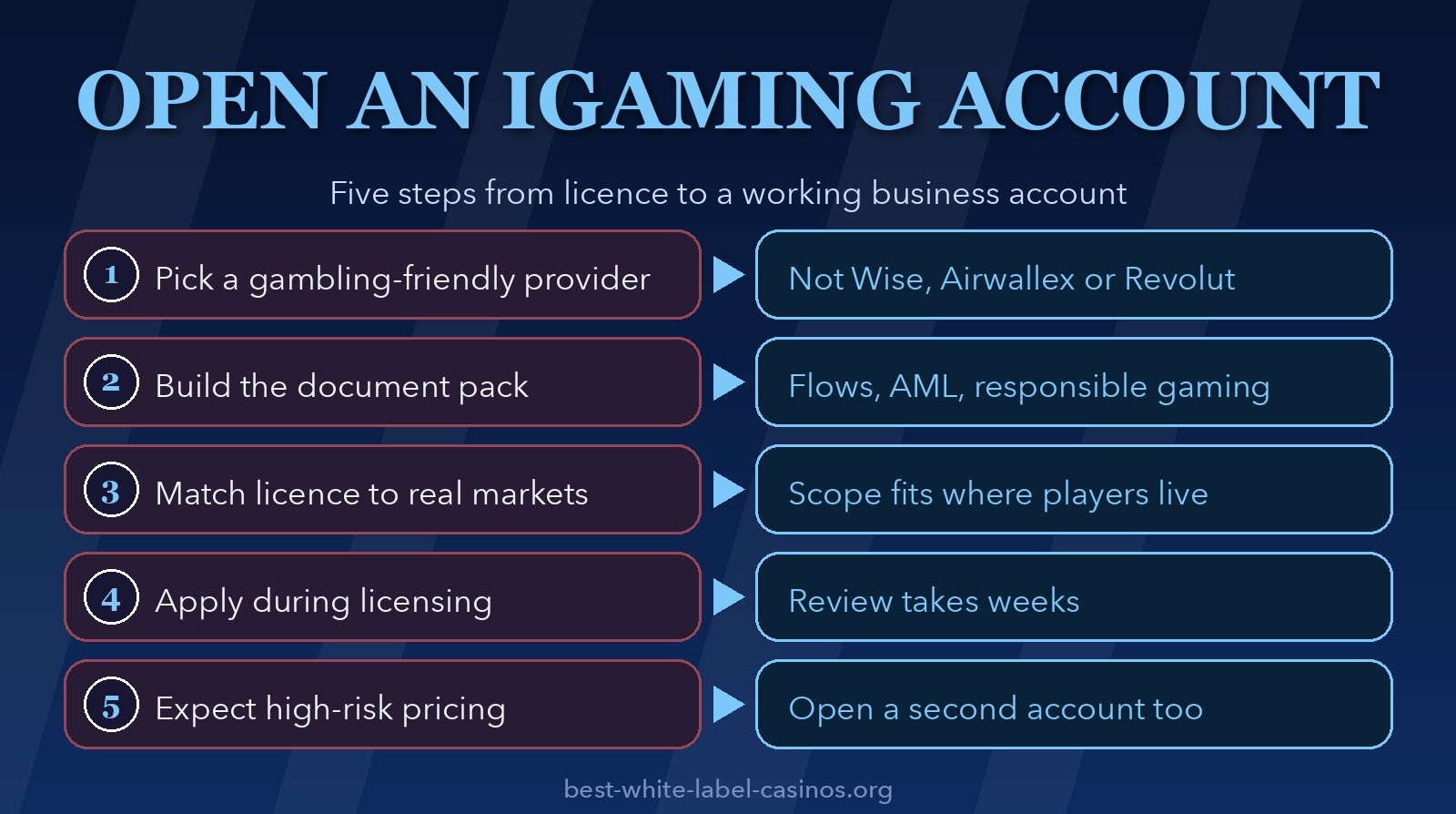 The route from licence to a working iGaming business account, step by step.
Here is how the main account types look in our research. We list them as examples of what providers say about themselves, not as promises that they will accept you.
| Account type | Example from our research | What the provider says | The catch |
|---|---|---|---|
| Payments bank | Banking Circle (Luxembourg) | Its public policy lists gambling as restricted, not banned | Strict conditions, covered below |
| EMI | Narvi (Finland), Genome and Satchel (Lithuania) | Narvi names iGaming among its industries, Satchel says it works with licensed gaming operators, Genome lists iGaming payments | Narvi quotes fees only after reviewing an application, Genome says gambling means higher fees |
| Payment institution with a partner | Xace (UK) | Its homepage markets accounts to gaming businesses | Accounts come via Modulr entities, so Modulr terms also apply |
| Consumer fintech | Wise, Airwallex, Revolut, Payoneer | Published terms ban or restrict gambling | Not a safe plan for an operator |
Banking Circle deserves a warning. According to its risk appetite policy, directly onboarded gambling clients must have been established for more than five years, must sit in a listed jurisdiction, and gambling flow is capped at 5% of its overall processed payments in any rolling 12 months. That rules out most new operators. For a start-up, EMIs are the more realistic first stop.
Wording on consumer fintech sites differs by country version, so read the current terms for your country. Wise’s Help Centre says it does not support any business involved in gambling anywhere in the world, and counts affiliate marketing for gambling companies too. Our EMI vs bank guide goes deeper on how the two protect money differently.
The documents banks ask for
The Legal 500 Cyprus commentary says banks and payment providers expect proof of existing controls, not future plans. They also want a clear description of your business model, player countries, payment flows and third parties such as affiliates and platform providers.
The documents it lists are:
- a business description,
- transaction flow diagrams,
- licensing documents,
- evidence of substance (a real office, staff and decision makers),
- AML procedures,
- responsible gaming policies,
- internal controls and reporting lines.
Two points save time. First, the licence scope should match the countries you serve and the operations you run. If your licence does not cover a country where most of your players live, expect questions. Our Malta vs Curaçao licence comparison shows how licence choice shapes the rest of the file.
Second, your flow diagram should show every party that touches player money: payment providers, the platform, affiliates and any crypto route. A bank that finds a party you did not mention will read it as a risk, not as a typo.
Step by step: from licence to live account
This is our suggested order. The time each step takes depends on the provider and your case, so we give no fixed dates.
- Fix your structure. Decide the company, the licence and the countries you will serve. Align the corporate structure with commercial reality, as Legal 500 advises, and keep legal, tax and banking records consistent.
- Build the control documents. Write the AML procedures and responsible gaming policy, draw the money flow, and name who owns each control.
- Shortlist providers from their own published policies. Check that each one says it serves gambling, which licences it names and which countries it covers. Drop any that ban gambling.
- Apply while the licence is still pending. A 2026 guide from a commercial provider, Vantegris, advises starting account onboarding during the licence application because onboarding and compliance review take weeks. That is a vendor’s advice, not a rule, but it matches the common sense that licensing and banking run in parallel.
- Answer follow-up questions quickly and in writing. Keep one folder with the latest version of every document.
- Run a small first test. Start with low volumes and consistent patterns before you move your full flow.
- Open a second account in parallel. One account is one point of failure. Our guide on why banks close iGaming accounts explains why.
In Malta, the choice of institution is part of licensing itself. A Legal 500 commentary dated 3 August 2026 says a player funds account must sit with a licensed credit, financial or payment institution and be approved by the Malta Gaming Authority (MGA). Check the MGA’s own rules before you sign with any provider.
What a refusal looks like and why it happens
Refusals are normal. Many providers will not answer a yes or no. They go quiet, ask for more documents, or say your business is outside their risk appetite.
The most common reasons, drawn from the sources above:
- the provider bans gambling outright,
- you fail a stated condition, such as company age, listed jurisdiction or a flow cap,
- your documents describe plans, not working controls,
- your structure, licence scope and real operations do not match,
- there is negative media about you or a related party.
Banking Circle’s policy adds a useful detail: it only accepts gambling clients registered with the local gambling commission, covered by EU or UK-equivalent AML rules and free of material negative media. Check your own name and the names of your directors before you apply.
If you are refused, ask which condition you failed. Fix that, then apply elsewhere. Do not reapply to the same provider with the same file.
Red flags that waste months
Some mistakes cost weeks each. These are the ones we would avoid.
- Applying to Wise, Airwallex, Revolut or Payoneer because they are easy to open. Their published terms prohibit or restrict gambling, and an account opened by hiding your business can be closed later. Revolut Business terms also reserve the right to restrict services outside its risk appetite after opening.
- Trusting a provider that lists no gambling policy at all. If you cannot find one, ask in writing before you spend time on forms.
- Believing aggregator sites that say a given bank is “friendly”. Those pages are often commercial, and our research used them only as leads.
- Showing plans where banks want proof. Policies that exist only as drafts slow everything down.
- Mismatched documents. The company address on the licence, the contract and the flow diagram should agree.
- Waiting for the licence to be issued before you start. That adds weeks you could have run in parallel.
- Putting all volume through one new account on day one.
If you launch on a white label platform, ask what payment and account setup is included. Whitelabels.com, for example, says it connects 250+ payment providers, but ask how company banking and player payouts are handled, and remember that each provider decides for itself.
Who this guide is not for
This guide is for operators with, or applying for, a gambling licence. It is not for unlicensed operations. Airwallex, for one, prohibits gambling run without required licences, and a licence is the first thing the other providers check. It is also not for players looking for a personal account.
This is not legal or financial advice. Banking rules differ by country, and each provider’s current policy can change. Talk to a lawyer in your licence jurisdiction before you apply.
For more on the wider payment picture, read our guides on how to accept payments as an iGaming operator and how much it costs to start an online casino.
FAQ
Can an iGaming company open a normal business bank account?
Sometimes, but not with most mainstream banks or fintech apps. Many publish rules that ban or restrict gambling. Operators usually need a bank or EMI that states a gambling policy, and each one decides after due diligence on your licence, structure and controls.
Is an EMI easier to get than a bank account?
Often, but that is not guaranteed. EMIs such as Narvi and Genome name gambling or iGaming in their public material, while a bank like Banking Circle sets tight conditions. Both review your risk, and EMIs may charge higher fees for a high-risk status.
How long does it take to open an iGaming bank account?
There is no fixed time. A commercial guide from Vantegris says onboarding and compliance review take weeks and advises starting during the licence application. A regulator does not set this timeline, so plan for delay and apply to more than one provider.
What documents do banks want from an iGaming operator?
According to a Legal 500 Cyprus commentary, banks may ask for a business description, transaction flow diagrams, licensing documents, evidence of substance, AML procedures, responsible gaming policies, and internal controls and reporting lines. They want proof that controls already work.
Can a new casino use Wise, Revolut or Airwallex?
It is a poor plan. Wise says it does not support any gambling business anywhere. Airwallex prohibits gambling without required licences and requires approval for casinos. Revolut’s terms vary by country and reserve the right to restrict services, so an account could be closed after opening.
What to do next
Write down your money flow, collect the control documents above and shortlist two or three providers from their own policies. Our banking ranking lists the options that state a gambling policy and explains the trade-offs. For the wider picture, see the iGaming provider hub and our white label casino ranking.
External sources used: the Legal 500 commentary on iGaming banking, Banking Circle’s risk appetite policy, Wise’s position on gambling and Genome’s guide to gambling accounts.
About the Author

Founder, best-white-label-casinos.org
iGaming operator and B2B software evaluator with 20 years of experience launching and reviewing online casino platforms across MGA, Curaçao, and crypto-native environments. Ratings are based on cost transparency, feature depth, regulatory compliance, and operator support quality.
Looking for the best white label casino platform?
Compare 12 providers by cost, launch time, licensing support and game library. Independent editorial, no paid placements.
Compare All Platforms →
← Previous
How to Add Crash Games to an Online Casino (2026)
Three ways to add crash games to your casino: aggregator, direct studio or your own build. Covers provably fair, certification and responsible gambling.

Next →
How to Submit an iGaming Press Release in 2026
How to submit an iGaming press release: which trade sites publish a route, paid versus editorial, what editors want, and sponsored-content rules.