Open Banking for Casinos: How Pay by Bank Works, Who Offers It and Where It Falls Short

Open banking for casinos means players pay and get paid through their own bank account instead of a card, and today it works best in the UK and Europe as an addition to cards, not a replacement. Five points to know:
- Pay by bank is an account-to-account payment, so it does not run on card networks and card chargebacks do not apply in the usual way,
- The providers in our ranking that serve gambling are Trustly, TrueLayer and Volt, plus pay by bank products from Nuvei and Paysafe,
- bet365 went live with TrueLayer’s Pay by Bank in the UK and Germany on 19 January 2026, and Midnite followed in August 2026,
- Most cost and conversion figures are provider claims, and public benchmarks are thin,
- Coverage is mostly UK and Europe, and bank rails do not cover cards, wallets or vouchers
UK open banking volume is growing fast, yet IBTimes UK reports that players who lost credit cards moved mostly to debit cards and e-wallets. Treat pay by bank as a second lane next to your card processor, and ask every provider for bank-level approval data before you sign.
- How open banking payments work for casinos
- Why casinos use pay by bank
- Providers that serve gambling
- Real operator examples
- Regulation and affordability checks
- Limits and downsides
- How to add pay by bank to a casino
- FAQ
How open banking payments work for casinos
In a pay by bank deposit, the player picks the option at checkout, chooses their bank and approves the payment in their banking app. The money moves from their account to the operator’s account. No card number is typed and no card network is involved.
Payouts run the other way. TrueLayer’s Verified Payouts product sends winnings back to the account that made the deposit, and TrueLayer claims a 99.7% payout success rate. That figure is the company’s own.
Some providers also merge sign-up and payment. Trustly’s Pay N Play, launched in 2015, lets a player register and deposit in one bank step. Trustly said in January 2025 that an upgrade cut average login time from 48 seconds to under 10 and raised transaction values by up to 10%. Those are Trustly’s claims, reported by The Paypers.
This is why the model is called account-to-account. The bank checks the player, and the operator gets a confirmed payment. Our payment providers ranking shows which companies sell this to gambling operators.
Why casinos use pay by bank
Operators point to four reasons.
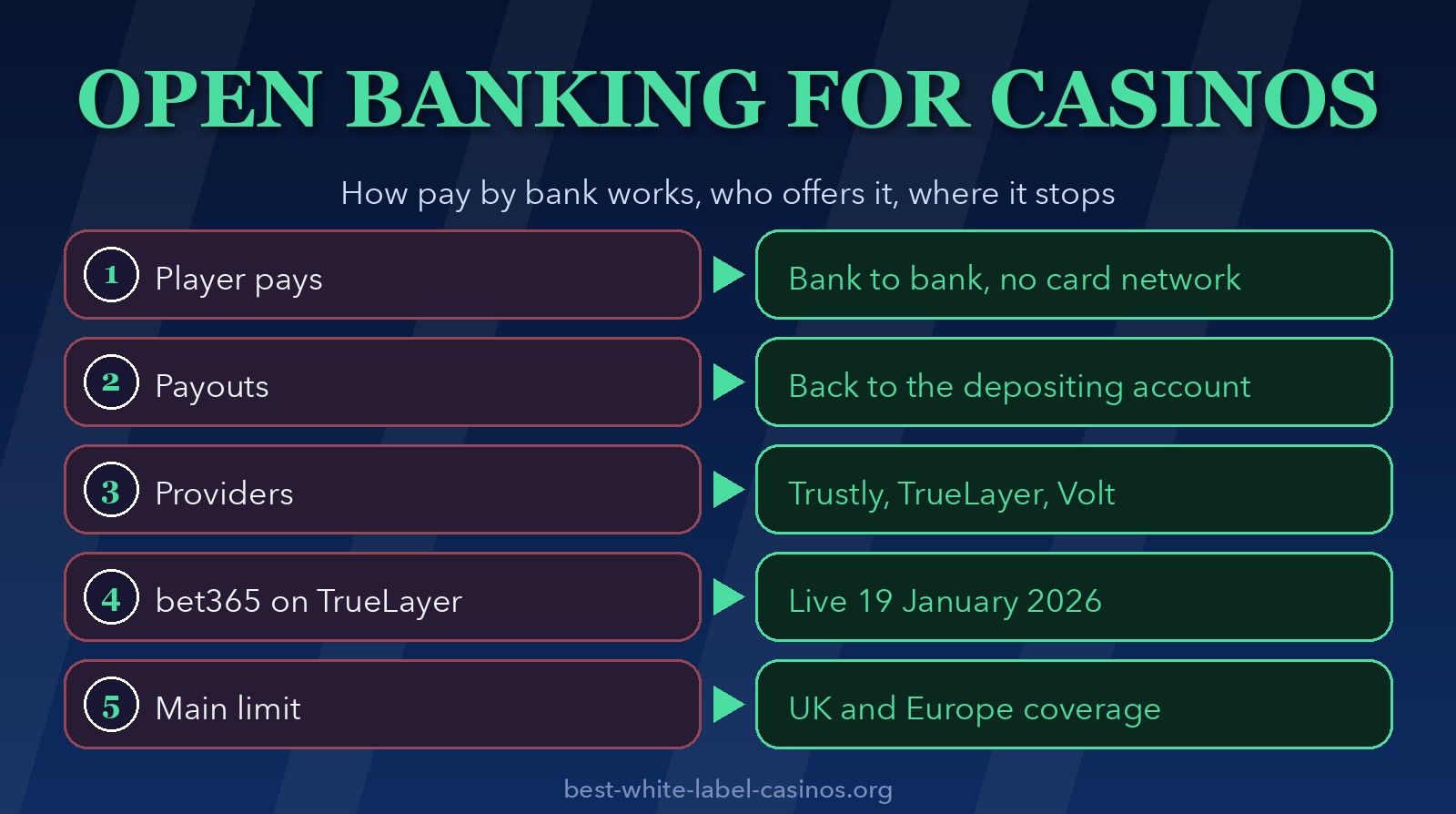 Pay by bank for casinos: the gains, the providers and the limits.
Cost. IBTimes UK reports that pay by bank is often cheaper than card deposits, but pricing varies by operator and provider. TrueLayer claims costs up to 50% lower than cards. None of the providers we reviewed publishes a rate card for gambling merchants, so you will only get a number from a quote.
Chargebacks. Because the payment does not travel over a card network, the card chargeback process does not apply in the usual way. IBTimes UK says pay by bank reduces chargeback exposure. Paysafe goes further for its US product and says all Pay by Bank transactions are indemnified, which is a company claim worth reading in the contract. For the card side of the picture, see our guide on processing fees, rolling reserves and chargebacks.
Payouts to the same account. Sending winnings back to the account that paid in keeps cash-outs simple and traceable. JOI Gaming’s Trustly deal in the Netherlands, announced in September 2025, covers iDEAL deposits and instant payouts available 24/7.
Checks at sign-up. TrueLayer’s Signup+ holds a deposit in a suspense account until age verification is complete, and refunds it if the check fails.
On fraud, UK Tech News reports that fraud on UK open banking payments ran at 0.013% of transactions by volume from March 2024 to September 2025, against an industry average of 0.045%. That covers all open banking, not gambling alone.
Providers that serve gambling
Five providers in our research have a sourced pay by bank offer for gambling. All pricing is on request.
| Provider | What it sells | Gambling evidence in our research | Reach |
|---|---|---|---|
| Trustly | Pay N Play, bank deposits, instant bank payouts | Names bet365, Flutter, William Hill, LeoVegas and Kindred; JOI Gaming, September 2025 | Claims 12,000 banks in 30+ markets |
| TrueLayer | Pay by Bank, Verified Payouts, Signup+ | bet365, January 2026; Midnite, August 2026 | UK and Europe, 22 countries live; FCA authorised |
| Volt | Open banking payments, usually through gateways | GiG (May 2020), MoneyMatrix (August 2021) | Says it reaches 5,000+ UK and EU banks via MoneyMatrix |
| Nuvei | Instant Bank Transfer inside a full PSP | 888 selected Nuvei for US card acquiring in August 2023; the release also covers Instant Bank Transfer for withdrawals | Global PSP; bank product is one part |
| Paysafe | Pay by Bank for US iGaming | Launched 29 April 2024 | US focus |
Volt adds one detail. In January 2026 it announced a ClearBank partnership covering payouts, refunds and virtual IBANs, but that announcement does not mention gambling. Volt also has fewer public gambling case studies than Trustly or TrueLayer.
Trustly and Nuvei both have live gambling pages, but the dated examples we found for them are older (Trustly’s latest is September 2025, Nuvei’s is from 2023), so confirm current gambling coverage with each directly.
Real operator examples
bet365 went live with TrueLayer’s Pay by Bank in the UK and Germany on 19 January 2026, according to TrueLayer’s announcement. The operator made it the recommended option at checkout, and TrueLayer says expansion to more markets is planned for 2026.
Midnite launched TrueLayer Pay by Bank for deposits and withdrawals, reported by The Paypers on 19 August 2026.
JOI Gaming chose Trustly as its main payment provider for the Dutch market in September 2025, with iDEAL deposits and instant payouts through open banking and Dutch instant payment schemes.
Paysafe’s April 2024 US launch lets players fund deposits from bank accounts and cash out to linked accounts. Paysafe says its research found 27% of bettors prefer direct bank transfers. That is company research, not an independent survey.
What these examples show: large operators will put pay by bank first at checkout, not hide it. They do not publish conversion or cost results. TrueLayer claims 100+ iGaming brands in Europe and a 75% deposit increase, but we have not seen the method behind those numbers.
Regulation and affordability checks
This is not legal advice. Check the rules in each market you serve.
In Great Britain, licence conditions have barred online casinos, betting and bingo from taking credit card payments since 14 April 2020, according to the UK Gambling Commission. IBTimes UK reports that the displaced volume moved mostly to debit cards and e-wallets, not to open banking.
Affordability rules give open banking a second role. UK Tech News reports that the Commission’s first stage of financial risk assessments applies to customers with net deposits above 5,000 pounds in a rolling 24 hours, or 2,500 pounds for under-25s. It names open banking as one alternative route where credit reference checks fail. Since October 2025, operators must also prompt customers to set a financial limit before their first deposit.
Variable recurring payments are not a near-term fix. The UK Payments Initiative, set up in late 2025 by 31 firms, runs a commercial scheme, but gambling is not generally seen as a first-wave use case. The Commission has said little in public about its view.
The wider market is growing. Open Banking Limited reports that UK open banking passed 1 billion cumulative payments in June 2026, and payment volume rose 45% in the 12 months to July 2026. Outside the UK, rules differ. Brazil’s ordinance SPA/MF 615/2024 allows Pix and TED bank transfers for betting, which our guide on payment methods for online casinos covers.
Limits and downsides
Pay by bank is not a full cashier. Know these limits before you build around it.
- Coverage. TrueLayer is UK and Europe only. Volt is UK and EU. Paysafe’s product is US. Trustly claims 30+ markets, mostly European. If your players are elsewhere, few of them will see the option.
- Bank rails only. Trustly’s bank-based service does not cover cards, wallets or vouchers, so you still need a card processor behind it.
- Bank-side blocks. We found no sourced list of banks that block gambling transfers. Ask each provider for approval rates by bank and market.
- Customer habit. After the UK credit card ban, players moved to debit cards and e-wallets, not open banking. Many will need a nudge, such as making it the recommended option.
- Thin benchmarks. IBTimes UK notes that public conversion benchmarks are limited, and provider figures come from the providers.
- Missing tools. TrueLayer marks its affordability product as coming soon.
Who this is not for: operators whose players mostly pay with vouchers, wallets or crypto, or whose markets have no bank-to-bank payment rail.
How to add pay by bank to a casino
- Map your top markets and check whether a provider has live bank coverage there. Our localization guide helps with the country side.
- Decide whether to buy direct or through your gateway or orchestration layer. Volt, for example, is usually reached through gateways.
- Ask for written answers on fees for deposits and payouts, settlement time, bank coverage and approval rates, refund handling and how age and identity checks work.
- Test the flow on mobile first, then make it the recommended option, as bet365 did.
- Keep your card processor and a wallet option. The steps for a full setup are in our guide on how to accept payments as an iGaming operator.
If cards fail, a bank route can also rescue the deposit. See our piece on why casino deposits get declined.
New operators should also read the wider launch guides: what you need to launch an online casino and the iGaming supplier hub.
FAQ
What is open banking for casinos?
It lets a player pay a casino, and receive winnings, directly from a bank account instead of a card. The player approves the payment in their banking app, and the money moves bank to bank. Providers such as Trustly, TrueLayer and Volt sell this to gambling operators in the UK and Europe.
Is pay by bank cheaper than cards for operators?
Often, but not always. IBTimes UK reports it is often cheaper than card deposits and cuts chargeback exposure, while pricing varies by provider and operator. TrueLayer claims up to 50% lower costs, a company claim. No provider we reviewed publishes a gambling rate card, so get quotes.
Does open banking have chargebacks?
Not card chargebacks in the usual sense, since the payment does not use a card network. Disputes and refunds still exist, and rules differ by provider. Paysafe says its US Pay by Bank transactions are indemnified, which is a company claim. Read the liability terms in your contract.
Which casinos use open banking?
bet365 went live with TrueLayer Pay by Bank in the UK and Germany on 19 January 2026. Midnite launched it in August 2026. JOI Gaming chose Trustly in the Netherlands in September 2025. Trustly also names William Hill, Flutter, LeoVegas and Kindred as gaming clients.
Can open banking replace card payments?
Not yet. Bank rails cover bank account holders in specific markets and do not cover cards, wallets or vouchers. IBTimes UK reports UK players moved to debit cards and e-wallets after the credit card ban, not to open banking. Use it as an extra lane.
Ready to compare providers? See our ranking of the best payment providers for iGaming, then check coverage in your own markets before you sign. You can also see how the same operators score on the white label casino ranking.
About the Author

Founder, best-white-label-casinos.org
iGaming operator and B2B software evaluator with 20 years of experience launching and reviewing online casino platforms across MGA, Curaçao, and crypto-native environments. Ratings are based on cost transparency, feature depth, regulatory compliance, and operator support quality.
Looking for the best white label casino platform?
Compare 12 providers by cost, launch time, licensing support and game library. Independent editorial, no paid placements.
Compare All Platforms →
← Previous
Is SOFTSWISS Legit? Licences, Incidents and Red Flags
Is SOFTSWISS legit? We checked its MGA licence and each red flag against regulator sources, and show what each incident does and does not say about it.

Next →
Payment Methods for Online Casinos Compared (2026)
Compare payment methods for online casinos: cards, e-wallets, pay by bank, vouchers and crypto, on speed, cost, payouts and chargeback risk. Updated 2026.