How to Add Crash Games to an Online Casino: Routes, Licences and Safety

Most operators add crash games by switching them on through a game aggregator, because it is the fastest and cheapest route, in five points:
- Crash games are time-based: the player bets, a multiplier rises, and the player must cash out before it crashes,
- The three routes are an aggregator catalogue, a direct deal with a studio, or building your own,
- Building your own game brings the heaviest certification and licensing work,
- “Provably fair” is a studio claim, so it does not replace lab certification or a regulator’s rules,
- Rounds are fast, so responsible gambling tools matter more than usual
Several aggregators list crash content, but certification differs by title and market. This guide is not legal advice.
- What crash games are
- Route 1: an aggregator
- Route 2: a direct studio deal
- Route 3: building your own
- Provably fair explained
- Certification and licence questions
- Responsible gambling cautions
- FAQ
What crash games are
SOFTSWISS added crash games to its aggregator in August 2021. Trade press at the time described them as time-based. The player places a bet and watches a multiplier climb on a line graph. The line can crash at any moment. The player must cash out before that happens, or the bet is lost.
The format is simple, and rounds are short. That is why operators want it, and also why regulators watch it.
Crash is now a standard content type. SOFTSWISS lists crash games among its aggregator content, next to slots, card games, live casino, casual and table games. EveryMatrix says its SlotMatrix covers crash within its 50,000+ casino, live casino, crash, table and instant games. Infingame and QTech Games list crash too. These counts are company claims.
If you are new to the term “aggregator”, read our guide on what a game aggregator is first.
Route 1: an aggregator
The aggregator route means you ask your aggregator to enable crash titles in your account. You already have the integration, so the work is small. SOFTSWISS said at launch that it added crash games from several game vendors through its single API.
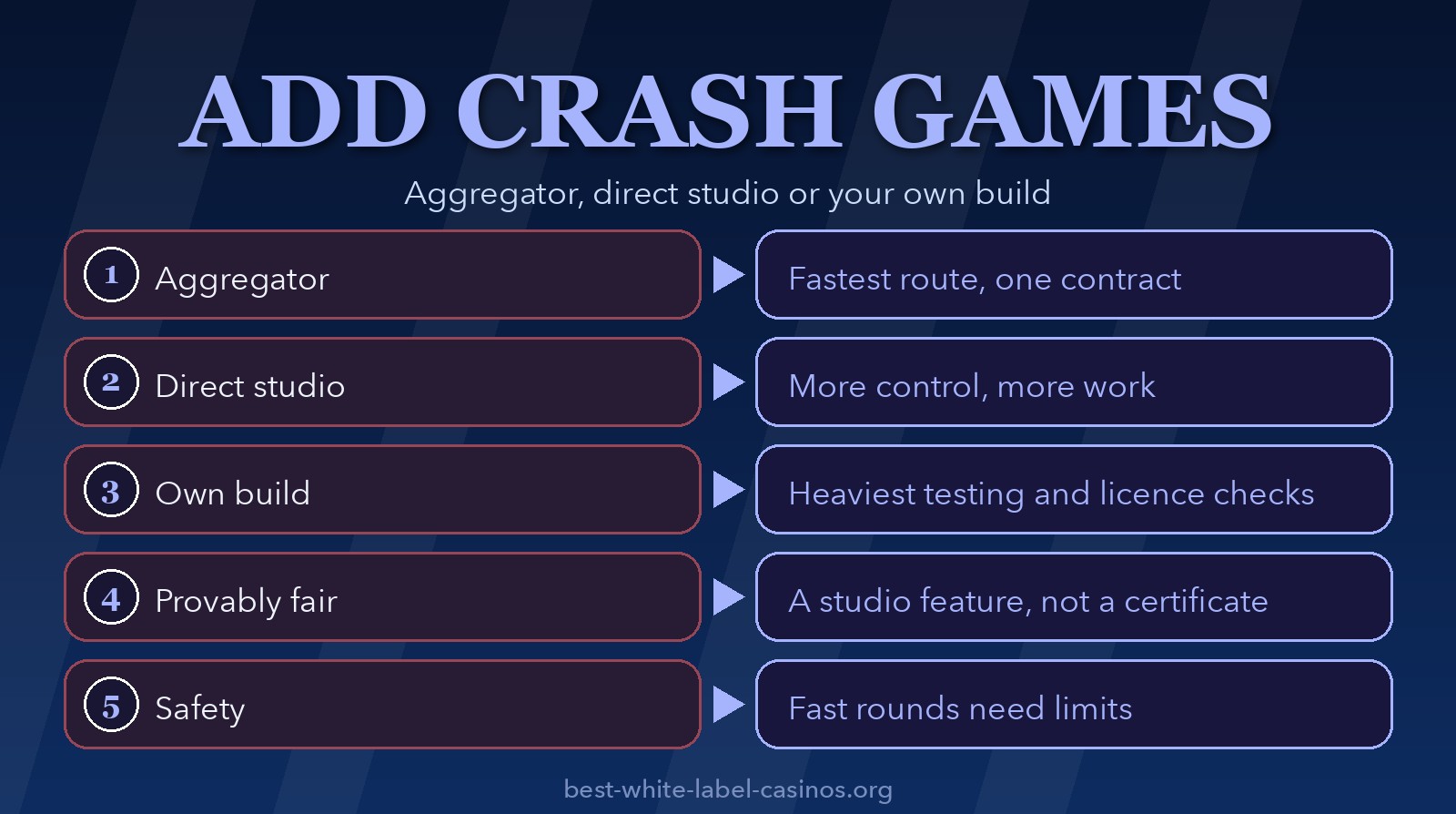 Three routes to crash content, and the checks that apply to each.
What you gain: speed, one contract, and a choice of titles from several studios. What you give up: the aggregator’s revenue layer on top of the studio’s share, and some control over which studio terms apply. We cover the fee side in how aggregators charge.
Questions to ask the aggregator:
- Which crash studios are available, and which are exclusive to another network?
- Which markets is each title certified for? Ask for the lab certificate per title and per market.
- Is the title restricted in any market I plan to serve?
- What is the wallet model? Fast rounds mean many bet and win calls. See single wallet versus transfer wallet.
Slotegrator says it works only with certified, licensed game developers. Its page does not publish a crash-specific rule, so even with that statement you should ask for documents.
Compare options in our game aggregator ranking. Filter by crash content and by the markets you target.
Route 2: a direct studio deal
A direct deal means you contract with the crash studio and connect to its game server yourself. You get a direct relationship, a say in terms, and no aggregator layer.
You also take on the legal, technical and certification steps for that studio, as we explain in aggregator versus direct integration. One crash hit may bring many players, but a single title rarely fills a lobby.
Direct deals make sense when one crash studio drives a large share of your play and you have engineers to spare. For most new operators, an aggregator first and a direct deal later is the safer order.
Check the studio’s own standing as well. A studio is a company with a licence, and regulators can act against it. The next section of this guide gives one factual example from the UK.
Route 3: building your own
Some teams build their own crash game, since the maths looks simple: a random multiplier and a cash-out button. The code is the small part.
You would need to build and test a random number generator, a game server, a wallet link, round history, a replay record for disputes and a way to show fair outcomes. You also need certification where your regulator asks for it. We cannot give a cost or a time for this, and we found no public figures to cite.
Regulators in many markets expect games to be tested by an approved lab before players use them. Whether your licence requires that depends on the licence, so ask your licensing body or lawyer. Our MGA versus Curaçao licence comparison shows how much the rules differ.
Building your own is not for a first launch. It suits operators with a studio team, a clear licence position and the budget to certify each game. Everyone else should buy content.
Provably fair explained
Provably fair is a method some crash studios use to let players check a round was not changed after the bet. Infingame says its crash titles use provably fair mechanics.
In a common design, the studio commits to a secret value before the round, often by publishing a hash of it. Player or operator inputs may be mixed in. After the round the studio reveals the secret, and the player can check that it matches the commitment and produces the result shown. Exact designs differ by studio, so read each one’s own description.
What it does and does not prove matters:
- It can show a single round was not changed after the fact.
- It does not prove the long-run payout rate is what the studio says.
- It does not replace lab testing, and a regulator may still demand it.
- It does not tell you whether the studio is licensed.
So treat “provably fair” as a feature, not a certificate. Ask for both the explanation and the lab report.
Certification and licence questions
Start with your own licence. Does it allow crash games? Are there rules on game testing, on maximum stakes or on auto-play features? Ask your regulator or lawyer. This is not legal advice.
One industry glossary says aggregators centralise certification in many jurisdictions, but that some regulators, including the MGA, UKGC and Ontario’s AGCO, require studio-level certification whatever the routing. That glossary is not a regulator, so confirm with each regulator.
Then check the studio and the market. Trade press reported that in March 2025 Kenya’s Betting Control and Licensing Board ordered licensed operators to submit their Aviator and crash games for review, and said standalone crash game applications would not be allowed. We could not open the original memo, so check the board’s own notices before acting on it. The lesson holds anyway: rules on crash games can change fast.
The UK Gambling Commission gives a factual example of studio-level scrutiny. Its news page says it suspended Spribe OÜ’s licence on 30 October 2025, citing serious non-compliance with the hosting requirements of its licensing framework, and that the suspension was lifted on 30 March 2026. Spribe is the studio behind Aviator. The Commission’s public register records a warning dated 12 June 2026, which says the licensee had operated without the appropriate licence between 28 May 2021 and 30 October 2025. It also says the licensee cooperated and took corrective steps.
We mention this only as an example of why you should check each studio’s licence status on the regulator’s register before you add its games. It says nothing about the games themselves.
Responsible gambling cautions
Crash rounds are quick, and the player can chase a higher multiplier again and again. That pattern can lead to fast losses. Plan for it before launch.
- Offer deposit, loss and time limits, and make them easy to find.
- Add reality checks and a visible round history.
- Consider stake caps and a cool-off option on crash titles.
- Train support staff to spot signs of harm.
- Do not use language that suggests a player can beat the game.
Marketing needs care too. Rules on advertising gambling differ by country, so check them. If gambling is a problem for you or someone you know, contact a local support service such as BeGambleAware.
Our iGaming hub has more guides, and our guide to what you need to launch an online casino lists the other building blocks. If you launch on a white label, Whitelabels.com says it offers 20,000+ games, for a $99 one-time setup fee plus 20% of GGR with no separate monthly platform fee. Check whether crash titles are included for your markets.
FAQ
What is a crash game in an online casino?
A crash game is a time-based game. The player bets, a multiplier rises, and the player must cash out before the multiplier crashes. If the player waits too long, the bet is lost. Rounds are short, so the game suits fast play and needs strong responsible gambling tools.
How can an operator add crash games?
There are three ways: switch them on through a game aggregator, sign a direct deal with a crash studio, or build your own game. The aggregator route is the fastest. Building your own brings the most certification and licensing work. Compare aggregators in our ranking.
What does provably fair mean in crash games?
It is a method that lets a player check that a round result was fixed before the bet and not changed afterwards. Studios design it differently. It does not replace lab certification or a regulator’s rules, so ask for both the explanation and the test report.
Do I need a special licence for crash games?
It depends on your licence and market. Some licences cover all casino games, while some regulators ask for game testing or review. Trade press reported a 2025 Kenyan order to review Aviator and crash games. Ask your regulator or lawyer. This is not legal advice.
Which aggregators offer crash games?
SOFTSWISS and EveryMatrix both list crash among their content types, according to their own pages. Infingame and QTech Games list it too. Catalogues change, so ask each aggregator which crash titles are certified for your markets. See our white label casino ranking if you want games bundled.
About the Author

Founder, best-white-label-casinos.org
iGaming operator and B2B software evaluator with 20 years of experience launching and reviewing online casino platforms across MGA, Curaçao, and crypto-native environments. Ratings are based on cost transparency, feature depth, regulatory compliance, and operator support quality.
Looking for the best white label casino platform?
Compare 12 providers by cost, launch time, licensing support and game library. Independent editorial, no paid placements.
Compare All Platforms →
← Previous
How to Accept Payments as an iGaming Operator (2026)
How an iGaming operator accepts payments: PSP vs acquirer vs gateway, MCC 7995, why gambling is high risk, what applications need and the order of steps.

Next →
How to Open a Bank Account for an iGaming Company (2026)
How to open an iGaming bank account in 2026: bank or EMI, the documents banks ask for, why refusals happen and the red flags that waste months.