iGaming Payment Processing Fees, Rolling Reserves and Chargebacks: What the Real Cost Looks Like

iGaming payment processing costs more than the headline rate, because the real bill also includes a rolling reserve, chargeback costs, payout fees and currency conversion. Five facts to hold onto:
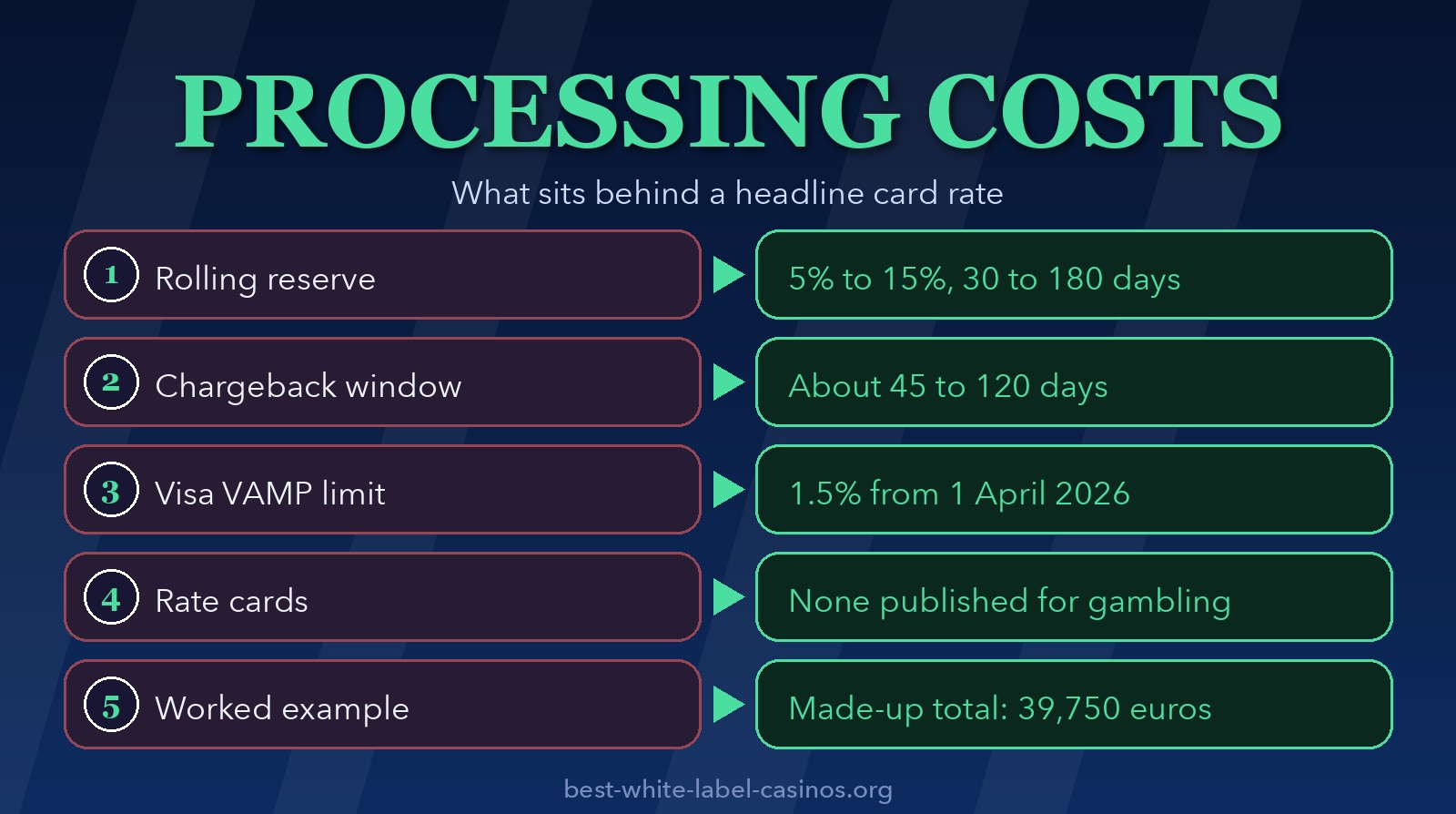
- None of the providers we reviewed (Nuvei, Paysafe, Trustly, Worldpay, PaymentIQ, Praxis, Volt) publishes a rate card for gambling merchants, so every price is a quote,
- Rolling reserves are usually 5% to 15% of turnover, held for about 30 to 180 days, according to Checkout.com and Stripe,
- Chargeback windows run about 45 to 120 days, which is why 180 days is a common reserve period,
- Visa’s Excessive merchant threshold fell to 1.5% on 1 April 2026 in the US, Canada, EU and Asia-Pacific,
- The reserve is cash tied up, not a fee, so it hits cash flow before it hits profit
This guide breaks the stack into parts and ends with a worked example. The example uses invented round numbers, so read it as a method, not as market data.
- What the cost stack contains
- Rolling reserves explained
- Chargebacks and card network thresholds
- Payout, currency and crypto settlement costs
- A worked example with made-up numbers
- How to compare two offers
- Why headline rates mislead
- FAQ
What the cost stack contains
A card deposit passes through several hands, and each takes a cut.
- Interchange goes to the bank that issued the player’s card.
- Scheme fees go to Visa or Mastercard.
- Processor markup is what the PSP or acquirer adds on top.
- Chargeback fees apply each time a player disputes a payment.
- Payout fees apply when you send winnings back.
- Currency conversion applies when the player’s currency differs from your settlement currency.
- A rolling reserve holds back part of your money for a period.
Some quotes bundle the first three into one blended percentage. Others show them separately. Neither is wrong, but you cannot compare them until you know which items each includes.
Wallet and bank methods add their own pricing. MiFinity says creating a wallet account is free and that deposit and withdrawal fees vary by payment method, with no figures on its homepage. IBTimes UK reports that pay by bank is often cheaper than card deposits, but pricing varies by operator and provider, as our guide to open banking for casinos explains.
No rate in this article belongs to a named provider. Our research found no published gambling rate cards, so all figures below come from the cited sources or from the invented example.
Rolling reserves explained
A rolling reserve is a percentage of your gross sales that the processor withholds for a set time. After that time, each slice is released.
 The cost stack behind a headline card rate, with an invented worked example.
Checkout.com says reserves are usually 5% to 15% of turnover, typically held for 30 to 180 days, with riskier merchants facing higher percentages. It names gambling as an example of a high-risk industry. It also says chargeback repayments are normally debited from the merchant’s account rather than the reserve, and that reserve funds sit in a non-interest-bearing account.
Stripe gives a similar picture: 5% to 15% of each transaction, with 30 to 90 days for lower-risk sectors and 180 days or more for higher-risk industries. It lists gambling among sectors with higher chargeback rates. It adds that card network chargeback windows run about 45 to 120 days, which is why 180 days is common.
Note that Checkout.com and Stripe are general payment companies. Their ranges describe the market, not what a gambling acquirer will offer you. Adyen, for one, restricts gambling merchants.
The reserve changes cash flow. If you hold 10% of every month’s deposits for six months, a large sum stays locked up at all times. Our guide on payout reserves and operator cash flow shows how that interacts with player funds and withdrawals.
Chargebacks and card network thresholds
A chargeback happens when a cardholder disputes a payment and the bank reverses it. Gambling sees more of them than most sectors, according to Stripe.
Card networks monitor merchants by ratio. According to chargeback vendor Justt, Visa’s VAMP ratio is fraud reports (TC40) plus disputes (TC15) divided by settled transactions (TC05). The Excessive merchant threshold fell from 2.2% to 1.5% on 1 April 2026 in the US, Canada, EU and Asia-Pacific, with formal monitoring from 1,500 combined events a month. We read this from Justt, a vendor, not from Visa’s rulebook, so check the current rule with your acquirer.
Acquirers can set stricter limits than Visa. A gambling merchant can be flagged by its acquirer while still below the Visa level, according to Justt.
Three practical points follow:
- Each chargeback costs the disputed amount, a fee, and staff time.
- A rising ratio can lead to a larger reserve or a termination.
- Moving some deposits to bank-based methods reduces card exposure, though it does not remove disputes.
Payout, currency and crypto settlement costs
Payouts are a separate cost line. Worldpay highlights payout capability and says it was first to market with Mastercard MoneySend. Nuvei says it offers instant withdrawals over the RTP network. Neither page shows a fee, so you need a quote for each payout route: card, wallet and bank.
Currency matters when players pay in one currency and you settle in another. Worldpay lists currency conversion among its tools. Ask whether conversion is marked up and whether you can hold balances in several currencies.
Crypto changes the question. Nuvei says its crypto service reconciles to fiat, so it manages the exchange and your volatility risk. Paysafe’s crypto product lets operators settle in stablecoins or in US dollars and other major fiat via MoonPay Virtual Accounts. For the player side, see our comparison of Bitcoin and USDT casino deposits.
A worked example with made-up numbers
The numbers below are invented to show the method. They are not data and not any provider’s price.
Imagine a casino with these monthly figures:
- Card deposits: 1,000,000 euros, in 10,000 payments averaging 100 euros.
- Blended processing rate: 3.0%.
- Chargebacks: 0.5% of deposit value (5,000 euros, or 50 disputes), with a 15 euro fee each.
- Payouts: 4,000 withdrawals at a flat 0.50 euros each.
- Currency conversion: 1.0% on 200,000 euros of non-euro deposits.
- Rolling reserve: 10% of deposits, held 180 days.
| Item | Calculation | Monthly cost |
|---|---|---|
| Processing | 3.0% of 1,000,000 | 30,000 euros |
| Chargeback losses | 0.5% of 1,000,000 | 5,000 euros |
| Chargeback fees | 50 x 15 | 750 euros |
| Payout fees | 4,000 x 0.50 | 2,000 euros |
| Currency conversion | 1.0% of 200,000 | 2,000 euros |
| Total cost | 39,750 euros |
The real cost is 3.975% of deposits, not 3.0%. The reserve is separate. Ten percent of 1,000,000 euros is 100,000 euros withheld each month, and with a 180 day hold roughly six months of slices sit in the reserve at the same time. That is about 600,000 euros of your own cash, and Checkout.com says reserve funds sit in a non-interest-bearing account. It is not a cost line, but it is money you cannot use for bonuses, marketing or payouts.
Change one input and the picture shifts. Halving the hold period to 90 days would cut the locked cash to about 300,000 euros in this example.
How to compare two offers
Put both quotes into the same table before you decide. Ask for these in writing:
- Is the headline rate blended or interchange plus? Which fees sit outside it?
- What reserve percentage and hold period apply, and when can they change?
- Is the reserve in a separate account, and does it earn interest?
- What is the fee per chargeback, and what ratio triggers a review?
- What do payouts cost by route (card, wallet, bank)?
- Is currency conversion marked up?
- What are the minimum monthly fees, setup fees and termination fees?
- How fast does settlement arrive, and are there rolling delays?
Then run your own volumes through each quote, as in the example above. For a broader view of fee models on the platform side, see our guide to GGR share and fee models and the white label casino cost breakdown.
Why headline rates mislead
A headline rate is a marketing number. In our research, no processor for gambling published a rate card, and fees often depend on your licence, markets and expected disputes. A low percentage on a quote may come with a higher reserve, a minimum monthly fee, a payout charge or a conversion markup.
This matches how the rest of the industry works. Platform GGR shares are rarely all-in either, since games, CRM, payments and support are often billed separately. Compare totals, not percentages.
Also compare risk terms. A processor that can raise your reserve on short notice carries more risk for you than the base rate suggests. Ask how it handles a sudden jump in disputes before you sign, and ask to see the reserve clause in the draft contract. For the wider payments setup, read our guide to accepting payments as an iGaming operator and the ranking of payment providers.
This is not legal or financial advice. Have your accountant review any reserve and settlement terms.
FAQ
What is a rolling reserve in iGaming payments?
A rolling reserve is a percentage of your sales that a processor withholds and releases later. Checkout.com says it is usually 5% to 15% of turnover, held for about 30 to 180 days. High-risk merchants such as gambling operators often face the higher end of those ranges.
How much do chargebacks cost an online casino?
The cost is the disputed amount, a chargeback fee and staff time. Fees vary by processor, and none of the providers we reviewed publishes gambling rates. Stripe lists gambling among sectors with higher chargeback rates, so budget for them from day one.
What is the Visa VAMP threshold in 2026?
According to chargeback vendor Justt, Visa’s Excessive merchant threshold fell from 2.2% to 1.5% on 1 April 2026 in the US, Canada, EU and Asia-Pacific. The ratio counts fraud reports plus disputes against settled transactions. Your acquirer may apply stricter limits, so ask for its own thresholds.
Do iGaming payment providers publish their fees?
Mostly not. Nuvei, Paysafe, Trustly, Worldpay, PaymentIQ, Praxis and Volt publish no rate card for gambling merchants in our research. MiFinity says fees vary by payment method and points to a fees page. Expect quotes that depend on licence, markets and risk.
Is pay by bank cheaper than cards?
Often, according to IBTimes UK, but actual pricing varies by operator and provider. TrueLayer claims up to 50% lower costs than cards, which is a company claim. Get a quote that includes payouts and refunds, then compare the full total with your card costs.
To compare providers, start with our ranking of the best payment providers for iGaming, then ask each shortlisted company for the eight answers above. Platform costs are covered in the white label casino ranking.
About the Author

Founder, best-white-label-casinos.org
iGaming operator and B2B software evaluator with 20 years of experience launching and reviewing online casino platforms across MGA, Curaçao, and crypto-native environments. Ratings are based on cost transparency, feature depth, regulatory compliance, and operator support quality.
Looking for the best white label casino platform?
Compare 12 providers by cost, launch time, licensing support and game library. Independent editorial, no paid placements.
Compare All Platforms →
← Previous
iGaming Operator Cash Flow and Payout Reserves Guide
Plan iGaming cash flow and payout reserves: rolling reserves, settlement delays, player funds rules and a simple worked example with made-up round numbers.

Next →
iGaming Podcast Listening Path for New Casino Operators
A step-by-step listening plan for a white label casino launch: platform, licence, payments, marketing and ongoing news, using verified episodes only.