How Game Aggregators Charge: Revenue Share, Minimums and Setup Fees

Game aggregators mostly charge a share of the revenue from each game, plus sometimes minimums and setup fees, and none of the ones we reviewed publishes a rate card, in five points:
- The usual model is a revenue share: the studio takes a cut per title and the aggregator adds its own layer,
- Published ranges come from a licensing consultancy and an industry glossary, and they are indicative only,
- Minimum guarantees and setup fees are contract terms, and the sources give no figures for them,
- The definition of revenue (GGR or NGR, and what is deducted) can move the real cost more than the headline percentage,
- “All-in” should mean every fee is named in writing, which a bare percentage rarely does
Any number below is a market range from a third party. It is not what any named company charges. This is not legal or financial advice.
- What you are really paying for
- What aggregators say about their own pricing
- Indicative ranges and why they disagree
- GGR, NGR and the deduction trap
- Minimums, setup fees and other terms
- How stacking works
- What all-in should mean
- FAQ
What you are really paying for
When you add a slot from an aggregator, money goes to at least two parties. The studio made the game and expects a cut. The aggregator built the link, signed the deals and runs the support, and expects its own pay.
Most deals are a revenue share. You pay a percentage of what players lose on those games, rather than a flat fee per game. If a game earns little, you pay little. If it earns a lot, you pay more.
You can see the main players in our ranking of game aggregators. If the term is new to you, read what a game aggregator is first.
The cost is not only the share. Setup work, minimum monthly guarantees, bonus cost, chargebacks and payment fees can sit in the same contract. A licensing consultancy, Vantegris, lists minimum monthly guarantees, bonus cost, chargebacks and payment fees as terms to fix in the supply contract, and gives no figures for them.
What aggregators say about their own pricing
None of the aggregators we reviewed publishes a rate card. Here is what their own pages say, and every line is a company claim.
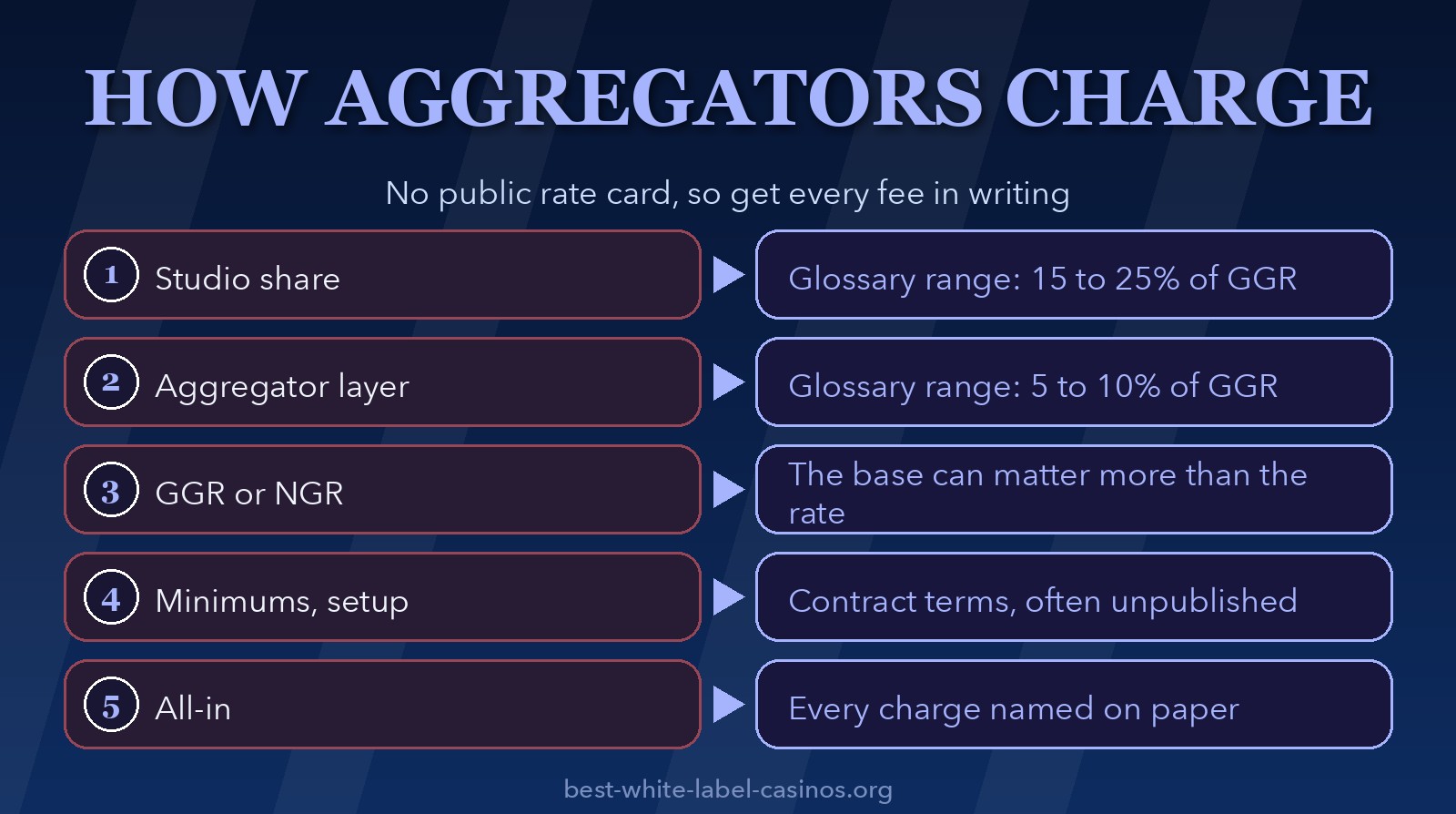 Aggregator pricing is layered, and none of the ranges here is a rate card.
- EveryMatrix says on its SlotMatrix page that there are zero platform fees for its game content. Studio terms are not published, so the studio revenue share is the cost to ask about.
- Alea says on its website that it has no minimum fees and no hidden setup fees, and that it gets better software prices through aggregated volume.
- Slotegrator publishes no prices on its APIgrator page. It says contract terms improve as more providers are added, so a larger bundle costs less per provider.
- SOFTSWISS, Hub88, Infingame and SoftGamings publish no fees on their aggregator pages.
That is the full public picture. Even a clear claim like “zero platform fees” leaves a question open: what do you pay instead, and to whom? Treat each statement as a starting point for a written quote, not an answer.
Indicative ranges and why they disagree
Two outside sources give ranges. Neither is an aggregator or a regulator.
One industry glossary puts the studio’s cut at about 15 to 25 percent of GGR per title and the aggregator’s layer at about 5 to 10 percent, with the operator keeping the rest. It calls these typical ranges, not fixed rates.
Vantegris says aggregator revenue share is 12 to 20 percent of NGR, a range it takes from published operator guides, and that the range covers both the aggregator’s margin and the pass-through to studios. The same page says the aggregator keeps about 3 to 6 points as its service fee. Vantegris describes all of its figures as 2026 market ranges that vary with volume and negotiation, not quotes.
These two do not match. The glossary adds a studio cut and an aggregator layer on GGR. Vantegris gives one combined range on NGR. They use different bases and describe different things, so do not mix them in one formula.
What they agree on is the shape: a share for the studio, a smaller share for the aggregator, and room to negotiate. Use them to judge whether a quote looks far out of line, and nothing more.
GGR, NGR and the deduction trap
GGR is gross gaming revenue: stakes minus wins. NGR is net gaming revenue, which takes off further costs before the split. The percentage matters less than the base it applies to.
Vantegris warns that NGR definitions vary. Bonus cost, payment fees, chargebacks, affiliate commission and gaming duty may or may not be deducted before the split. It says to confirm whether the share is on GGR or NGR, and exactly what is deducted first.
Here is a made-up example with round numbers. Say a game earns 100 in GGR in a month. Your bonuses and payment costs on that game are 20. A 15 percent share on GGR is 15. A 15 percent share on NGR after those costs is 12. The rate is the same, yet the bill is 3 lower. The numbers are invented to show the effect, and they are not any company’s terms.
So ask for the contract’s revenue definition and a worked example from the aggregator, using your own mix of games.
The fee data also travels with the transaction. Hub88’s developer docs show that a field called billable_amount affects only GGR reporting, and that direct_fee_value and direct_fee_reason are informational. That comes from one aggregator’s docs. It does mean you should ask how every fee is reported to you, so your books match its invoice.
Minimums, setup fees and other terms
Minimum monthly guarantees are a floor. If your revenue in a slow month is below it, you pay the floor. Vantegris says to fix the amount and how it behaves in a slow month. Alea’s claim of no minimum fees stands out because the topic is so rarely stated. It is still a company claim.
Setup fees are the second item. Alea says it has no hidden setup fees. Others publish nothing, so ask whether there is a fee to connect, to test, and to switch on each studio.
For comparison, Vantegris says going direct costs EUR 500 to 5,000 in setup per provider, plus 2 to 4 weeks of engineering for each one. It also says going direct recovers about 3 to 5 points of revenue share otherwise kept by the aggregator. Those are consultancy figures. They help you weigh the two routes, which we compare in aggregator versus direct integration.
Other terms to put in writing:
- Which markets are restricted, and who pays if a blocked game is served. Vantegris notes the operator is usually the liable party.
- The wallet model, which can affect your bonus engine. See single wallet versus transfer wallet.
- Uptime commitments, service credits and data export if you leave.
- Which certificates the contract names for each title and market.
How stacking works
Stacking is when several layers each take a share of the same revenue. In a typical content deal there can be three:
- The studio’s share of the game’s GGR.
- The aggregator’s margin on top.
- Your platform’s share of GGR, if you run on a white label or a turnkey platform.
Using the glossary’s ranges as an illustration only: a studio at 20 percent plus an aggregator at 7 percent would be 27 percent of GGR on that title. That is before any platform share, payments or support. A headline of “15 percent” can sit beside a real cost much higher. Those numbers are an example, not any company’s rate.
Platforms stack in their own way. Our guide to casino platform GGR share fee models explains how a platform share interacts with game costs. We also cover the full picture in our white label casino cost guide.
What all-in should mean
On this site, a headline GGR rate is rarely all-in. Games, CRM, payments and support are often billed separately, and the percentage on the sales page may cover only one of them.
A fair test of “all-in”: can you list every charge for a normal month, on paper, with the base each applies to? That list should cover the studio share, the aggregator margin, minimums, setup, payment fees, bonus cost treatment and any support or hosting fee.
Whitelabels.com is one example of a single-price model. It says it charges a $99 one-time setup fee plus 20% of GGR with no separate monthly platform fee, and that it offers 20,000+ games. These are the platform’s own claims. See our Whitelabels.com review. If you buy platform and content separately instead, add the layers yourself.
This guide is not for anyone who wants a single number to plug into a budget, because no honest public number exists. Get quotes from at least two aggregators, using the same list of studios and the same revenue definition, and compare the totals. For more on choosing, read how to choose an iGaming platform provider and browse our iGaming hub.
FAQ
How much does a game aggregator charge?
No aggregator we reviewed publishes a rate card, so there is no verified price. One glossary gives about 15 to 25 percent of GGR for the studio plus 5 to 10 percent for the aggregator. Vantegris gives 12 to 20 percent of NGR. Both are indicative ranges, not quotes.
Do game aggregators charge setup fees or minimums?
It varies, and most do not say publicly. Alea says it has no minimum fees and no hidden setup fees. EveryMatrix says zero platform fees for game content. Vantegris lists minimum monthly guarantees as a term to fix in the contract. Ask each aggregator in writing.
What is the difference between GGR and NGR in aggregator deals?
GGR is stakes minus wins. NGR takes off more costs before the split, and definitions vary. Vantegris says bonus cost, payment fees, chargebacks, affiliate commission and gaming duty may or may not be deducted. Fix the definition in the contract, because it can change the bill.
What does all-in mean for game content pricing?
It should mean every charge is named in writing: studio share, aggregator margin, minimums, setup, payment fees, bonus treatment and support. A headline percentage rarely covers all of these. Ask for a worked monthly example using your own game mix.
Is it cheaper to go direct than to use an aggregator?
Sometimes. Vantegris says going direct recovers about 3 to 5 points of revenue share but costs EUR 500 to 5,000 per provider plus engineering time. Those are consultancy figures. Compare real quotes, and see our ranking of game aggregators and our white label casino ranking.
About the Author

Founder, best-white-label-casinos.org
iGaming operator and B2B software evaluator with 20 years of experience launching and reviewing online casino platforms across MGA, Curaçao, and crypto-native environments. Ratings are based on cost transparency, feature depth, regulatory compliance, and operator support quality.
Looking for the best white label casino platform?
Compare 12 providers by cost, launch time, licensing support and game library. Independent editorial, no paid placements.
Compare All Platforms →
← Previous
Game Aggregator vs Direct Studio Integration (2026)
Aggregator or direct studio integration? Compare contracts, certification, tech effort, launch time, fee stacking and control, with a decision table.

Next →
How to Accept Payments as an iGaming Operator (2026)
How an iGaming operator accepts payments: PSP vs acquirer vs gateway, MCC 7995, why gambling is high risk, what applications need and the order of steps.