Why Casino Deposits Get Declined and How Operators Fix It

Casino deposits get declined mostly because the player’s bank blocks gambling payments, a 3-D Secure step fails, or a country rule bans the method, and operators fix it with routing, retries, alternative methods and clear messages. Five causes to check first:
- Issuers can block the gambling merchant category code (MCC 7995), and some banks block it by policy,
- Credit cards are refused by design in Great Britain and Brazil, so those declines are rules, not faults,
- A soft decline asks the player to complete extra authentication, usually 3-D Secure, and a failed redirect loses the deposit,
- A hard decline is a final refusal, and retrying the same card will not help,
- Vendors claim recovery gains from routing and retries, but those numbers are self-reported
Each cause has a different fix, so the first job is to sort your declines by reason code. This guide shows how.
- Causes and fixes at a glance
- Issuer blocks on MCC 7995
- Country and licence rules
- 3-D Secure, SCA and soft declines
- Risk scoring and hard declines
- What operators can do
- Messaging that keeps the player
- FAQ
Causes and fixes at a glance
| Cause | What the player sees | Operator fix |
|---|---|---|
| Issuer blocks gambling MCC 7995 | Declined with a generic message | Offer a non-card method, check merchant coding |
| Credit card banned by rule | Declined or hidden option | Hide the method, show debit, wallet or bank options |
| 3-D Secure or SCA step fails | Redirect, timeout, abandoned deposit | Better authentication flow, retry paths |
| Soft decline | Prompt for extra authentication | Resubmit with authentication, route to another acquirer |
| Hard decline | Final refusal | Do not retry, switch method |
| Risk scoring | Declined or extra checks | Tune risk rules, send clean data |
Sorting by cause matters because the wrong fix wastes effort. Retrying a banned credit card will not work, and adding a wallet will not fix a poor 3-D Secure screen. Our payment providers ranking lists which companies sell routing, retry and decline recovery tools.
Issuer blocks on MCC 7995
MCC 7995 is the merchant category code for betting and casino gambling. Rapyd describes it as assigned to betting and casino gambling businesses, and says issuers decide whether to allow or block it. That is a vendor description, not a card network rule.
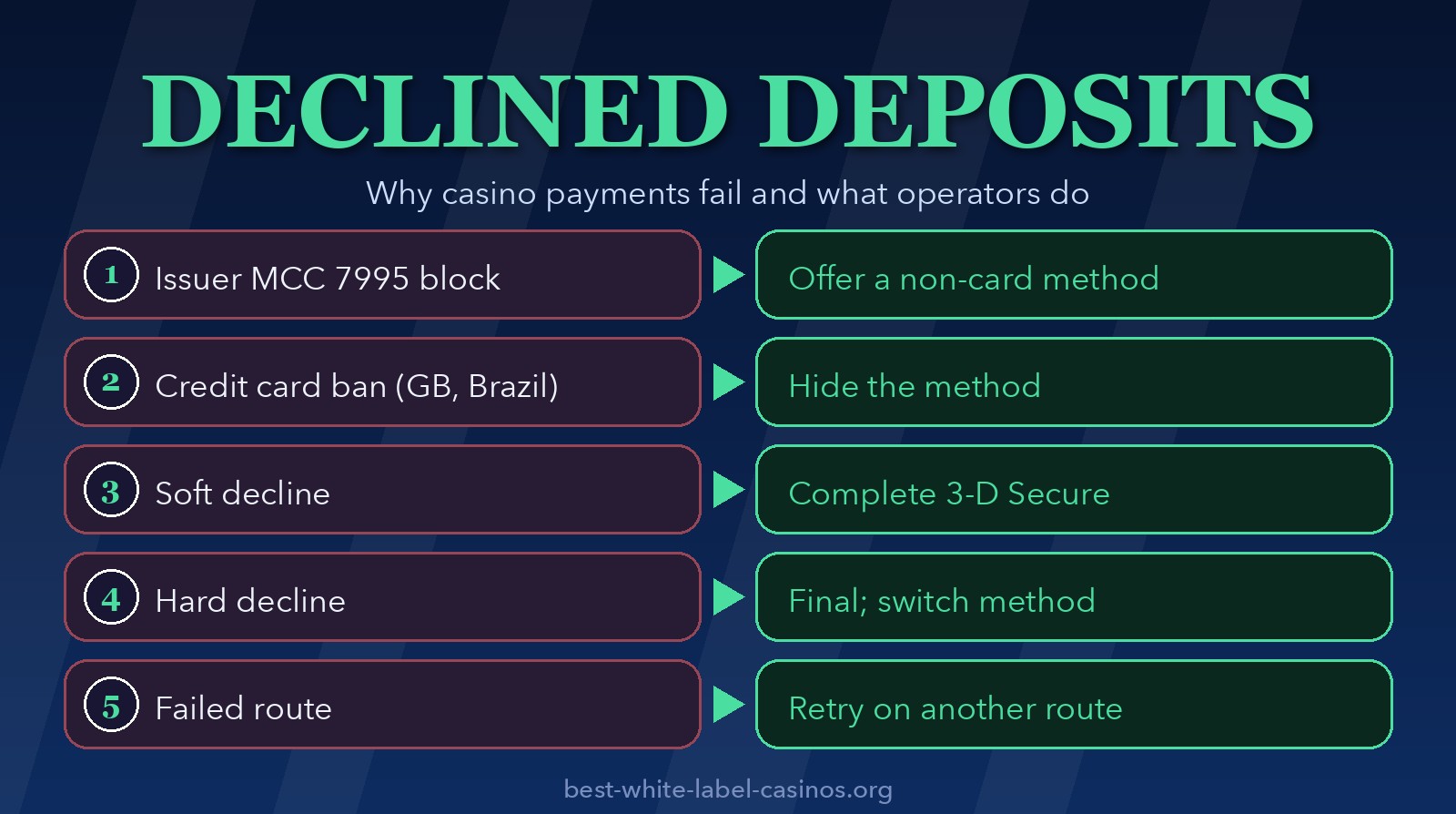 Common causes of declined casino deposits, each paired with an operator fix.
A bank policy example comes from Nationwide in the UK. It says its credit cards cannot be used for gambling and that it blocks transactions it knows or suspects are gambling using merchant category codes. It also says a gambling company using the wrong code will not be blocked, and a non-gambling company using a gambling code may be.
That detail cuts two ways. Correct coding is required for gambling merchants, so do not try to hide behind another code. Equally, check that your own non-gambling transactions, such as a separate shop, are not wrongly coded. Nationwide adds that some gambling transactions cannot be blocked, such as scratch cards and lottery tickets in some shops, depending on till set-up.
For the player, a bank block looks like a plain decline with no useful reason. You cannot override it. The fix is a second route: another card, a wallet or a bank payment. For how operators get accepted in the first place, see how to accept payments as an iGaming operator.
Country and licence rules
Some declines are the rule working as intended.
In Great Britain, licence conditions bar online betting, casino and bingo operators from accepting credit card payments for gambling since 14 April 2020, according to the UK Gambling Commission. Credit card declines on UK-licensed sites are by design. The Commission also says operators taking e-wallet payments should check that the money was not loaded from a credit card.
Brazil bans credit cards for regulated betting under ordinance SPA/MF 615/2024, so credit card deposits there are rejected by rule. The ordinance allows Pix, TED, debit or prepaid cards and book transfers, as iGaming Business reports.
For these markets, the fix is not routing. Do not show the banned method at all, or explain why it is unavailable and offer allowed options. Our guide on payment methods for online casinos and the piece on localization by country list what to show where. This is not legal advice.
3-D Secure, SCA and soft declines
Datatrans defines a soft decline as a transaction the cardholder’s issuing bank declines that then requires the customer to complete additional strong customer authentication (SCA), usually by being redirected to complete 3-D Secure.
In plain terms, the bank says “not yet, prove it is you”. If the player completes the check, the payment can pass. If the redirect fails, times out or confuses the player, the deposit is lost.
Operators can lose deposits here in three ways:
- The authentication page loads slowly or looks like a different site.
- The player does not have their banking app or code to hand.
- The system treats the soft decline as final and never resubmits with authentication.
A Nuvei case study describes a way to limit this. It says Rank Group needed to meet PSD2 authentication rules without adding checkout friction. Lower-risk deposits went through without extra checks and higher-risk ones got additional authentication, which the case study says led to a 9% increase in approval rates and 17% year-on-year growth in transaction volume. It is a vendor case study with no date, so treat the numbers as one example, not a benchmark.
Praxis offers another tool. Its 3DS Cascading, announced in February 2024, lets a transaction move to another route after a processing error without the customer authenticating again, keeping the same security protocols.
Risk scoring and hard declines
A hard decline is a final refusal, for example when the bank has blocked gambling on the card. Retrying the same card in a loop does not help, so switch the method.
Risk scoring adds a third layer. Your processor, your own fraud tools and the issuer each score a deposit, and any of them can say no or ask for more checks. The Rank Group example shows the principle: apply fewer checks to low-risk deposits and extra ones where risk is higher.
Your own ratios matter as well. According to chargeback vendor Justt, Visa’s Excessive merchant threshold fell to 1.5% on 1 April 2026 in the US, Canada, EU and Asia-Pacific, and acquirers can set stricter limits. A merchant close to the line has less room for risky approvals, which can mean tighter rules and more declines. Our guide to processing fees, reserves and chargebacks explains how this feeds into cost.
What operators can do
Fixes fall into four groups.
- Routing and retries. Worldpay lists dynamic routing among its tools, and PaymentIQ says it routes across several acquirers and lets operators A/B test checkout by market. Both are company claims. Ask any vendor how it handles a soft decline and a hard decline differently.
- Decline recovery. Nuvei says it recovers declined payments with an automatic account updater and prompts for alternative methods. It claims its Optimize product lifts approval rates by up to 5 percentage points depending on merchant, region and transaction profile. Self-reported figures like this depend on your traffic.
- Alternative methods. Offer a second route that does not rely on the card. Paysafe says first-time Pay by Bank users link an account in seconds and returning users can pay with one click. Our open banking guide covers who sells it.
- Better data. Send clean merchant descriptors, correct coding, and consistent customer details so issuers and risk tools have less reason to doubt a deposit.
Start with measurement. Break declines down by method, country, issuer, reason code and device. A single cause often explains most of the lost volume, and it may not be the one you expected. If you are launching on a white label platform, ask what decline reporting and fallback methods come with it. See what you need to launch an online casino for the wider checklist.
Messaging that keeps the player
A decline message decides whether the player tries again or leaves.
- Say what happened in plain words, such as “your bank declined this card” or “this method is not available in your country”.
- Offer the next step on the same screen: another method, or a retry with authentication.
- Never imply the casino is at fault when the bank or the law caused the decline.
- Keep the player’s basket or amount filled in so they do not start again.
- Do not push a player into a loop of failed attempts. Offer a different method after the first hard decline.
For players on UK-licensed sites, a credit card decline should say credit cards are not accepted for gambling. If gambling is a problem for you or someone you know, contact a support service such as BeGambleAware.
FAQ
Why was my casino deposit declined?
Common reasons are a bank block on gambling payments (MCC 7995), a failed 3-D Secure step, a credit card used where it is banned, or a risk check. The bank usually gives no detailed reason. Try another method such as a debit card, wallet or bank payment.
What is a soft decline?
Datatrans defines it as a transaction the cardholder’s issuing bank declines that then requires the customer to complete additional strong customer authentication, usually by being redirected to complete 3-D Secure. If the player completes the step, the payment may succeed, so resubmit with authentication.
What is the difference between a soft and a hard decline?
A soft decline asks for more proof, usually 3-D Secure, and can pass after authentication. A hard decline is a final refusal, such as a blocked card, and retrying the same card will not help. The right fix differs, so log the reason code.
Why can’t I use a credit card at UK online casinos?
Since 14 April 2020, UK Gambling Commission licence conditions bar online betting, casino and bingo operators from accepting credit card payments for gambling. Those declines are by design. Debit cards, e-wallets and bank payments remain available, though e-wallet funds must not have been loaded from a credit card.
How can operators reduce declined deposits?
Sort declines by cause, hide banned methods, and add routing with sensible retries. Offer alternatives such as pay by bank when a card fails, and use risk-based authentication so low-risk players see fewer checks. Vendors like Nuvei and Praxis claim gains from these tools, but those figures are self-reported.
To compare vendors with routing, retry and recovery tools, see our ranking of the best payment providers for iGaming. Then test the flows yourself before you launch, and compare platforms in the white label casino ranking.
About the Author

Founder, best-white-label-casinos.org
iGaming operator and B2B software evaluator with 20 years of experience launching and reviewing online casino platforms across MGA, Curaçao, and crypto-native environments. Ratings are based on cost transparency, feature depth, regulatory compliance, and operator support quality.
Looking for the best white label casino platform?
Compare 12 providers by cost, launch time, licensing support and game library. Independent editorial, no paid placements.
Compare All Platforms →
← Previous
Why Banks Close iGaming Accounts and How to Lower the Risk
Why banks close iGaming accounts: de-risking explained with regulator and industry statements, plus a practical checklist to lower your risk of closure.

Next →
SOFTSWISS Pricing Explained: Setup Fee and Extra Costs
SOFTSWISS pricing explained: the €35,000+ setup fee, the 10% GGR share, what costs extra, and an all-in estimate at $50K, $250K and $750K of yearly GGR.