iGaming Operator Cash Flow and Payout Reserves: A 2026 Planning Guide

A new iGaming operator needs cash for more than the platform: money gets tied up in reserves, delays and rules about player balances before profit appears. The main points:
- Processors can hold a rolling reserve, commonly 5% to 15% of each transaction for months, and gambling is named as a higher-risk industry,
- Settlement delay means you pay players before deposits reach your account,
- Where player funds rules apply, balances must be covered at all times, and shortfalls come from your own cash,
- Some regulators also require positive equity, such as the MGA’s July 2025 capital policy,
- A simple cash plan adds these items together before you launch, so the first big payout day does not stop the business
The worked example below uses made-up round numbers to show the method. They are an illustration, not data. This is not legal or financial advice. For providers that state a gambling policy, see our banking ranking.
- Why cash flow breaks new operators
- Where cash gets tied up
- Rolling reserves explained
- Player funds and your own money
- A worked example with made-up numbers
- How to build your own cash plan
- Mistakes to avoid
- FAQ
Why cash flow breaks new operators
Revenue and cash are not the same thing. A casino can show a healthy margin on paper and still be unable to pay a winner on a Friday night. The reason is timing. Players withdraw quickly. Your money arrives slowly, and some of it is held back.
New operators feel this most, because processors and banks have no history with them. Genome, a Lithuanian EMI, says gambling businesses face higher fees, more business information and ongoing monitoring. Legal 500 commentary adds that banks expect documented management of chargebacks, fraud prevention, player verification and transaction monitoring. A thinner file usually means tighter terms.
If you have not yet set up the accounts, start with our guide on how to open a bank account for an iGaming company. The cost side of the launch is in our guide to how much it costs to start an online casino.
Where cash gets tied up
| Item | What happens | What the sources say |
|---|---|---|
| Rolling reserve | The processor holds a share of each transaction for a set time | Stripe says 5% to 15%, commonly six months to a year |
| Settlement delay | Deposits take time to reach your account | Set by each provider, so ask |
| Player balances | Money players hold with you must be covered | Malta: coverage at all times, with up to 10% in transit |
| Capital rules | The licensee must keep a positive equity position | MGA Capital Requirements Policy, July 2025 |
| Fees and monitoring | Higher fees for a high-risk status | Genome |
| Running costs | Staff, marketing, support and tools | Your own budget |
Each line is cash you cannot spend on growth. Add them up before launch, not after.
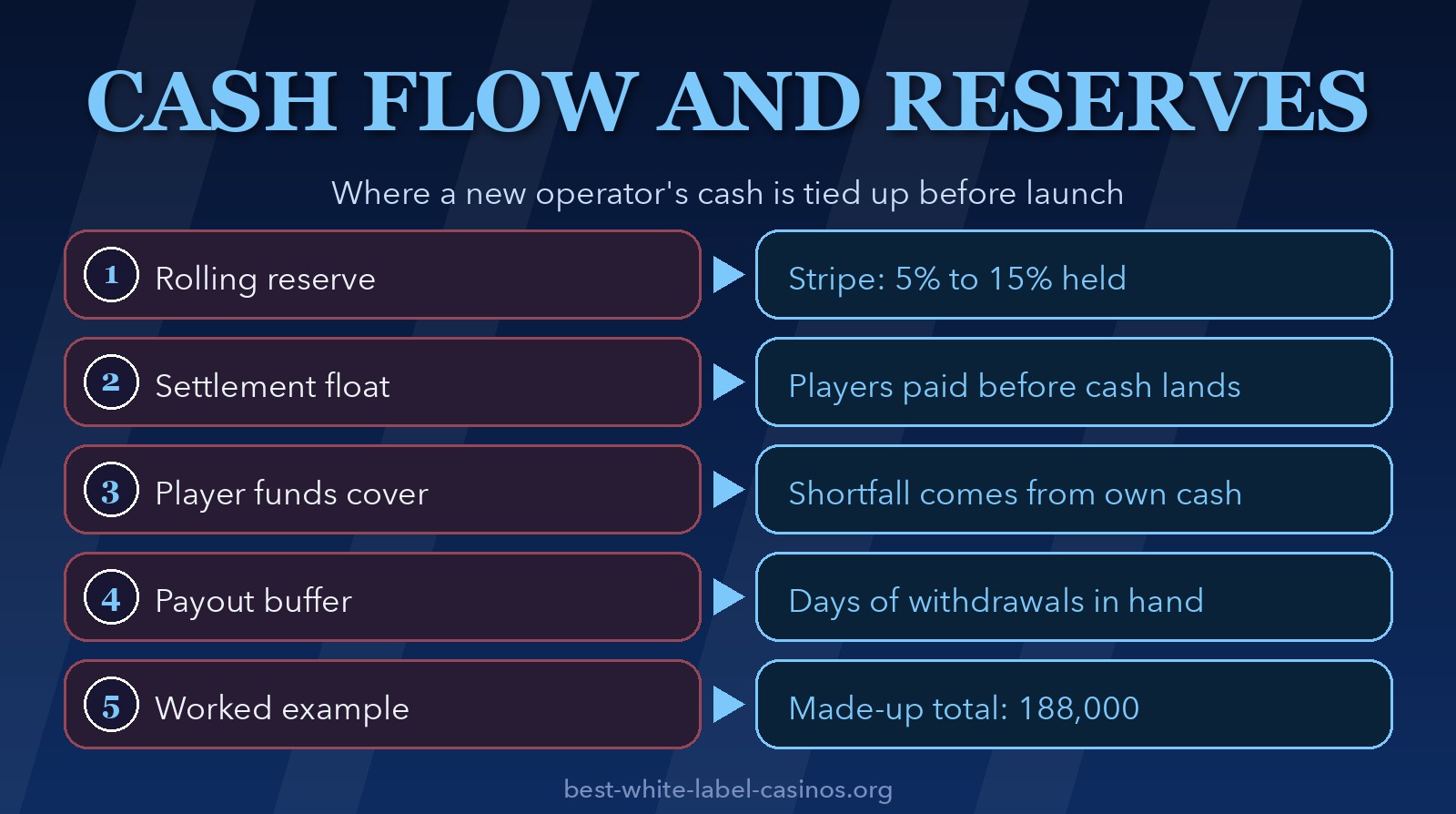 Where a new operator’s cash gets tied up before the first payout.
Rolling reserves explained
A rolling reserve is a share of each transaction that a processor holds back, then releases after a set time. Stripe’s guide says processors usually withhold 5% to 15% of each transaction, commonly for six months to a year, and uses 180 days as an example. It names gambling as a higher-risk industry that may face reserves of 180 days or more.
Checkout.com gives a wider range: rolling reserves are typically held between 30 and 180 days. It also says no law mandates them for card processing, and that a processor may require one as a condition of opening an account for a high-risk business.
The key point is that the terms are set in your merchant agreement. The percentage, the hold period and the release rules differ by processor, and they may be open to negotiation only within the limits of your risk profile.
For the full picture of fees, reserves and chargebacks, read our guide on iGaming payment processing fees, rolling reserves and chargebacks. If you launch on a platform that connects processors for you, the reserve terms still sit in each provider’s contract. Whitelabels.com, for example, says it connects 250+ payment providers, but you should read the terms of the ones you switch on.
Player funds and your own money
Some licences add a second layer. According to a Legal 500 commentary dated 3 August 2026, Malta requires safeguarded value to equal at least the total of player balances at all times. At least 90% must sit in player funds accounts, and up to 10% may be funds in transit or being cleared. Any shortfall must be covered immediately from the licensee’s own funds.
That commentary is not the text of the MGA directive, so confirm the rule with the regulator. The planning point stands, though. A delay in settlement, or a reserve held by a processor, can leave player balances short. If so, your own cash fills the gap. Our guide on EMI vs bank accounts for player funds covers the rule in more detail.
Capital rules sit alongside. According to a Mondaq summary, the MGA issued a Capital Requirements Policy in July 2025 requiring licensees to maintain a positive equity position throughout the licence term. Equity is not the same as cash, but running out of cash is the quickest way to lose equity.
A worked example with made-up numbers
This is an illustration with made-up round numbers. It is not data from any operator or provider. Your terms will differ.
Assume a new operator with these inputs:
- Card deposits of 100,000 per month, flat.
- A processor that holds a 10% rolling reserve for 180 days (about six months).
- Card deposits that settle three days after the player pays.
- Player withdrawals of 120,000 per month, or 4,000 per day.
- Monthly running costs of 30,000, with a plan to hold three months of them.
The reserve builds up. Ten percent of 100,000 is 10,000 held each month. The first month’s reserve is released after six months, so the total held rises, then levels off.
| End of month | Reserve held |
|---|---|
| 1 | 10,000 |
| 2 | 20,000 |
| 3 | 30,000 |
| 4 | 40,000 |
| 5 | 50,000 |
| 6 | 60,000 |
| 7 | 60,000 |
If volume grows, the reserve grows with it. If volume doubles, a flat 10% reserve held for six months doubles too.
The settlement float. Card volume is about 3,333 per day (100,000 divided by 30). With a three-day delay, about 10,000 of deposits are always in transit. Players can already see that money in their balances.
The payout buffer. Withdrawals run at 4,000 per day. A week of buffer is 28,000, enough to pay out during a slow week or a short freeze.
Running costs. Three months at 30,000 is 90,000.
| Cash need | Amount (made up) |
|---|---|
| Rolling reserve at steady state | 60,000 |
| Settlement float | 10,000 |
| One week of payout buffer | 28,000 |
| Three months of running costs | 90,000 |
| Total cash to plan for | 188,000 |
Now a Malta-style check, if your licence has such a rule. Say player balances are 80,000. Ten percent, or 8,000, may be in transit. In the example, 10,000 sits in transit, so up to 2,000 might need to come from your own funds, depending on how your regulator treats each item. Ask your compliance adviser how it counts.
The lesson is the method, not the numbers. Without the reserve and float, the operator would think it needs about 118,000. With them, it needs 188,000. The gap is cash that exists but is not yours to spend.
How to build your own cash plan
Use your own inputs and keep the steps in this order.
- List every payment method and its expected monthly volume.
- Ask each processor for the reserve percentage, hold time and release rules, in writing.
- Ask each provider how long settlement takes to your account, for deposits and for payouts.
- Work out daily withdrawals and the buffer you want in days.
- Check your licence for player funds coverage and capital rules.
- Add the monthly running costs and the number of months you want covered.
- Add everything up, then add a margin for chargeback losses and fees.
- Redo the sum each time volume changes by a large amount.
Payout tools help the cash side too. Genome says its payout API supports batches of up to 3,000 payments at once, and Satchel says its accounts support transfers in 20+ currencies through SEPA and SWIFT. Batch payouts save time, but they do not remove the need for cash in the account when the batch runs.
Narvi quotes fees only after reviewing an application, and says they depend on risk, industry and country. Do not budget fees from a marketing page. Get a written quote.
Mistakes to avoid
- Counting revenue as cash. Reserves and delays mean it is not available.
- Planning for flat volume when you plan to grow. The reserve rises with sales.
- Using one account for everything. If it freezes, so do your payouts. See our guide on why banks close iGaming accounts.
- Forgetting that player balances are not your money.
- Spending the whole launch budget on the platform and marketing. Our guide on the mistakes new operators make lists this as a common failure.
- Assuming you can avoid a reserve. Checkout.com says a processor may require one as a condition of opening an account for a high-risk business.
FAQ
What is a rolling reserve in iGaming?
A rolling reserve is a share of each transaction that a processor holds for a set time, then releases. Stripe says processors usually withhold 5% to 15% for six months to a year. Terms are set in your merchant agreement, so they differ by provider.
How much cash does a new online casino need for payouts?
There is no single number. It depends on withdrawals per day, settlement delay, reserves, licence rules and running costs. Work out each item and add them up. Our worked example uses made-up numbers to show the method, so use your own inputs.
Are rolling reserves required by law?
No. Checkout.com says no law mandates them for card processing. A processor may still require one as a condition of opening an account for a high-risk business, so the demand comes from the contract, not the regulator.
Do player funds count as my cash?
No. Where player funds rules apply, balances must be covered at all times. A Legal 500 commentary on Maltese law says shortfalls are covered immediately from the licensee’s own funds. Treat player money as separate from operating cash and check your licence.
How can I reduce the cash tied up in reserves?
Ask each processor about the percentage, hold time and release terms before you sign, and keep chargebacks and fraud low with documented controls. Banks expect those controls per Legal 500. Terms are negotiated case by case, and nothing guarantees a lower reserve.
What to do next
Build the cash plan above with your own volumes, then ask each provider for its terms in writing. Our banking ranking lists providers with a stated gambling policy, and the iGaming hub covers the other parts of the stack. If you are still choosing a platform, see the white label casino ranking and our guide to launching a white label casino in 2026.
Sources used: Stripe’s guide to rolling reserves, Checkout.com on rolling reserves, the Mondaq summary of the MGA capital policy, the Legal 500 commentary on player funds in Malta and Genome’s guide to gambling accounts.
About the Author

Founder, best-white-label-casinos.org
iGaming operator and B2B software evaluator with 20 years of experience launching and reviewing online casino platforms across MGA, Curaçao, and crypto-native environments. Ratings are based on cost transparency, feature depth, regulatory compliance, and operator support quality.
Looking for the best white label casino platform?
Compare 12 providers by cost, launch time, licensing support and game library. Independent editorial, no paid placements.
Compare All Platforms →
← Previous
iGaming Mergers and Acquisitions: How to Follow Deals
Where iGaming M&A is reported, how to read cash, shares, earn-outs and enterprise value, and a short list of verified 2024 to 2026 deals.

Next →
iGaming Payment Processing Fees, Reserves and Chargebacks
What iGaming payment processing really costs: interchange, markup, rolling reserves, chargeback fees, payout and FX costs, with a made-up worked example.