Why Banks Close iGaming Accounts, and What Operators Can Do About It

Banks close iGaming accounts mainly because of de-risking, which means ending a whole category of customers instead of managing its risk. The main causes in the sources we found:
- De-risking by policy, where a provider bans or restricts gambling for every client,
- Real risk factors: high volumes, cross-border flows, fraud and chargebacks,
- A mismatch between your structure, your documents and your real activity,
- Supervisory pressure that changes a bank’s appetite, as in Malta in 2019,
- The provider itself failing or losing its authorisation
You cannot stop every closure. You can lower the odds and make sure one closure does not stop your business. This is not legal or financial advice. See our banking ranking for providers that publish a gambling policy.
- What de-risking means
- The reasons banks give
- Closures can come after you are open
- A real example: Malta in 2019
- When the provider itself is shut down
- A checklist to lower the risk of closure
- What to do if you get a closure notice
- FAQ
What de-risking means
De-risking is a banking term, and regulators have defined it. The European Banking Authority (EBA) issued an opinion in January 2022 (EBA/Op/2022/01). According to a summary by the law firm Bird & Bird, it defines de-risking as a financial institution deciding not to enter into, or to end, relationships with customers or categories of customers linked to higher money laundering or terrorist financing risk.
The Financial Action Task Force (FATF) uses a similar definition. It describes de-risking as financial institutions ending or restricting relationships with clients or categories of clients to avoid, rather than manage, risk.
Notice the word “categories”. A bank can decide that a whole industry is outside its appetite. In that case your licence, your clean record and your good controls do not change the outcome.
The EBA opinion also says firms should manage that risk instead of ending relationships. That is a supervisory position. It is not a promise that any bank must open or keep your account, so do not plan around it.
The reasons banks give
Why does gambling land in the “restricted” bucket so often? A Legal 500 commentary from a Cyprus law firm (January 2026) lists what banks cite: high transaction volumes, cross-border payments, fraud and chargeback exposure, and sensitivity to regulatory enforcement and reputational risk. It calls bank decisions “cautious by design, not arbitrary”.
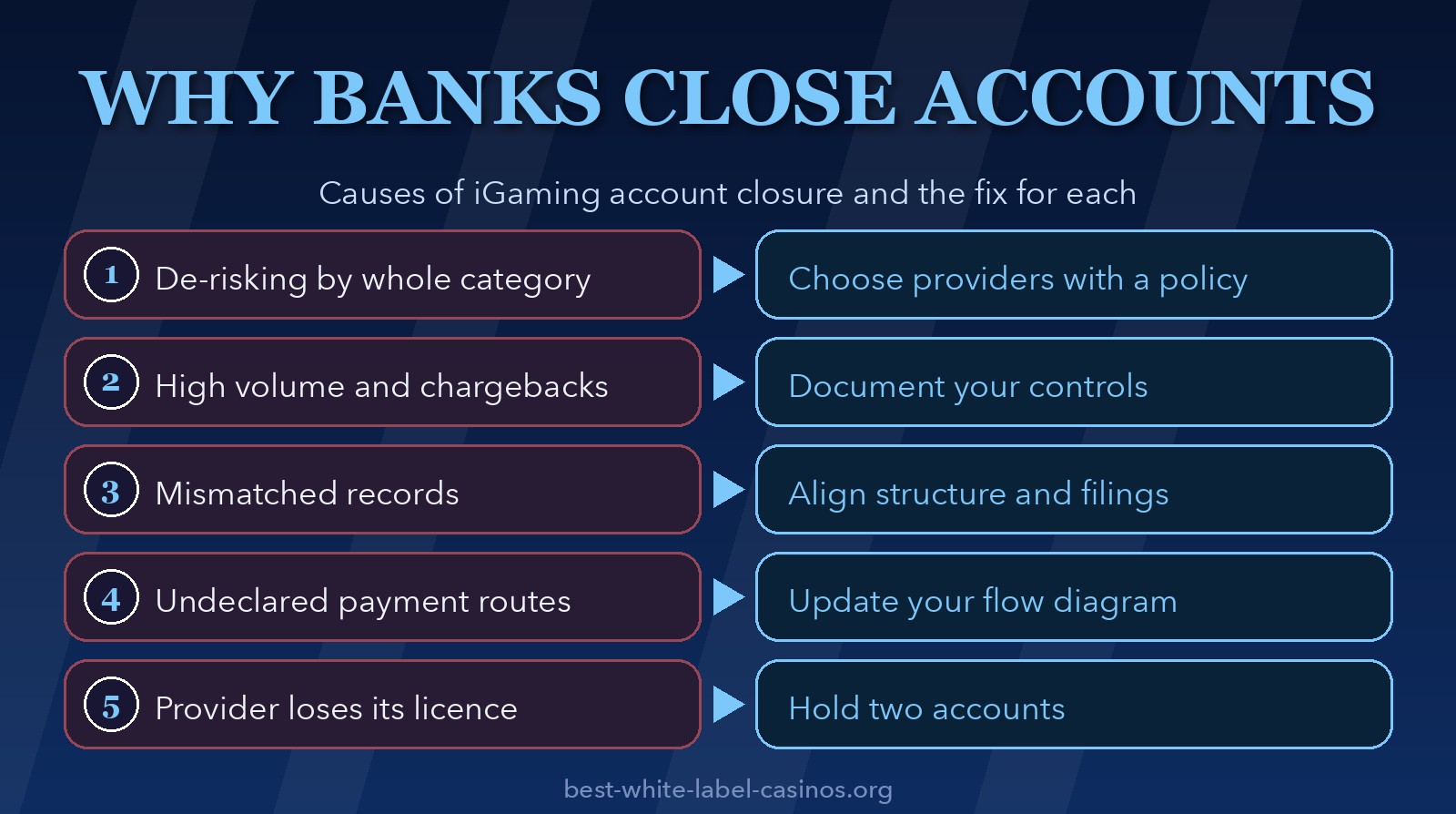 Why accounts get closed, and the matching fix for each cause.
Some providers go further than caution and write the rule down. These examples come from their own published terms and pages:
| Provider | What its published page says |
|---|---|
| Wise | It does not support any business involved in gambling anywhere in the world, may close the account, and counts affiliate marketing for gambling companies in that scope |
| Banking Circle | Gambling is restricted. Its policy bars gambling flows for its PSP clients and allows a narrow direct path with a 5% flow cap |
| Revolut Business | Its terms reserve the right to restrict services outside its risk appetite, even after an account is opened |
| Airwallex | Gambling without required licences is prohibited, and casinos and online gambling need its approval |
| Payoneer | Its prohibited transaction list names games of chance, internet gambling and lotteries, subject to possible pre-approval |
Wording differs by country version for some of these, so check the current terms that apply to your account. The pattern is clear. For many large providers, the answer to gambling is “no” or “only with strict limits”, before your file is even read.
That is why affiliates and suppliers get caught too. If Wise counts affiliate marketing for gambling companies as in scope, an affiliate business on Wise is exposed to the same closure.
Closures can come after you are open
Many operators think the hard part ends when the account opens. It does not. Revolut Business terms, for instance, reserve the right to restrict services that fall outside its risk appetite after an account is opened. Wise says it may close a business account if the business is involved in gambling.
Banks also review accounts over time. Genome, an EMI, says gambling brings ongoing monitoring on top of higher fees and more business information. A change in your volumes, countries or payment mix can trigger a review.
Typical triggers we would watch for, in our judgment and not from a single source:
- a sudden jump in volume with no explanation,
- new player countries your file never mentioned,
- a new payment route, such as crypto, that you did not declare,
- chargeback or fraud spikes,
- adverse press about you, a director or a partner.
Each one is a question the bank will ask. If you can answer it from a document, you are in better shape. Our guide on how to open an iGaming bank account shows which documents to keep ready.
A real example: Malta in 2019
The best sourced case in our research is Malta. In October 2019, Lovin Malta reported that Bank of Valletta, then described as the only major Maltese bank accepting gaming companies, warned several of them that their accounts would close. The warnings followed instructions on de-risking from the European Central Bank. The bank later called the episode a misunderstanding.
Two lessons come out of it. First, even a bank with a reputation for taking gaming clients can send a closure warning, and a licence from the local regulator does not stop it. Second, the report is from 2019, so it tells us nothing about the bank’s present policy. We do not know its current appetite, and we do not suggest it accepts or refuses operators today.
The practical point is concentration. When one bank is “the” bank for a whole sector, one policy change can hit many companies at once.
When the provider itself is shut down
Closure does not always start with your provider’s risk appetite. Sometimes the provider is the problem. Sweden’s Finansinspektionen (FI) withdrew the authorisation of Intergiro Intl AB to issue electronic money on 18 June 2025. The FI page records the withdrawal, and it does not state the reason in the text we read. Other coverage cites anti-money laundering failures, but we have not verified that.
For an operator, the result is the same whatever the cause. If your only EMI loses its authorisation, your payouts and settlements can stall. The point is not that EMIs are unsafe. The point is that any single provider can disappear, so one account is one point of failure.
Our guide on EMI vs bank accounts for player funds covers how safeguarding rules change what you can recover when a provider fails.
A checklist to lower the risk of closure
None of these steps guarantees an account stays open. They remove the avoidable reasons for closure.
- Choose providers that state a gambling policy in public. Do not open an account by leaving gambling out of your description.
- Align your corporate structure with commercial reality. Legal 500 advises this, along with keeping legal, tax and banking records consistent and treating banking as a risk to address early.
- Keep your licence scope matched to the countries you serve and the operations you run.
- Document your controls: AML procedures, responsible gaming, player verification, chargeback handling and transaction monitoring. Legal 500 says banks expect these to be documented.
- Declare every payment route, third party, affiliate and platform provider in your flow diagram, and update it when something changes.
- Tell your bank before big changes: new countries, new payment methods, big campaigns.
- Keep flows steady and explainable. Spikes need a reason in writing.
- Hold more than one account with more than one provider, ideally in different regimes. Read the termination and notice clauses in each contract.
- Keep a cash cushion outside any one provider, so a freeze does not stop payouts.
- Check your own name, your directors and your partners for negative media before it becomes a bank’s finding.
Step 9 matters most for player trust. Our cash flow and payout reserves guide shows how to size that cushion.
What to do if you get a closure notice
Read the notice for the reason and the deadline. Ask in writing which condition you failed, and whether the bank will give more time. Do not wait for the deadline to look for a replacement.
Move quickly on three things. Open or activate your second account. Tell your payment processors and platform provider, because settlement details may change. Stop new deposits into the closing account before the date arrives, so no player money is caught in the middle.
If player funds are involved, speak to your regulator and your lawyer. Your licence conditions may require you to report or to protect balances. For the payment side, our guide to accepting payments as an iGaming operator covers backup routes.
Do not try to reopen an account elsewhere by changing how you describe the business. That path leads to a second closure, usually with worse notes on your file.
FAQ
Why do banks close iGaming accounts?
Mostly because of de-risking and risk appetite. Banks cite high volumes, cross-border payments, fraud and chargebacks, and regulatory and reputational risk, according to a Legal 500 commentary. Some providers, such as Wise, ban gambling outright and may close accounts they find.
What is de-risking in banking?
The EBA defines it as a financial institution deciding not to enter into, or to end, relationships with customers or categories of customers linked to higher money laundering or terrorist financing risk. The FATF describes it as avoiding risk rather than managing it. It targets categories, not single clients.
Can a bank close my account without notice?
It depends on the contract and the local law, and we cannot say for your case. Provider terms often reserve a right to restrict or close. Read the termination and notice clauses before you sign, and ask a lawyer in your licence jurisdiction.
Does a gambling licence stop a bank from closing my account?
No. A licence is required, but it is not enough. Banks look at your whole risk profile, per Legal 500. In 2019, Bank of Valletta warned several Maltese gaming companies that accounts would close, then called it a misunderstanding.
How many bank accounts should an iGaming operator have?
At least two, with different providers. Any one account can be restricted or closed, and a provider can lose its own authorisation, as Intergiro did in Sweden in June 2025. A second account keeps payouts moving. Review each provider’s terms.
What to do next
Spread your risk before you need to. Compare providers that publish a gambling policy in our banking ranking, then review the iGaming hub for payment and platform options. If you are still planning your launch, our guide to launching a white label casino and the white label casino ranking cover the other pieces.
Sources used: the Legal 500 commentary on iGaming banking, the Bird & Bird summary of the EBA opinion on de-risking, Wise’s position on gambling, Banking Circle’s risk appetite policy and the Finansinspektionen notice on Intergiro.
About the Author

Founder, best-white-label-casinos.org
iGaming operator and B2B software evaluator with 20 years of experience launching and reviewing online casino platforms across MGA, Curaçao, and crypto-native environments. Ratings are based on cost transparency, feature depth, regulatory compliance, and operator support quality.
Looking for the best white label casino platform?
Compare 12 providers by cost, launch time, licensing support and game library. Independent editorial, no paid placements.
Compare All Platforms →
← Previous
What Is a Game Aggregator in iGaming? A 2026 Guide
A game aggregator connects your casino to many studios through one API and one contract. See what it does, what it leaves to you, and named examples.

Next →
Why Casino Deposits Get Declined and How to Fix It
Why casino deposits get declined: issuer blocks on MCC 7995, 3-D Secure failures, soft vs hard declines, country rules, and what operators can do about it.