EMI vs Bank Account for iGaming Player Funds: Where Can the Money Sit?

Whether player money can sit in an EMI or a bank depends on your licence, not on the provider type alone. The main points:
- An EMI (electronic money institution) holds client money in safeguarded accounts, but it is not a bank and its balances may carry no deposit insurance,
- Malta requires a player funds account at a licensed credit, financial or payment institution approved by the MGA, according to a Legal 500 commentary,
- The UK Gambling Commission (UKGC) sets rules on segregating and disclosing customer funds, with a segregation exemption for most B2B operators,
- Safeguarding at the provider is a different protection from the rules that shield players if your own company fails,
- Pooled accounts can be allowed if your records show each player’s share
This is not legal or financial advice. Your licence conditions decide where player money may go, so read them first. Our banking ranking compares providers that state a gambling policy.
- Why this choice matters
- Where player money can be held
- What an EMI can and cannot do
- Malta: the player funds account
- UKGC: segregation and disclosure
- Side-by-side comparison
- How to choose for your licence
- FAQ
Why this choice matters
Player balances are not your money. If your company fails, players expect to get their balances back. Regulators in major regimes write rules to make that happen, and those rules change where you may hold the cash.
There are two separate risks. The first is that your own company becomes insolvent. Segregation and trust-style rules deal with that. The second is that the bank or EMI holding the money fails. Safeguarding and deposit insurance deal with that. A single account can protect against one risk and not the other, so you need to know which one you are buying.
If you are still getting your first account, start with our guide on how to open a bank account for an iGaming company. Here we cover where the money sits once the account exists.
Where player money can be held
In practice, operators use some mix of these:
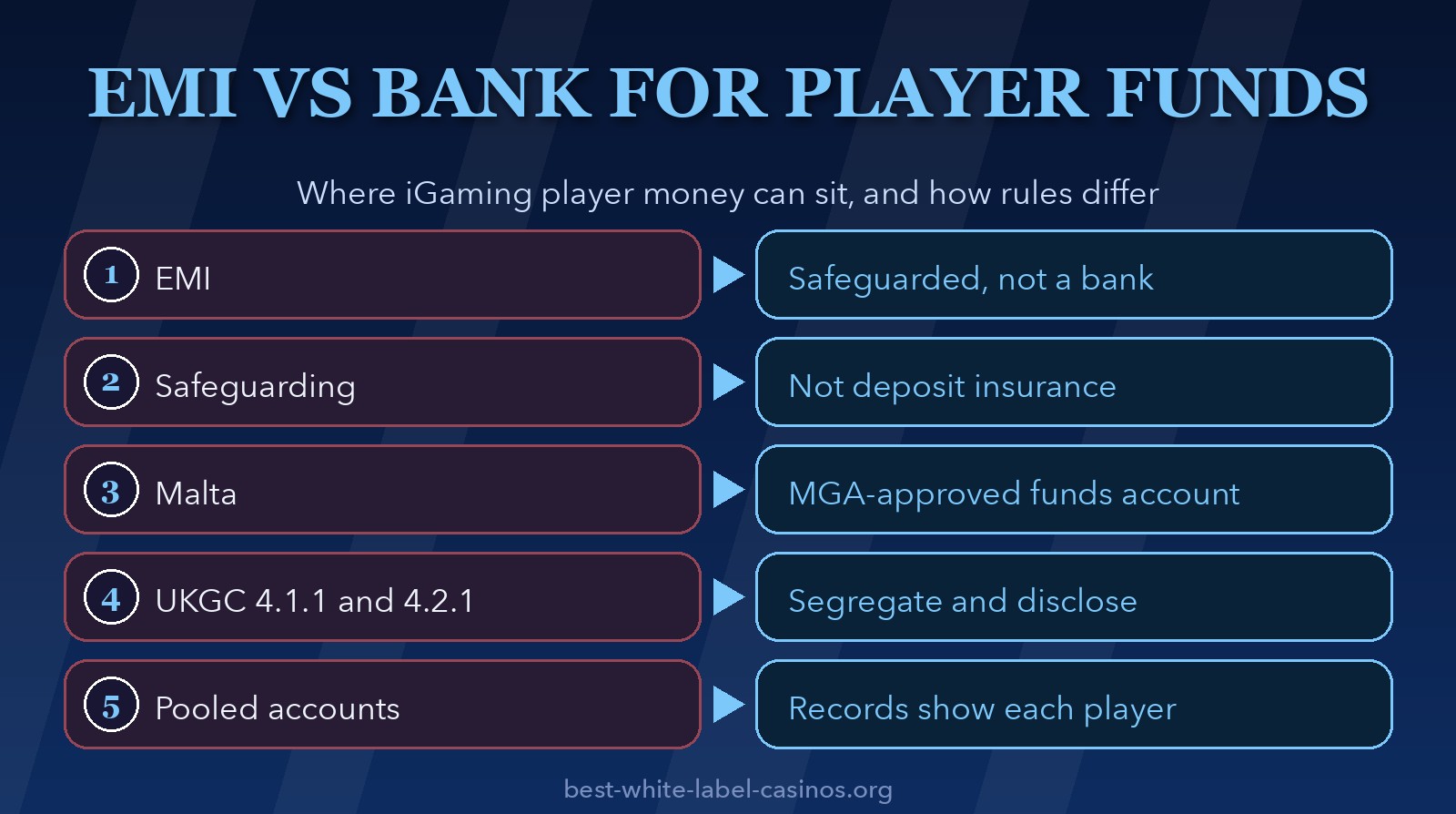 What an EMI and a bank each do for player money, and where the rules differ.
- a business account at a bank,
- an account at an EMI or a payment institution,
- balances held with payment providers while they settle,
- crypto wallets for players who deposit crypto (see our guide on crypto-to-fiat banking).
Which ones your licence allows is a regulatory question. A provider’s marketing page cannot answer it. Some regimes name a type of institution. Others ask for segregation and disclosure, and leave the choice to you.
Where your licence expects it, keep player funds apart from your own operating money. Mixing them can create trouble, as the Malta section shows.
What an EMI can and cannot do
An EMI issues electronic money. In our research, EMIs such as OpenPayd, Narvi, Genome and Satchel offer IBANs, multiple currencies, payout tools and API access. OpenPayd says its multi-currency accounts hold 35 major currencies and that it offers virtual IBANs per end user. Genome says its payout API supports batches of up to 3,000 payments at once. Satchel says its multi-currency set-up gives real-time visibility into segregated accounts.
Those are provider claims, and they help with player payouts and affiliate payments. Now the limits.
- An EMI is not a bank. Its balances are e-money, not deposits.
- Safeguarding is not deposit insurance. Equals Money, an FCA-authorised provider with an iGaming page, says payment account money is not covered by the Financial Services Compensation Scheme (FSCS). It says funds are instead safeguarded under the Payment Services Regulations and the E-money Regulations, in accounts with Tier 1 banks.
- Your licence may name which institution types it accepts. In Malta it does, as we cover next.
- An EMI can lose its own authorisation. Sweden’s financial regulator withdrew Intergiro Intl AB’s authority to issue electronic money on 18 June 2025, which strands that EMI’s customers. Our guide on why banks close iGaming accounts covers the case.
- A “bank-grade” claim on a website is not a licence. Check the regulator’s register.
Banks sit on the other side of this table. A bank can offer a wider relationship, but the one bank with a published gambling policy in our research sets tight conditions. Banking Circle caps direct gambling flow at 5% of its processed payments in any rolling 12 months, according to its risk appetite policy.
Malta: the player funds account
The Malta points in this section come from a Legal 500 commentary on Maltese law dated 3 August 2026, not from the text of the MGA’s Player Protection Directive. We have not checked the directive ourselves, so use this as a guide and read the directive before you act.
According to that commentary:
- A player funds account is held with a licensed credit, financial or payment institution. The arrangement must be presented to and approved by the MGA, and the MGA gets viewing and information rights.
- Safeguarded value must at all times equal at least the total of player balances. At least 90% must be in player funds accounts, and up to 10% may be funds in transit or being cleared.
- Any shortfall must be covered immediately from the licensee’s own funds.
- Operator creditors have no claim against player funds. In an insolvency, the MGA may direct the transfer of control, possession and title of player funds to a designated person.
- Mixing operator and player money can turn the player portion into a privileged claim instead of operator property.
- Pooled player accounts are allowed if the operator’s records show each player’s entitlement.
For an operator, three things follow. The choice of institution is part of licensing. A weak settlement flow becomes your problem because the shortfall comes from your own cash. And clean records are a compliance requirement, not only good housekeeping. We show how that shortfall affects planning in our cash flow and payout reserves guide.
UKGC: segregation and disclosure
The UKGC takes a different route. Instead of naming an institution type, its licence conditions focus on segregation and telling customers how well their money is protected.
According to the UKGC’s own pages, licence condition 4.1.1 (remote operators) covers segregation of funds, and condition 4.2.1 (remote and non-remote operators) covers disclosure to customers. Both apply to operators holding customer funds.
The details matter:
- Segregation under 4.1.1 applies to remote operators, except B2B operators and those with ancillary remote bingo or casino licences.
- Disclosure under 4.2.1 applies to all operators holding customer funds. Customers must acknowledge the disclosure at deposit.
- Operators must rate the level of protection of customer funds against insolvency, rather than the likelihood of insolvency, and disclose that rating to customers.
- Operators with a “not protected” rating must remind customers every six months that funds are not protected if the operator becomes insolvent.
We do not list the UKGC’s other rating levels here because we have not confirmed their names from the primary page. Read the UKGC summary of customer funds requirements for the exact wording and your own obligations.
The takeaway is that a UK operator chooses how to hold money, then must be honest with players about the level of protection that choice gives.
Side-by-side comparison
| Question | EMI | Bank | Malta (per Legal 500) | UKGC |
|---|---|---|---|---|
| Who holds the money | An e-money issuer | A deposit-taking bank | A licensed credit, financial or payment institution approved by the MGA | Your choice, within segregation and disclosure rules |
| Protection if provider fails | Safeguarding rules, no deposit insurance in some cases (Equals says FSCS does not apply) | Depends on the bank and country | Player funds protected from operator creditors | Disclosure of protection level to customers |
| Pooled accounts | Check the provider’s terms | Check the provider’s terms | Allowed if records show each player’s entitlement | Not covered in our sources |
| Main catch | Provider can lose authorisation | Stricter conditions for gambling | MGA approval, 90% coverage rule | B2B exemption from segregation, disclosure duties |
Cells that say “check” or “not covered” need a check against your licence conditions and the provider’s terms. We have no source that settles them.
How to choose for your licence
Use this order. It protects you from picking a provider that your licence does not accept.
- Read the fund-holding rules in your licence conditions or directive.
- Ask any provider in writing whether it accepts player funds, not only operating money, for your licence type.
- Check how it safeguards balances and under which regime, on its own pages.
- Confirm whether pooled accounts are allowed and how it supports per-player records.
- Ask about payout tools, currencies and settlement times for your player countries.
- Plan a second provider in case the first one closes.
White label and B2B operators should check one more thing: whether the platform or the licence holder carries the funds duty. Ask who holds the licence and who carries the funds duty, because the platform provider may not. Our white label vs turnkey guide shows how responsibilities split.
FAQ
Can iGaming player funds be held in an EMI account?
It depends on your licence. Some regimes name acceptable institutions, and others set segregation and disclosure rules. In Malta, a Legal 500 commentary says a player funds account sits with a licensed credit, financial or payment institution approved by the MGA. Check your own licence conditions first.
Is an EMI safer than a bank for player money?
Not automatically. An EMI safeguards client money but is not a bank, and balances may lack deposit insurance. Equals Money says its payment account funds are not covered by the FSCS. A bank brings deposit rules, but its gambling conditions are tighter. Safety depends on the regime.
What does safeguarding mean for an operator?
Safeguarding means a provider keeps client money separate from its own funds. Equals Money says it holds payment account funds in accounts with Tier 1 banks. It addresses the provider failing. Rules on segregation and player funds in your licence address your own failure.
What does the UKGC require for customer funds?
The UKGC has licence conditions on segregating customer funds (4.1.1) and disclosing protection to customers (4.2.1). B2B operators are excluded from segregation. Operators must rate protection against insolvency and disclose it, with six-monthly reminders for a “not protected” rating.
Does Malta allow pooled player accounts?
According to a Legal 500 commentary dated 3 August 2026, yes, if the operator’s records show each player’s entitlement. Safeguarded value must always cover player balances, with at least 90% in player funds accounts. Confirm the details against the MGA directive.
What to do next
Read the fund-holding rules in your licence, then shortlist providers that state a gambling policy and say how they safeguard money. Our banking ranking is a good place to start, and the iGaming hub links to the payment and platform side. Compare licences in our Malta vs Curaçao guide, and see the white label casino ranking if you are choosing a platform.
Sources used: the Legal 500 commentary on player funds under Maltese law, the UKGC pages on segregation of funds and customer funds requirements, and Equals Money’s iGaming page.
About the Author

Founder, best-white-label-casinos.org
iGaming operator and B2B software evaluator with 20 years of experience launching and reviewing online casino platforms across MGA, Curaçao, and crypto-native environments. Ratings are based on cost transparency, feature depth, regulatory compliance, and operator support quality.
Looking for the best white label casino platform?
Compare 12 providers by cost, launch time, licensing support and game library. Independent editorial, no paid placements.
Compare All Platforms →
← Previous
Crypto to Fiat Banking for iGaming Operators (2026)
How iGaming operators move between crypto and fiat in 2026: OTC desks, EMI conversion, stablecoin settlement, who works with crypto and compliance basics.

Next →
Game Aggregator vs Direct Studio Integration (2026)
Aggregator or direct studio integration? Compare contracts, certification, tech effort, launch time, fee stacking and control, with a decision table.