What Is a Game Aggregator in iGaming? A Plain Guide for Operators

A game aggregator is a service that connects an online casino to games from many studios through one technical integration and one contract, in four points:
- You integrate once and get content from dozens or hundreds of studios,
- The aggregator usually adds a back office, bonus tools, reporting and tournaments on top,
- Certification, licensing and market rules still need checking game by game and market by market,
- Game counts and prices are company claims, so ask for both in writing
The idea is simple. The details are not, because aggregators differ in catalogue size, wallet model, licences and fees. This guide defines the term, shows where the layer sits, and names real examples from public company pages. It is not legal advice.
- What a game aggregator is
- Where the aggregation layer sits
- What an operator gets
- What you still have to do yourself
- Platform, aggregator and studio compared
- Named examples and how they differ
- How to shortlist an aggregator
- FAQ
What a game aggregator is
One industry glossary defines a casino game aggregator as a platform that pulls slots, table games and live casino content from many studios into one API integration. That matches how the companies describe themselves.
SOFTSWISS calls its product a single API integration to content from 300+ providers, and says it marked 11 years of the product in October 2026. Hub88 describes its setup the same way, with studios reaching players “with just one API integration”, according to its developer docs.
The term “game aggregation” is also used for the business model. The aggregator signs deals with studios, handles the technical link, and resells the bundle to operators. You can see who runs the biggest networks in our ranking of game aggregators.
Think of it as a wholesaler for games. The studio makes the game. The operator shows it to the player. The aggregator sits in between and keeps the pipes working.
Where the aggregation layer sits
There are three parties in the chain. Players use your casino front end. Your platform holds accounts, wallets, bonuses and payments. The studio’s game server decides the outcome of each round.
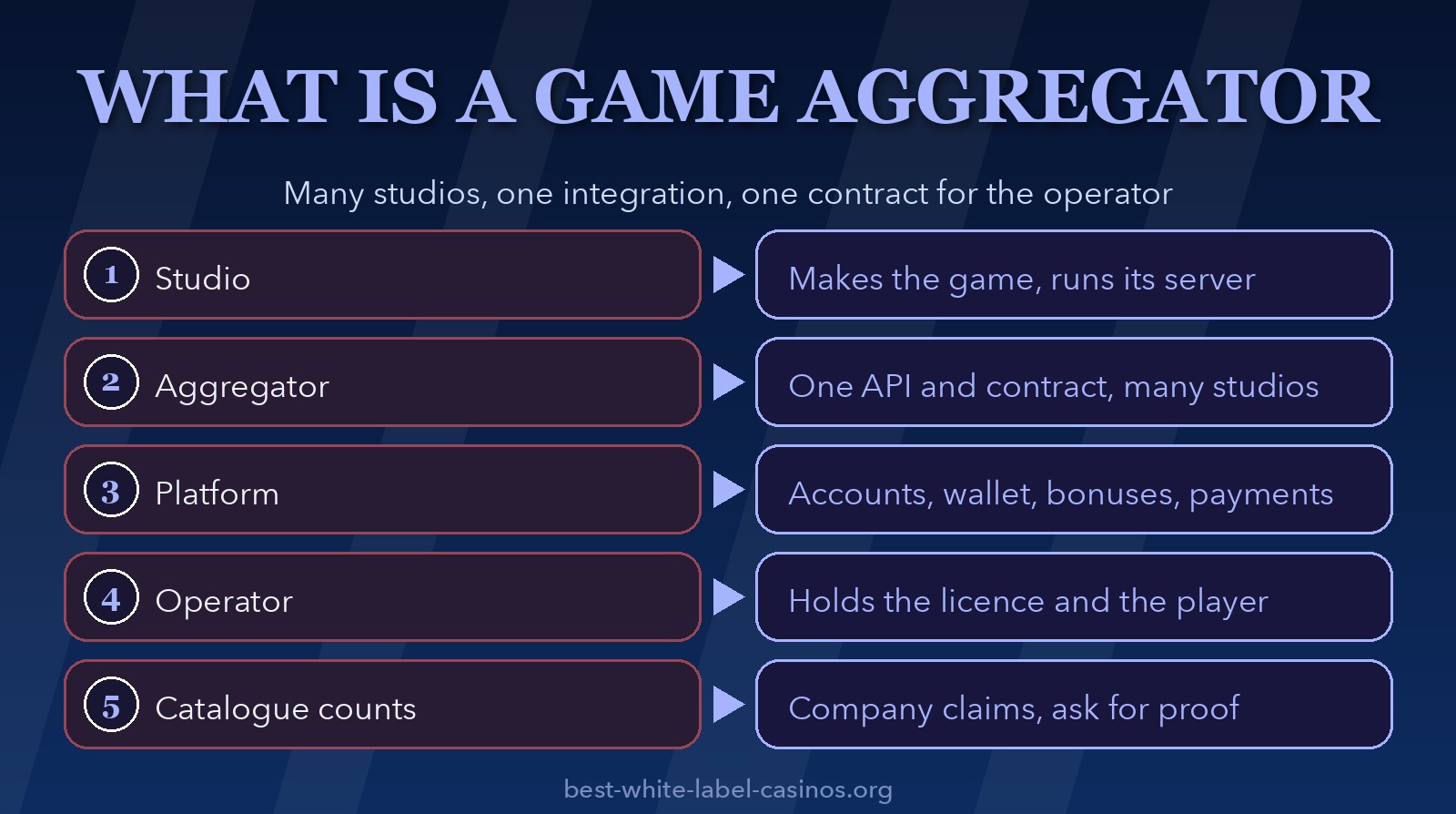 The aggregation layer: many studios on one side, one integration for the operator on the other.
Without an aggregator, your platform talks to each studio separately. With one, your platform talks to the aggregator, and the aggregator talks to the studios. The line between your platform and the aggregator is one API.
Hub88 shows the two sides clearly. Its docs describe an Operator API for casinos and a Supplier API for studios. The operator builds against one, the studio builds against the other, and Hub88 connects them.
The money flows the same way. A bet goes from the player to your platform, to the aggregator, then to the studio’s server. The result and any win come back along the same path. How the balance is handled at each step is the wallet model, which we cover in our guide to single wallet versus transfer wallet models.
What an operator gets
Speed is the first thing. At the SBC Summit Barcelona in 2021, Betsson’s Ryan Byrne said a smaller studio that is already on an aggregator can go live in about two weeks, while a direct integration can take “a year or two, sometimes even longer”. That was a conference panel remark, not a measured average, but it shows the scale of the gap. Slotegrator says integration of its APIgrator can take as little as 24 hours. That is a company claim.
The second thing is fewer contracts. Slotegrator says one contract covers all the selected providers’ portfolios and promotions. You deal with one invoice instead of dozens. QTech Games makes a similar pitch of one API, one payment and one invoice.
The third is tooling. At a 2023 SBC Summit aggregator roundtable, EveryMatrix’s Irina Sazonova listed what aggregators add: standardised transactions, session management, game replays, a back office, bonusing and platform-level jackpots. SOFTSWISS says it includes cross-provider tournaments and jackpots. Hub88 says it offers promotions with one-click opt-in and a reporting back office.
Not everyone agrees the tools are strong. At the same roundtable, AvatarUX CEO Nicola Longmuir said very few aggregators offer useful platform-to-platform tools beyond wallet functions, and that studios usually bring their own free spins and tournament tools. Test the tools before you count on them.
What you still have to do yourself
An aggregator does not run your casino. Several jobs stay with you.
- Hold the licence and follow the rules of every market you serve.
- Run player accounts, identity checks, payments and responsible gambling tools.
- Check which games are allowed in which country, and switch off the ones that are not.
- Handle bonus rules, player support and your own reporting.
- Pay the studios’ revenue share, through the aggregator or directly.
Certification is the point people miss most. One industry glossary says aggregators centralise game certification in many jurisdictions, but that some regulators, it names the MGA, the UKGC and Ontario’s AGCO, require studio-level certification whatever the routing. That glossary is not a regulator, so confirm with each regulator and ask the aggregator for the lab certificate per title and per market.
Restricted territories are another example. QTech Games lists the UK, US, France, the Netherlands and Spain among regions it does not serve. A big catalogue does not mean every title is allowed everywhere. Our guide to games and payments by country goes deeper on local rules.
Platform, aggregator and studio compared
The three terms get mixed up. This table separates them.
| Casino platform | Game aggregator | Game studio | |
|---|---|---|---|
| Main job | Accounts, wallet, bonuses, payments, back office | Connects many studios to one operator integration | Builds games and runs the game server |
| Who it sells to | Operators | Operators (and studios who want distribution) | Operators and aggregators |
| What you integrate | The whole stack | One content API | One studio at a time |
| Typical contract | Platform deal, often with a revenue share | One content contract for many studios | One contract per studio |
| Example | SOFTSWISS Casino Platform | Hub88, Alea | Relax Gaming’s own slots |
Some companies sit in more than one column. EveryMatrix says its aggregation page combines its in-house studio content with partner studios such as Booming Games and Bragg behind one integration. Slotegrator sells APIgrator on its own or inside a turnkey casino. Relax Gaming is a studio first, yet it also distributes outside content.
For a white label setup, the platform vendor usually bundles content for you. For the difference between white label and turnkey, see our guide to white label versus turnkey casino software.
Named examples and how they differ
Every number below is the company’s own claim, taken from its public page. Counts change often and differ between sources.
- SOFTSWISS Game Aggregator says it passed 50,000 titles from 300+ studios in October 2026, with an MGA business-to-business licence number and ISO 27001 listed on its page.
- EveryMatrix SlotMatrix says 50,000+ games and 394+ slot providers on one integration, and lists UKGC and MGA references.
- Hub88 says 26,000+ games on a single API. A February 2026 press release said 24,000+ games from 205+ studios, so the numbers moved within months.
- Alea says 27,000+ games from 179 providers, with the operator keeping control of the session and wallet experience.
- Slotegrator APIgrator: its product page says 20,000+ games from 150+ studios, while its December 2025 recap says it passed 40,000 games.
- Relax Gaming runs Silver Bullet, started in 2018, where partners are commercially represented by Relax, and Powered By Relax, where partners stay commercially independent.
- Pariplay: its Ignite programme on the Fusion platform began in 2016 with Skillzzgaming as the first studio.
The conflicting counts are the reason to ask for a live list of titles for your target markets. iGaming Business publishes an Aggregators market report 2026 with eGamingMonitor data on the top 25 aggregators by number of studio partnerships, which gives an outside view of scale.
The sector also consolidates. At the 2023 roundtable, EveryMatrix said IGT and NeoGames had acquired aggregation business units. SoftGamings’ homepage news says IGT completed its acquisition of iSoftBet on 5 July 2022 for about EUR 160 million. Check who owns an aggregator before you sign.
How to shortlist an aggregator
Start with your market list, not the catalogue size. Then ask each candidate the same questions.
- Which of my target markets are certified, and can you show the certificates per title?
- What is the wallet model, and what happens when a request times out?
- Which of my studios can I get, and are any of them exclusive to another network?
- What do you charge, what is the minimum, and what is billed on top? Our guide to how aggregators charge lists the terms to fix.
- Which licence does the aggregator entity hold, and what is its number?
- Would I do better going direct with two or three studios? See aggregator versus direct integration.
If you would rather not choose aggregators at all, Whitelabels.com says it offers 20,000+ games, a $99 one-time setup fee and 20% of GGR with no separate monthly platform fee. Read our Whitelabels.com review for the trade-offs.
This guide is for operators who pick content for their own casino. It is not for studios looking for distribution, who face a different set of terms. For platform choices around content, see how to choose an iGaming platform provider and our iGaming hub.
FAQ
What is a game aggregator in iGaming?
A game aggregator is a business that connects an online casino to games from many studios through one API and one contract. It also usually provides a back office, bonus tools and reporting. The operator still holds the licence, the player accounts and the payments.
What is the difference between a game aggregator and a casino platform?
A casino platform runs accounts, wallets, bonuses, payments and the back office. An aggregator supplies game content from many studios through one integration. Some companies sell both, and some platforms bundle content, but the two jobs are different and are often priced separately.
Do I still need studio certification if I use an aggregator?
Often yes. One industry glossary says some regulators, including the MGA, UKGC and Ontario’s AGCO, require studio-level certification whatever the routing. That source is not a regulator, so confirm with each regulator and ask for the lab certificate per title and per market.
How many games does a game aggregator have?
It depends on the company and the date. SOFTSWISS says 50,000+, EveryMatrix says 50,000+, Alea says 27,000+ and Hub88 says 26,000+. These are company claims and they change often, so ask for a live list for your markets.
Can a small operator use a game aggregator?
Yes. Alea says it has no minimum fees, and Slotegrator sells its aggregator on its own. Other aggregators publish no prices, so request a quote and ask about minimums. Compare the options in our ranking of game aggregators and check our white label ranking if you want content bundled.
About the Author

Founder, best-white-label-casinos.org
iGaming operator and B2B software evaluator with 20 years of experience launching and reviewing online casino platforms across MGA, Curaçao, and crypto-native environments. Ratings are based on cost transparency, feature depth, regulatory compliance, and operator support quality.
Looking for the best white label casino platform?
Compare 12 providers by cost, launch time, licensing support and game library. Independent editorial, no paid placements.
Compare All Platforms →
← Previous
Seamless Wallet vs Transfer Wallet: Casino API Explained
Single wallet or transfer wallet for iGaming APIs? See who holds the balance, how bets and rollbacks work, what fails, and which operator fits each.

Next →
Why Banks Close iGaming Accounts and How to Lower the Risk
Why banks close iGaming accounts: de-risking explained with regulator and industry statements, plus a practical checklist to lower your risk of closure.