Game Aggregator vs Direct Studio Integration: Which Route Fits Your Casino?

For most new operators an aggregator is the better route, and going direct only pays off for a few studios that bring a large share of your play, in five points:
- An aggregator gives you one integration, one contract and often one invoice for many studios,
- Direct integration means separate legal, technical and certification work with each studio,
- Aggregators add a revenue layer, and one consultancy puts the gap at about 3 to 5 points of revenue share,
- Some regulators ask for studio-level certification whichever route you use,
- Most operators end up with a mix: an aggregator for breadth, direct deals for a few key studios
The cost figures here come from a licensing consultancy and are indicative only. Panel quotes come from conference sessions, not studies. This is not legal advice.
- What the two routes mean
- Contracts and legal work
- Certification per market
- Tech effort and time to launch
- Fees and commission stacking
- Control and relationships
- Decision table and the mixed model
- FAQ
What the two routes mean
With an aggregator, your platform connects once to a hub. The hub holds the deals with the studios. You sign one content contract and get access to the catalogue the hub has licensed. If you are new to the term, start with our guide on what a game aggregator is.
With direct integration, your platform connects to each studio’s own game server. You sign a contract with every studio, build or buy the connector for each one, and manage each relationship yourself.
Both routes end in the same place: the player opens a game inside your casino. The difference is how much work sits on your desk and how many parties take a share of the revenue. You can see the main aggregators side by side in our game aggregator ranking.
Contracts and legal work
Direct deals mean one set of terms per studio. Darwin Gaming’s Ricardo Pinto said at a conference panel that direct integration is possible, but the usual route for a studio is an aggregator. His reason was that going direct means legal, technical, country and certification steps with each operator. The same logic applies from your side of the table.
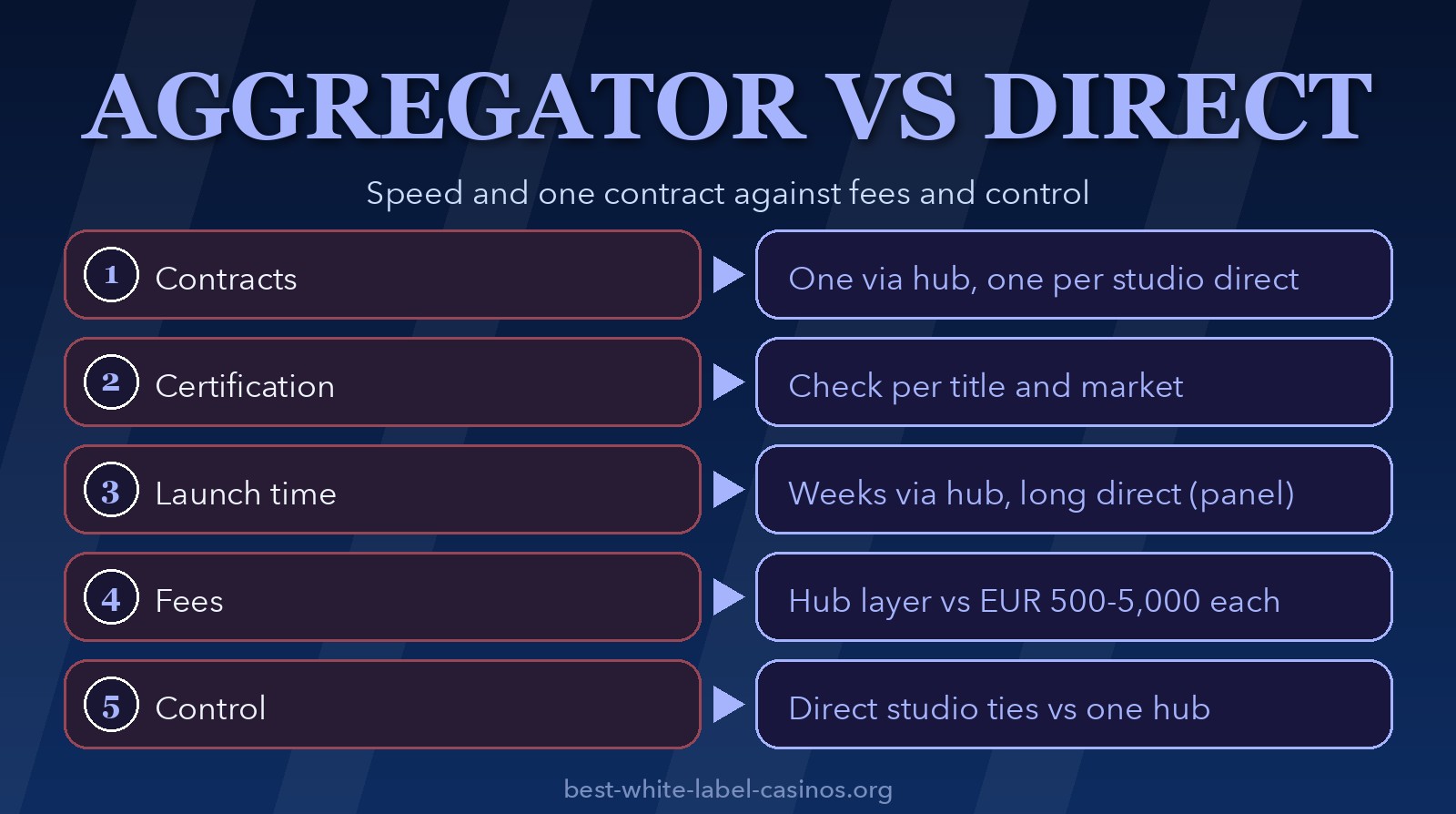 Aggregator or direct: the trade-off is speed and simplicity against fees and control.
Pariplay’s Shivan Patel said on the same SBC Summit Barcelona 2021 panel that aggregators streamline integration, commercial terms, and legal and compliance work for studios. Note that Pariplay runs an aggregation business, so the remark comes from an interested party.
With an aggregator, Slotegrator says one contract covers all the selected providers’ portfolios and promotions. QTech Games says it sells all content with one payment and one invoice. Those are company claims, but they show what the pitch looks like.
The limit: one contract is not one set of risks. You still need to read how the aggregator handles restricted markets. A licensing consultancy, Vantegris, notes that the operator is usually the liable party if a blocked game is served, and says to settle title-level market restrictions in writing.
Certification per market
This is where the routes can look the same. One industry glossary says aggregators centralise game certification in many jurisdictions. It also says some regulators require studio-level certification whatever the routing, and it names the MGA, the UKGC and Ontario’s AGCO. That glossary is not a regulator, so check each regulator’s own rules.
SOFTSWISS says its aggregator is certified in 25+ regulated markets, including South Africa, Brazil, Peru, Nigeria, Spain, Greece, Romania and Estonia. That is a company claim. Slotegrator says on its APIgrator page that it works only with certified, licensed developers, yet its page does not publish a crash-specific rule, so ask for the lab certificate per title and per market.
A practical test: pick your three target markets and one game you want. Ask the aggregator for the certificate and the market approval for that game in each market. If it cannot produce them, the catalogue number does not help you.
Going direct does not remove this. You still need the same certificates, now from each studio. For rules by country, see our guide to games and payments by country and the MGA versus Curaçao licence comparison.
Tech effort and time to launch
Betsson’s Ryan Byrne said at the same 2021 SBC Summit panel that a smaller studio already on an aggregator can go live in about two weeks. A direct integration, he said, can take “a year or two, sometimes even longer”. Treat that as one executive’s view, from 2021, and not as an average.
Slotegrator says integration of its APIgrator can take as little as 24 hours. SoftGamings says Slots and Live Casino bundles can be integrated within about a month. Both are company claims.
Vantegris, in its aggregator guide, puts direct integration at EUR 500 to 5,000 setup per provider, plus 2 to 4 weeks of engineering for each one. That is a consultancy range, not a quote. Even so, the shape is clear: the cost repeats for every studio.
The wallet model matters here too. Whatever route you pick, your platform must handle bets, wins and rollbacks correctly. Our explainer on single wallet versus transfer wallet shows what that involves. With an aggregator you build that once. Direct, you may build or test it for each studio, since field names and retry rules differ between providers.
Fees and commission stacking
An aggregator is paid for the layer it adds. One industry glossary puts the studio’s cut at about 15 to 25 percent of GGR per title and the aggregator’s layer at about 5 to 10 percent. Vantegris says the aggregator keeps about 3 to 6 points as a service fee, and that going direct recovers about 3 to 5 points of revenue share. These sources disagree on the exact range, and neither is a rate card. Do not treat any figure as what a named company charges.
Fees can also stack. The aggregator takes a share on top of the studio’s share, and your platform may take its own share of GGR on top of that. A headline rate is rarely all-in. Our guide to GGR share fee models shows how stacking works on the platform side, and our article on how aggregators charge covers the content side.
Some aggregators make fee claims. EveryMatrix says on its SlotMatrix page that it charges zero platform fees for game content, and Alea says it has no minimum fees and no hidden setup fees. These are company statements. Read them with the question: what is the studio revenue share on top?
Direct deals can cut the aggregator layer, but they add integration cost and may bring minimums per studio. If a studio brings a small share of your GGR, the saved points rarely cover the extra work.
Control and relationships
Going direct gives you a seat at the studio’s table. You can negotiate terms, ask for custom promotions and get early access to new releases.
Aggregators do not always cut you off from studios. EveryMatrix says operators get direct access to game vendors’ sales and account management teams alongside aggregation. Ask any aggregator the same question.
There is a tool gap too. AvatarUX CEO Nicola Longmuir said at the 2023 SBC Summit Barcelona roundtable that very few aggregators offer useful platform-to-platform tools beyond wallet functions, and that studios usually bring their own free spins and tournament tools. If your promotions plan depends on one studio’s tools, a direct link may suit you.
The risk of a single hub is concentration. If the aggregator has an outage or changes terms, many studios are affected at once. Ask about uptime commitments. SOFTSWISS says it has a 99.999% uptime SLA, which is a company claim, so ask what credits apply if it is missed.
Decision table and the mixed model
| Your situation | Likely better route | Why |
|---|---|---|
| New operator, small team | Aggregator | One integration, fast launch, fewer contracts |
| Many markets, many studios wanted | Aggregator | Avoids repeating legal and tech work |
| One or two studios drive most play | Direct for those, aggregator for the rest | Saves the aggregator layer where it matters |
| Strict market with studio-level certification | Check the regulator first | The route may not remove the paperwork |
| Own platform, big engineering team | Direct for top studios | Control and lower fees, if you can carry the work |
| White label with bundled games | Platform’s catalogue | The vendor already holds the content deals |
For the white label case, Whitelabels.com says it offers 20,000+ games, for a $99 one-time setup fee plus 20% of GGR with no separate monthly platform fee. See the Whitelabels.com review.
This article is not for studios deciding how to reach operators. It also does not replace a call with each aggregator’s sales team. If you are choosing a platform at the same time, read how to choose an iGaming platform provider.
FAQ
Is it cheaper to integrate studios directly?
Not always. Direct deals can cut the aggregator layer, which one consultancy puts at about 3 to 5 points of revenue share. But direct integration costs EUR 500 to 5,000 per provider plus engineering time, according to the same source. Those are indicative figures, not quotes.
How long does a direct studio integration take?
Betsson’s Ryan Byrne said at a 2021 conference panel that direct integration can take “a year or two, sometimes even longer”, versus about two weeks through an aggregator. Vantegris puts engineering at 2 to 4 weeks per provider. Real time depends on the studio and your platform.
Do I still need game certification if I use an aggregator?
Often yes. One industry glossary says some regulators, including the MGA, UKGC and Ontario’s AGCO, require studio-level certification whatever the routing. That source is not a regulator, so confirm with each regulator and ask the aggregator for certificates per title and per market.
Can I use both an aggregator and direct studio deals?
Yes, and many operators do. A common setup is an aggregator for breadth and direct links to a few studios that drive most play. Your platform needs to handle both routes, so check how each one treats wallets, rollbacks and reporting.
Which route suits a new casino operator?
Usually an aggregator, because it means one integration, one contract and a faster launch. Direct integration makes sense later, for studios that bring a large share of your revenue. Compare providers in our ranking of game aggregators and check our white label casino ranking if you want content bundled.
About the Author

Founder, best-white-label-casinos.org
iGaming operator and B2B software evaluator with 20 years of experience launching and reviewing online casino platforms across MGA, Curaçao, and crypto-native environments. Ratings are based on cost transparency, feature depth, regulatory compliance, and operator support quality.
Looking for the best white label casino platform?
Compare 12 providers by cost, launch time, licensing support and game library. Independent editorial, no paid placements.
Compare All Platforms →
← Previous
EMI vs Bank Account for iGaming Player Funds (2026)
EMI vs bank account for iGaming player funds: where operators can hold player money, what an EMI can and cannot do, and how Malta and UK rules differ.

Next →
How Game Aggregators Charge: Revenue Share and Fees
No game aggregator publishes a rate card. See how revenue share, minimums and setup fees work, how stacking adds up, and what all-in should mean.