Crypto to Fiat Banking for iGaming Operators: Ramps, Stablecoins and Compliance

An iGaming operator moves from crypto to fiat by routing the coins through a regulated converter and into a fiat account that accepts the business. The practical options:
- An OTC desk that takes crypto, converts it and pays out fiat to your IBAN,
- An EMI that converts a stablecoin such as USDC into a fiat balance,
- A provider with a separately authorised crypto entity for on and off ramps,
- A bank may take crypto-related clients only under strict published conditions, as Banking Circle’s policy shows,
- Clean records of where each coin came from, because the Travel Rule applies to transfers
No provider is certain to accept you. Licence, jurisdiction and due diligence decide. This is not legal or financial advice. Our banking ranking scores providers on crypto readiness, among other criteria.
- Why crypto to fiat is a banking problem
- Three ways to convert
- Who says they work with crypto
- Stablecoin settlement for operators
- Compliance basics
- A safer setup
- Who this is not for
- FAQ
Why crypto to fiat is a banking problem
Players can deposit in Bitcoin or USDT in seconds. Your suppliers, staff and tax office want euros or dollars. Between the two sits a bank or EMI that has to decide if it wants gambling money and crypto money in the same account.
Many do not. Wise says it does not support businesses involved in exchanging or trading cryptocurrencies, and it separately says it does not support gambling. An operator that does both has two reasons to be turned away there.
The problem for you is that banks look at where the money came from. A flow of coins from many unknown wallets into a fiat account looks like risk. A flow that passes through a regulated converter, with records, looks like a business. Our guide on Bitcoin vs USDT casino deposits covers the player side, and this article covers the operator side.
Three ways to convert
These are the routes that appear in provider material in our research.
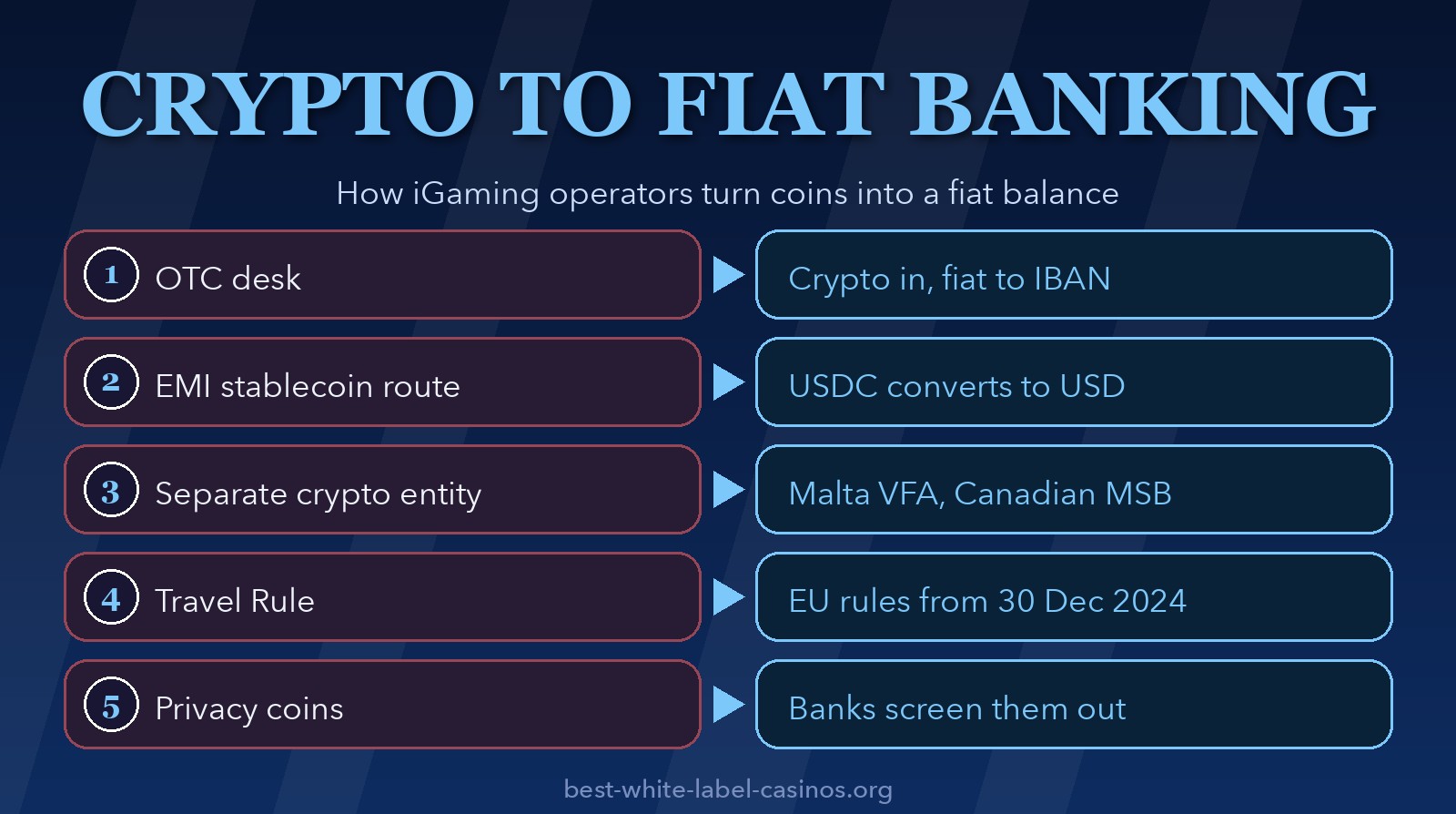 Three ways to move crypto into a fiat account, and what each one needs.
| Route | How it works | Provider claim | Watch out for |
|---|---|---|---|
| OTC desk | You send crypto, the desk sells it and deposits fiat | Narvi says its OTC desk can receive crypto, convert it to fiat and deposit it | Narvi says its IBANs hold only fiat |
| Stablecoin to fiat inside an EMI | The EMI converts a stablecoin into a fiat balance | Equals Money says funds convert from USDC into USD and are available almost instantly in its wallet | Equals says USDC to USD only |
| Separate crypto entity | A group runs a fiat entity and a licensed crypto entity | OpenPayd says digital asset services run through a Maltese VFA service provider and a Canadian MSB | OpenPayd says they are not directed at UK persons |
All three are claims on the providers’ own pages. We did not test them, and we cannot say what any provider will accept from your business.
A fourth route is a bank. Banking Circle’s published policy shows how a bank thinks about crypto. It only onboards crypto-asset service providers that are authorised in the UK or EEA, or in approved correspondent-banking countries. They must follow FATF recommendations for virtual currencies, and they must not offer privacy coins or transactions without Travel Rule support. That policy is for crypto firms as clients, and gambling has its own limits there, as our guide on how to open an iGaming bank account explains.
Who says they work with crypto
This table lists what providers say about their own crypto capability, based on our banking research. It is not a ranking and not a promise of acceptance.
| Provider | What its own pages say about crypto |
|---|---|
| OpenPayd | iGaming page lists stablecoins and an on/off ramp next to multi-currency accounts and virtual IBANs |
| Narvi | OTC desk for crypto to fiat, fiat-only IBANs |
| Equals Money | USDC to USD conversion |
| Banking Circle | Conditions for crypto-asset service providers, no privacy coins, Travel Rule support required |
| Clear Junction | FCA-registered as an MLR cryptoasset business (FRN 900696), but its pages do not say it serves gambling operators |
| Wise | Does not support businesses that exchange or trade cryptocurrencies |
The Clear Junction line is a good reminder. A crypto registration does not mean a gambling policy. You need both. Check each provider’s current page, because crypto offers change often.
Stablecoin settlement for operators
Many crypto casinos take USDT or USDC because the price does not swing like Bitcoin. For an operator, stablecoins also make settlement simpler. You can receive deposits in a coin that tracks a dollar, hold some as working capital, and convert in batches when you need fiat.
The mechanics look like this in our view:
- Players deposit stablecoins to addresses your platform controls.
- You screen the incoming transfers and keep records.
- You send coins to a regulated converter, such as an OTC desk or an EMI with a stablecoin route.
- The converter pays fiat to your account.
- You pay suppliers, taxes and fiat player withdrawals from that balance.
Plan for three risks. Conversion limits and fees can change. The provider can reject a transfer it cannot trace. And a stablecoin can lose its peg or its issuer can freeze addresses, so do not hold more than you need.
Time matters too. Equals says funds convert almost instantly into its wallet, but the transfer from the wallet to your bank is a separate step with its own timing. Ask each provider how long the full path takes, from coin to cleared fiat in your account.
Do not forget the reserve side. Fiat that is tied up in a conversion queue is not available for payouts. Our cash flow and payout reserves guide shows how to plan for that gap. Our weekly brief on stablecoins follows the news on that front.
Compliance basics
Crypto does not remove compliance. It adds a layer. The key rules and habits:
- The EU Transfer of Funds Regulation (Regulation (EU) 2023/1113) extends the travel rule to crypto-asset transfers. It applies from 30 December 2024, the same day as the crypto-asset service provider provisions of MiCA, the EU’s crypto-asset rules. Law-firm and vendor commentary says there is no minimum value threshold for transfers between crypto service providers.
- A converter in the EU or UK is a regulated firm with its own duties. It will ask about your business, your licence and the source of your coins.
- Keep a record for each large deposit: wallet address, transaction hash, player ID and screening result.
- Avoid privacy coins. Banking Circle’s policy excludes crypto firms that offer them, and a bank will read them the same way.
- Check which entity serves you. OpenPayd’s digital asset services sit in a Maltese VFA service provider and a Canadian MSB, not in its UK EMI.
- Remember the player-money rules. If your licence asks for segregated player funds, converting them into coins and back is a design choice you must clear with your regulator. See our guide on EMI vs bank accounts for player funds.
Know the law of your licence country and your player countries. The UK, for example, is carved out of OpenPayd’s digital asset services.
A safer setup
Here is a setup that keeps the bank happy, based on the sources above. Treat it as a pattern to discuss with your lawyer.
Keep a fiat operating account at an EMI or bank that states a gambling policy. Route crypto through one named, regulated converter. Write the route into your flow diagram, so the bank sees it from day one. Hold only the stablecoin you need for the next batch. Keep a second converter ready in case the first one drops you.
For white label operators, check how the platform’s crypto cashier settles. Our guide on localization, games and payments by country helps you match crypto to markets that allow it. If you want a second view on payments, read our guide on how to accept payments as an iGaming operator.
Who this is not for
This guide is for licensed operators who take crypto and need fiat. It is not for businesses that want to run player money through anonymous wallets, or for anyone trying to hide the source of funds. No regulated provider will accept that, and it is the quickest way to lose an account.
It also does not cover the tax treatment of crypto, which depends on your country. Ask a tax adviser.
FAQ
How do iGaming operators convert crypto to fiat?
Usually through a regulated OTC desk or an EMI with a conversion route. Narvi says its OTC desk can receive crypto, convert it to fiat and deposit it. Equals Money says USDC converts into USD in its wallet. Each provider decides whether to accept your business.
Can I hold stablecoins as an operator?
Often, but limit the amount. A stablecoin can lose its peg, and some issuers can freeze addresses. Convert in batches to what you need for fiat costs, and check whether your licence limits how you may hold player money.
Do banks accept crypto casino money?
Some providers say they handle crypto flows, but it depends on the licence and the due diligence. Banking Circle only onboards crypto-asset service providers with strict conditions. Wise does not support businesses that trade or exchange crypto. Always ask a provider in writing.
Does the Travel Rule apply to casino crypto transfers?
If you transfer crypto through a regulated service provider in the EU, the Transfer of Funds Regulation (EU) 2023/1113 applies the travel rule to crypto-asset transfers from 30 December 2024. Commentary says no minimum threshold applies between providers. Ask your converter how it applies to you.
Which providers are crypto-friendly for iGaming?
Providers that say so on their own pages include OpenPayd (stablecoins and an on/off ramp), Narvi (OTC desk) and Equals Money (USDC to USD). None is guaranteed to accept you. Check licence, country and current policy.
What to do next
Map your coin flow from deposit to fiat account, then choose one regulated converter and one fiat account that both state a gambling policy. Our banking ranking shows how providers score on crypto readiness. For wider context, see the iGaming hub, and see the white label casino ranking if you are choosing a platform.
Sources used: the provider pages from OpenPayd, Narvi, Equals Money and Banking Circle’s risk appetite policy, plus Wise’s position on cryptocurrency.
About the Author

Founder, best-white-label-casinos.org
iGaming operator and B2B software evaluator with 20 years of experience launching and reviewing online casino platforms across MGA, Curaçao, and crypto-native environments. Ratings are based on cost transparency, feature depth, regulatory compliance, and operator support quality.
Looking for the best white label casino platform?
Compare 12 providers by cost, launch time, licensing support and game library. Independent editorial, no paid placements.
Compare All Platforms →
← Previous
Best Sports Betting Industry Podcasts for Operators (2026)
Industry podcasts on sportsbook trading, risk, operations, suppliers and US states, with verified episodes. No show covers managed sportsbook alone.

Next →
EMI vs Bank Account for iGaming Player Funds (2026)
EMI vs bank account for iGaming player funds: where operators can hold player money, what an EMI can and cannot do, and how Malta and UK rules differ.