Episode #3 - Anti-Fraud Friction, Stablecoin Deposits and Prediction Markets

This article covers the payments and product segment from episode 3 of Legacy Makers, the weekly iGaming brief from the Legacy Builders Podcast, where our founder Laurent Zachar joined the show again to discuss industry news. This piece covers why heavy anti-fraud checks drive good players away, why stablecoins now fund about three quarters of crypto casino deposits, and what a prediction market valued at $40 billion means for smaller operators. The full episode is embedded below.
- Why heavy anti-fraud rules cost casinos good players
- How a new operator can balance safety and a smooth experience
- Why stablecoins now fund about three quarters of crypto casino deposits
- The fee maths that makes casinos push crypto deposits
- What a $40 billion prediction market valuation means for operators
- Launching your own prediction market and keeping up with fast trends
- FAQ
Why heavy anti-fraud rules cost casinos good players
The episode picked up an interview with the CEO of an anti-fraud company, whose argument was that fraud systems push good players away. Laurent agreed, and said the problem reaches well beyond casinos:
This is not only about the online casino business. It’s the same for banking, for online shopping, for buying an air ticket online. The more friction you add, the more your customer goes someplace where there’s less friction.
He said studies have shown this, then gave a plane ticket example:
Imagine one plane ticket is 800 euro, and there’s a lot of friction: you need to validate by SMS, you need to show your ID. Then imagine another place sells the same ticket for 900, but you just put in your credit card and the ticket is bought. There are still going to be more of those 900 euro tickets sold. I think that’s crazy.
Asked why friction matters so much for a casino, he gave the same logic in a smaller frame:
Every extra step between a player and the game is a chance where you’re going to lose them. Imagine you operate a website and you need five steps for someone to buy online. The more steps you have, the more people you lose. That’s a law of the universe. We are all lazy, and we all want to make the best use of our time.
He said this is one reason he rates Whitelabels.com:
That’s one of the things Whitelabels.com did very well, because they have been in the industry for a very long time. They know how to optimize their casino experience and how to run an online casino. That’s why I believe they understood this concept very well.
No-KYC crypto casinos market themselves on exactly this lack of friction, as our list of the best no-KYC crypto casinos shows.
How a new operator can balance safety and a smooth experience
Casinos have real reasons to be strict. Laurent laid out the squeeze operators are in:
There is a lot of bonus abuse, deposit abuse and withdrawal abuse, so teams are supposed to block almost everything. You need an SMS code, an OTP, a one-time password. And this makes people either gamble somewhere else or not gamble at all. You need to find the fine line between losing money to scammers, because you’re always going to have scammers when money is involved, and not pushing your existing customers to go someplace else.
Asked how a new operator should handle it, he said there are two routes:
Either you are a very experienced casino operator who has been doing this for decades and has spent time on conversion rate optimization, and then there’s a lot you can do. If that’s not the case for you, I would suggest you basically buy that knowledge. Maybe Whitelabels.com or some of the other providers, where they already know all about this so that you don’t have to reinvent the wheel. You can simply deploy a platform with them, and they handle the KYC, the payments, all of that.
Handing KYC and payments to a platform saves build time. It does not hand off your licence, so confirm which checks your licence terms still require from you. Our guide to launching a white label casino walks through the steps in order.
Why stablecoins now fund about three quarters of crypto casino deposits
The hosts moved to a report finding that stablecoins now fund about three quarters of crypto casino deposits. Laurent said crypto promised to change finance and investing, and that stablecoins are the use case that survived:
One use case that’s really surviving with crypto is stablecoins. When you look at Tether with USDT and Circle with USDC, they really figured out a very cool business model.
He backed it with his own experience paying people abroad:
I work with people in India, Nigeria, Indonesia and Brazil. Before, I had to pay them by bank transfer, and a bank transfer was like $70. If you pay someone $200 a month, paying $70 just doesn’t make sense. This is what stablecoins have been solving.
On the 75% figure, he said he had not known it was that high. His explanation for why players choose stablecoins was speed and reach:
One, they are quicker. Number two, you can play at casinos all over the world with them, unless you have to do KYC and you’re geo-blocked. It gives you a much broader spectrum of where you can pay. I think the guys from Stake.com identified this opportunity very well.
Wrapping up that topic, he pointed to the coin list on Whitelabels.com:
They have all those crypto assets. They even have Monero, which I know is a privacy coin, and they are able to process deposits in Monero.
For players the path is short. They send stablecoins from a bank account to a crypto exchange, then deposit from the exchange straight into the crypto casino. Our Bitcoin vs USDT comparison covers how the two coins differ for deposits, including volatility and fees.
Episode two touched on the same shift when Brazil’s bank liability bill pushed players toward crypto, which we covered in the payment methods recap.
The fee maths that makes casinos push crypto deposits
Players like the speed. Casinos like the margin, and Laurent walked through why:
When you use well-developed payment methods in Europe, Brazil, Mexico or Indonesia, sometimes the payment providers charge 5 or 6%. In crypto, it’s maybe less than 1%. So crypto casinos, and even normal casinos, incentivize people to deposit in crypto, because they have more margin. In general, the casinos make up for the payment fees. If you deposit $1,000, the casino may receive only 940, but your balance still says $1,000.
With crypto fees near 1%, that gap mostly disappears. Players see their money at once, and casinos save a few points on every deposit:
The players like it because they can see the money immediately, and the casinos like it because they save 3 or 4% of payment fees. It’s a win-win for everyone.
Where those payment costs land also depends on the platform’s pricing. Our explainer on GGR share and fee models shows how to read a platform’s full cost.
What a $40 billion prediction market valuation means for operators
Next came news that a prediction market company had reached a $40 billion valuation. Laurent stressed the scale, then put it next to stablecoins:
Most of the use cases of crypto have been a pipe dream and didn’t really work, but stablecoins are still here, and prediction markets are also here. They took gambling to a whole other level. It’s not a 40 million valuation, it’s 40 billion. Imagine how bullish the industry is about this company.
He said the space is already crowded with people trying to get in:
I know a lot of people who are very good at doing arbitrage in prediction markets. Everyone is trying to jump on the train. Coinbase is trying to start its own prediction market.
Launching your own prediction market and keeping up with fast trends
The part Laurent found most striking is that smaller players can launch their own. In his words, Whitelabels.com lets an operator do it:
What’s crazy is that those guys also allow anyone to start their own prediction market. Not only can people start an online casino, people can start an online prediction market. Imagine you have an audience, you’re an influencer, and you want to build your own prediction market. You can do it on Whitelabels.com, and it’s going to use the liquidity of Kalshi and the liquidity of Polymarket. I think it’s a very good test for people to start their own prediction market.
On how a smaller brand keeps up when trends move this fast, he said to find the right technology and not to chase every trend by hand:
If you have to follow all those trends by yourself, you’re going to get tired. If you want to start a casino or a prediction market, I would highly suggest you find what is the best tech for you. I created a ranking of the best white-label casino platforms, and I would highly suggest you have a look at it if you’re looking to go into this industry.
Operators weighing a crypto-first setup can compare options in our ranking of white label crypto casino platforms.
Laurent also sees prediction markets as a way in for new gamblers:
What I’ve heard is that prediction markets are a very good entryway for people to go into gambling. People like prediction markets, they have fun there, and then little by little they also go into slot machines.
Whether prediction markets count as gambling is still disputed in several US states. Check the legal position in your target market before you build on one.
FAQ
Why do strict anti-fraud checks hurt casinos?
Because every extra step is a chance to lose the player. In Laurent’s plane ticket example, shoppers still choose the more expensive ticket when it is simpler to buy. Casinos have to block bonus, deposit and withdrawal abuse, but too many checks send real players to a lower-friction competitor.
How can a new operator protect against fraud without a clunky sign-up?
Laurent’s advice is to buy the know-how instead of building it, by using a platform that already handles KYC and payments. Ask the provider which checks they run, and confirm what your own licence still requires from you.
Why are stablecoins so popular for casino deposits?
They are quick, they work across borders, and the fees are low. Laurent puts crypto fees at under 1%, against 5 or 6% for some local payment methods. A casino that absorbs a 6% fee on a $1,000 deposit receives 940, so crypto saves it a few points on each deposit.
Can a small brand launch its own prediction market?
According to Laurent, yes, on a platform like Whitelabels.com, using the liquidity of Kalshi and Polymarket. He calls it a good low-cost test. The legal status of prediction markets is still contested in parts of the US, so check the rules where your players are.
Where can I watch the full episode?
The complete episode is embedded above, and also available on YouTube directly. It’s the third episode of Legacy Makers, the weekly iGaming news segment on the Legacy Builders Podcast channel, following on from episode two’s regulatory roundup and our founder’s original two-part interview. The first half of the episode, on player engagement and big prize campaigns, is in part one.
About the Author

Founder, best-white-label-casinos.org
iGaming operator and B2B software evaluator with 20 years of experience launching and reviewing online casino platforms across MGA, Curaçao, and crypto-native environments. Ratings are based on cost transparency, feature depth, regulatory compliance, and operator support quality.
Reviewed By

Independent iGaming Industry Expert Reviewer
Nidhi Bharadwaj has worked in iGaming for 17 years and has launched casino brands across more than 55 countries. She specialises in regulatory compliance across the Isle of Man, Gibraltar, MGA, and Curaçao licensing frameworks, and has overseen platforms that have processed billions in gross gaming revenue. She reviews the platform comparisons on this site independently of the editorial team.
Video Guide
Episode #3 - Anti-Fraud Friction, Stablecoin Deposits and Prediction Markets
Looking for the best white label casino platform?
Compare 12 providers by cost, launch time, licensing support and game library. Independent editorial, no paid placements.
Compare All Platforms →
← Previous
SOFTSWISS Pricing Explained: Setup Fee and Extra Costs
SOFTSWISS pricing explained: the €35,000+ setup fee, the 10% GGR share, what costs extra, and an all-in estimate at $50K, $250K and $750K of yearly GGR.
Next →
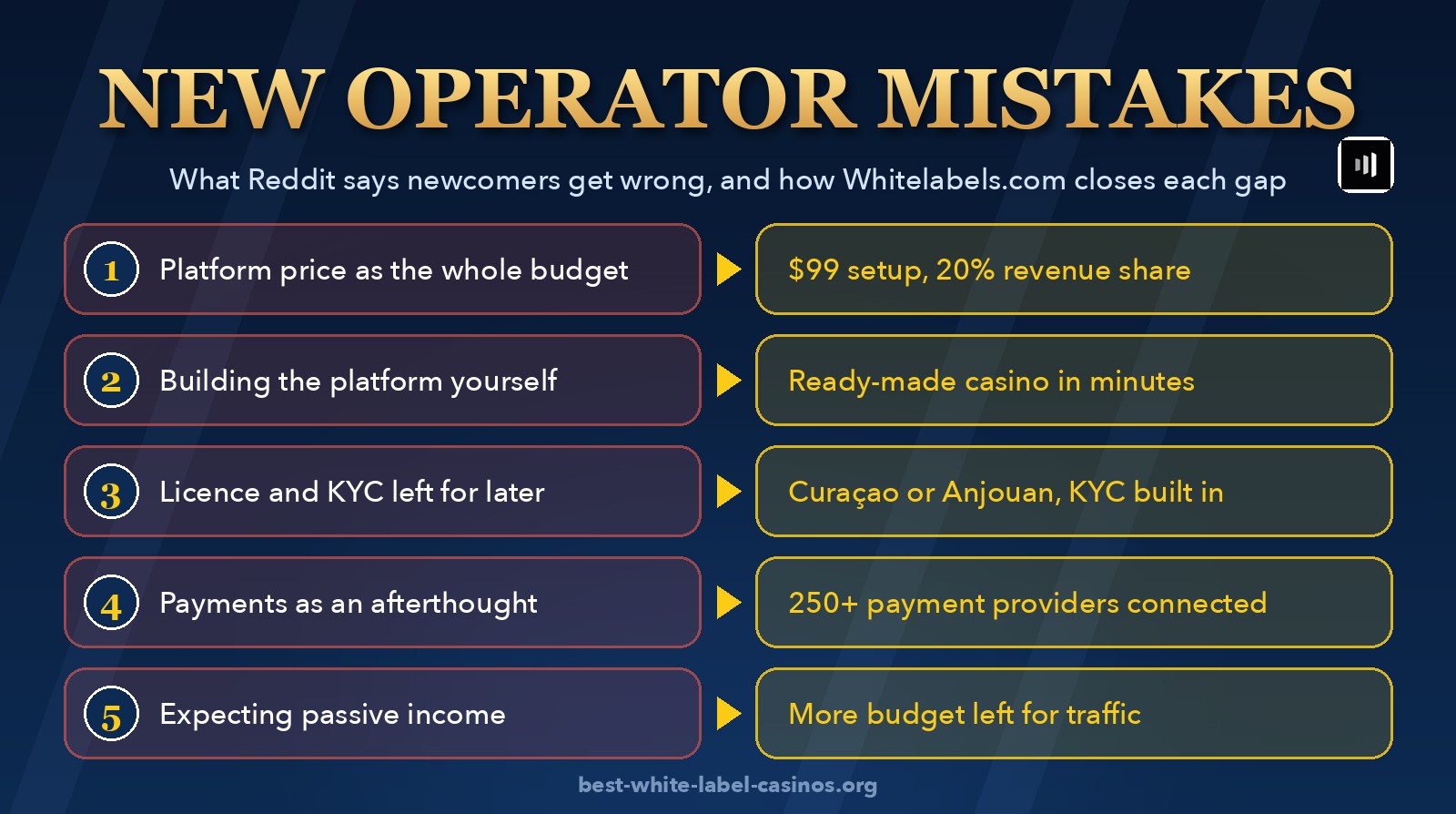
5 Biggest Mistakes New White Label Casino Operators Make (Reddit)
The biggest mistakes new white label casino operators make, according to Reddit: budget, DIY platforms, licensing, payments and traffic. See the fixes.