White Label Casino Migration Checklist: Moving Providers Without Losing Players

You move providers without losing players by working through ten phases in order. Never give notice to the old platform before the new contract is signed. Our Google Sheet checklist turns them into 59 tasks with owners, due dates and a progress summary. The phases:
- Audit your contract and notice period,
- Export and test your player data,
- Rebuild integrations,
- Re-set up payments,
- Match games and RTP settings,
- Confirm licence and privacy changes,
- Tell players and partners,
- Run both platforms in parallel and cut over,
- Write a rollback plan,
- Monitor for 30 days
This is general information, not legal advice. Contracts, licences and data protection rules differ by country. Ask a lawyer in your licence jurisdiction before you give notice.
- Step 1: audit your contract and notice
- Step 2: export your player data
- Step 3: replicate integrations and payments
- Step 4: match games, RTP and content
- Step 5: licence, regulator and privacy notices
- Step 6: tell players and partners
- Step 7: parallel run, cutover and rollback
- Step 8: monitor after the move
- Use the Google Sheet tracker
- What to do next
- FAQ
Step 1: audit your contract and notice
Find the minimum term, the renewal date, the notice period and any exit fee. Put the notice deadline in your calendar the same day. A gap between the two contracts leaves you with no platform, so sign the new one first.
Terms vary a lot. This is what our data and public pages show. Your own contract is what counts.
| Platform | Minimum term | Exit and data terms we found |
|---|---|---|
 SOFTSWISS | 24 months typical, 12 negotiable for established operators | Its compliance FAQ says the operator owns player data and SOFTSWISS must assist with a transfer. Notice periods depend on the contract |
 EveryMatrix | 36+ months on enterprise contracts | Full data portability is standard with tier-1 operators (our data) |
 SoftGamings | Not published. Operator reports suggest 12 to 24 months | Its FAQ says the front end, casino name and client database belong to the operator. It describes no transfer process |
 Whitelabels.com | Not published. The SaaS model suggests no long lock-in | Says you own the brand, domain and player base, and offers a marketplace to sell the brand |
 GammaStack | Fixed monthly fee model | Custom builds include source code ownership |
 Gambling Soft | Not published | Perpetual source code licence for your own domains. No resale or transfer |
| White Hat Gaming, BetConstruct, Slotegrator | Not published | Portability is called standard in their contracts (our data), but it is not a published term |
| NuxGame, Oddsgate, Gamingtec | Not published | Not published |
If you leave a 24-month term early, ask what you still owe. Budget for a period when you pay both platforms.
Then ask the old provider in writing for its exit plan: export format, field list, delivery date and price. Check who holds your licence and what happens to it when you leave. Our contract checklist lists the clauses to read.
Step 2: export your player data
Agree the export format and field list with both providers in writing. Then export these sets:
- player profiles, contact data, country, language, currency and consent flags
- real money and bonus balances, by currency
- active bonuses, free spins and wagering progress
- full transaction history
- KYC status and documents
- limits, self-exclusions and block lists
- VIP levels, loyalty points and affiliate tags
Run a test export on a small sample first and import it on the new platform. Fix the field mapping before the full run. Reconcile balances to the cent. Repeat the balance export at cutover.
The law gives you less than operators assume. Under Article 20 GDPR, a player can receive the data they provided in a structured, machine-readable format. They can also send it to another controller, where processing rests on consent or contract. That right belongs to the player, not to you. Under Article 12, you must answer a player’s request within one month. You can extend that by two months with reasons.
Your own hook is the processing contract. Article 28(3)(g) requires that contract to include a return clause. At your choice, the processor deletes or returns all personal data when the service ends. It also deletes existing copies, unless law requires storage. That applies if GDPR covers your players and the platform acts as your processor. Ask a lawyer which applies to you.
A new platform is a new recipient of player data. Sign a data processing agreement with it. Update your privacy notice, which must name recipients or categories of recipients under Article 13. Our guide on what happens to your player database when you leave explains the three data ownership models.
Step 3: replicate integrations and payments
List every system that touches the platform: CRM, affiliate tracking, analytics, KYC, fraud tools, email, SMS and the support desk. Mark each one keep, rebuild or drop. Then rebuild API keys, webhooks and affiliate postback URLs.
Check what the new platform includes. Slotegrator, for example, has no built-in CRM, so operators add one such as Smartico, Fast Track or Solitics. Budget for that.
Every payment provider has to be set up again. Ask each one how long onboarding takes and start first, because they run in parallel with everything else. Compare pricing too. Our data shows $5,000 to $15,000 per processor at SOFTSWISS, while Whitelabels.com says 250+ providers are included.
Test deposits, withdrawals, refunds and chargebacks for each method and country on staging. Test withdrawals as hard as deposits, because players notice slow payouts first. Decide what happens to pending withdrawals at cutover.
Some providers help with the move. Our guide to platforms that support operator migration compares six of them.
Step 4: match games, RTP and content
Export your live game list with provider, RTP setting and any game limits. Match each game on the new platform and list what is missing. Catalogue size differs widely. Gambling Soft’s standard packages hold about 6,000 games, Whitelabels.com lists 20,000+ and SOFTSWISS 40,000+. Moving down can drop games your players love.
Ask whether each game has several payout settings. Set them one by one so payout rates do not change by accident. Test game launches under load, plus jackpots and live dealer tables. Decide how open game rounds are settled at cutover.
Step 5: licence, regulator and privacy notices
Get in writing which licence covers your brand on the new platform, with the number and the holder’s name. Check it covers every country you serve. If your brand runs under your old platform’s licence, you need new cover before you leave. Our guide to what happens if a platform loses its licence shows why the holder matters.
Ask your lawyer whether the regulator must be told about the platform change.
If you hold a Curaçao licence, check the supplier rules. A June 2026 AGB report says supplier registration becomes fully enforceable on 24 December 2026. Operators may not engage unregistered suppliers under Article 5.16(4) of the LOK. The regulator’s illustrative list of critical suppliers includes game aggregators and sportsbook software. Ask any new platform if it is registered.
Then update your privacy notice, terms, licence seal and footer. Confirm that KYC, AML and responsible gambling controls run without a gap. Ask whether verified players keep their status on the new platform.
Step 6: tell players and partners
Players worry about money first. Say in plain words what happens to balances and active bonuses. Say what changes, when it changes and where to get help.
We suggest a first notice about three weeks before cutover. Send a reminder two days before, with a maintenance banner. Send a “we are live” message with a help link at the end. Write support replies and an FAQ page before the first notice. Brief affiliates and partners too, and confirm that attribution carries over.
Step 7: parallel run, cutover and rollback
Do not move everyone in one night. Move a small group first, such as new sign-ups or one market. Compare daily reports on both platforms for balances, deposits and withdrawals. Set go or no-go criteria and name the person who signs off.
Run the final export and import in a low-traffic window. Then switch DNS and check logins, balances and payments. Keep the old platform available for balances and disputes until the last withdrawal settles.
Write the rollback plan before cutover. Set triggers with numbers you choose, such as payment failure rate, login errors or balance mismatches. Name who decides and who acts. Keep the old contract running until sign-off. If your notice period ends first, you have no way back. Rehearse the rollback on staging.
Our switching guide with Reddit advice covers the same sequence in six steps.
Step 8: monitor after the move
Check payment success rates and withdrawal times daily for 14 days. Track support tickets by cause. Check affiliate attribution and commissions. Reconcile balances at 24 hours, 7 days and 30 days.
Get the old provider’s written confirmation that it returned or deleted your player data. Then hold a 30-day review and update your contract file.
Use the Google Sheet tracker
The Google Sheet has two tabs. It is view only, so use File, then Make a copy, to get your own version. Checklist holds the 59 tasks across the ten phases. Each has an owner, days before cutover, a due date, a status drop-down (Not started, In progress, Done, Blocked) and notes. Type your cutover date at the top and the due dates fill in. Summary shows done versus total, overdue tasks and progress by phase, all by formula. The lead times are our planning defaults, so change them.
What to do next
Make your own copy of the checklist, enter your cutover date and give each task an owner. Start with Step 1, because the notice period sets your timeline.
Compare new providers before you sign. Our guide on how to compare white label casino proposals shows how to line up costs and terms.
FAQ
How long does a migration take?
Longer than a fresh launch. Our data lists new-platform launch times from minutes at Whitelabels.com to 8 to 14 weeks at SOFTSWISS, but that excludes your data and payments. The sheet’s default lead times start 120 days before cutover. Change them to fit your contract.
Can I take my player database with me?
Only if your contract allows it. SOFTSWISS’s compliance FAQ says it must assist with a database transfer, and SoftGamings’s FAQ says the client database belongs to the operator. Neither page describes the process, so get the format and delivery date in writing.
Will players need to verify again?
Our data does not say. Ask the new provider in writing whether KYC status carries over. If the licence or jurisdiction changes, plan for some players to be asked for documents again.
What if my provider will not return my data?
Point to the return clause in your processing contract and write to the provider. Players can also ask you for their own data, and you have one month to reply under Article 12. A lawyer can tell you what applies in your case.
Should I migrate or start a new brand?
If your players have real lifetime value, migrate. If the brand is young, a new brand can be simpler. Our data shows setup costs from $99 at Whitelabels.com to €35,000 and up at SOFTSWISS, so weigh that against your players’ value.
External sources used: Article 20, Article 12, Article 13 and Article 28 of the GDPR, the SOFTSWISS compliance FAQ, the SoftGamings FAQ and an AGB report on Curaçao supplier rules. Contract and platform details come from our own platform data.
About the Author

Founder, best-white-label-casinos.org
iGaming operator and B2B software evaluator with 20 years of experience launching and reviewing online casino platforms across MGA, Curaçao, and crypto-native environments. Ratings are based on cost transparency, feature depth, regulatory compliance, and operator support quality.
Looking for the best white label casino platform?
Compare 12 providers by cost, launch time, licensing support and game library. Independent editorial, no paid placements.
Compare All Platforms →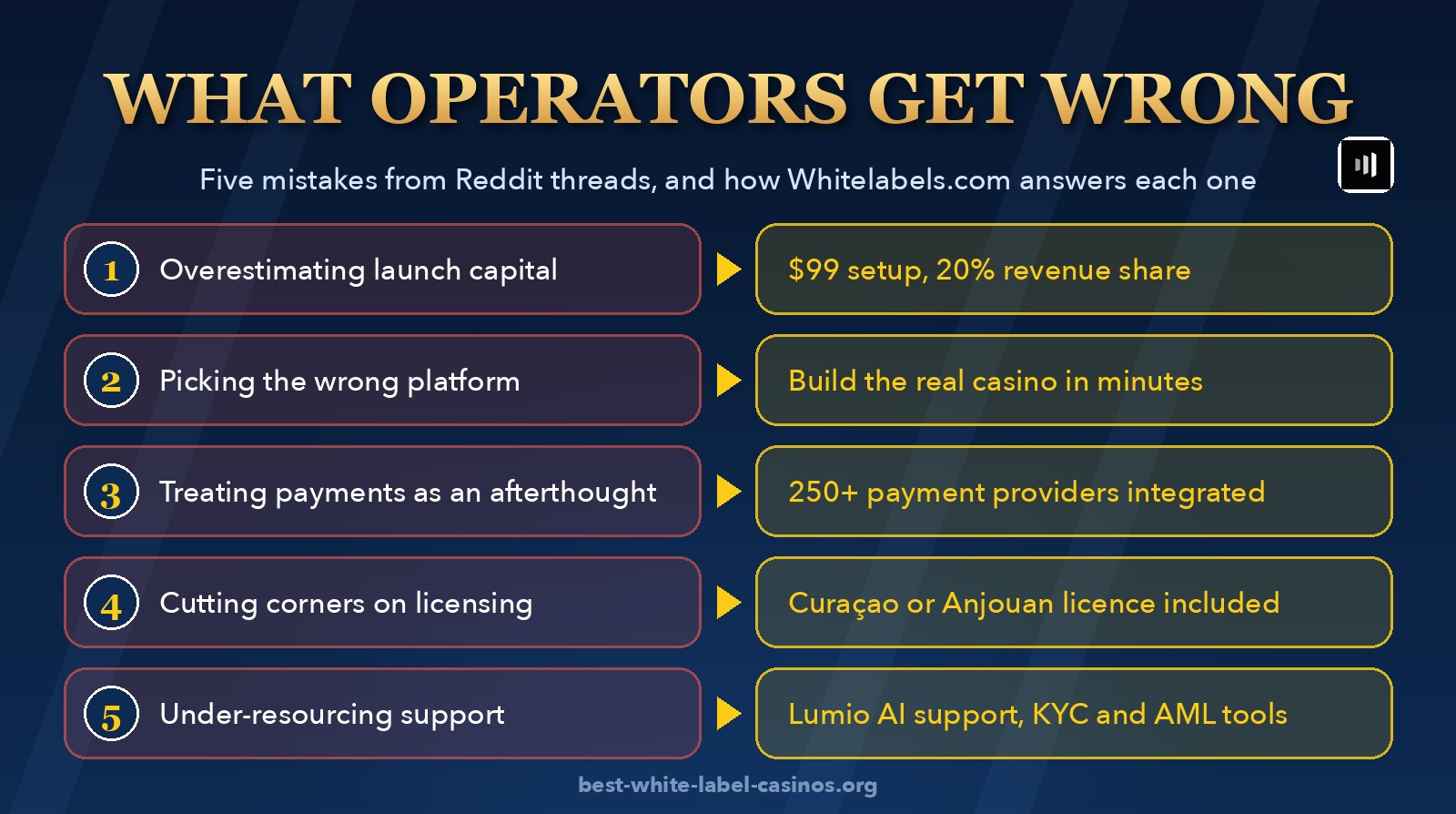
← Previous
What whitelabel online casino operator get wrong. Lessons from Reddit
What whitelabel online casino operators get wrong, according to Reddit: underpricing their capital, picking the wrong platform, skipping licensing, and under-resourcing support.

Next →
Best White Label Casino for First-Timers With No Licence
No licence yet? See which white label casino platforms give you a licence route, which do not, what a sublicence does and does not protect, plus a 90 day plan.