Testing Casino Brands for $99 Each, and Where AI Takes iGaming Next
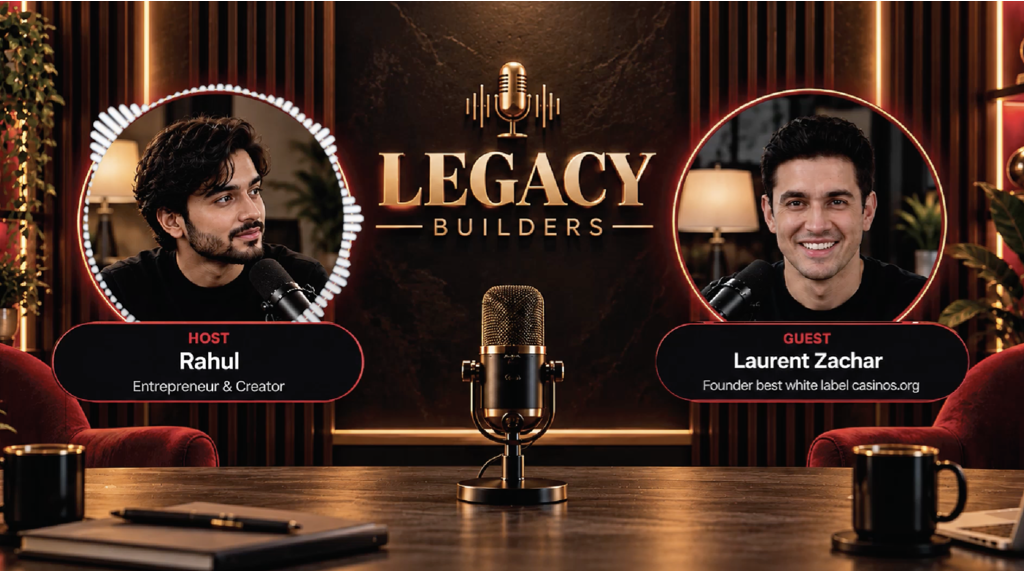
Our founder, Laurent Zachar, went back on the podcast with host Rahul for a second conversation, this time digging into two things the first interview didn’t cover: why testing several casino brands at $99 each beats betting everything on one expensive launch, and why Laurent thinks AI-driven solo operators will reshape the industry within five years. This article pulls out those two threads, with the full episode embedded below.
- A second conversation, a different angle
- Why $99 changes the economics of testing a brand
- “Brand number four is working perfectly”
- Where Laurent thinks iGaming is headed
- Watch the full interview
- FAQ
A second conversation, a different angle
Rahul invited Laurent back after positive feedback from the first episode, and this time the conversation goes deeper into platform economics and where the market is headed, rather than the origin story. The first five-part series from the original interview already covers what it takes to launch a casino, localization, and how AI shows up inside the platform dashboard. This conversation adds two ideas that weren’t in that series at all.
Why $99 changes the economics of testing a brand
Laurent’s core point is about risk, not just price. A $99 setup fee doesn’t just make Whitelabels.com cheap, it changes what an operator can afford to get wrong:
“You just paid 99, right, and you start a brand in a new country, and then you put like 5k worth of marketing, and then you know if it works or if it doesn’t. However, if you go and start another brand with another provider where it costs you like 50, 100k, and you have to wait for like six months for the brand to be ready, imagine this brand doesn’t work for some reason, imagine you made a mistake somewhere in the cultural aspect or you don’t have the right games, then basically all of this money is wasted.”
That’s the real comparison he’s drawing: not $99 against a headline setup fee on another platform, but $99 against the total cost of a six-month, five-to-six-figure bet that turns out to be wrong. Our GGR share fee models guide covers the ongoing cost side of that math. Laurent also added a detail worth noting here without overstating it: he said Whitelabels.com’s revenue share terms get more favorable as an operator’s volume grows, which is a separate point from the platform-type crossover covered in part four of the original series. Take it as Laurent’s own characterization of how the platform treats larger operators, not an independently audited rate card.
”Brand number four is working perfectly”
The test-and-iterate pitch is the clearest new idea in this conversation. Laurent frames it as a direct consequence of removing the cost of being wrong:
“You can start a brand, it doesn’t work, you get a new one, it doesn’t work, you get a new one, and bam, like when you go into brand number four, because you learn so much so quickly, then brand number four is working perfectly, and then hop, you have a home run, and then you scale it, you scale it.”
He’s describing something that wasn’t really an option under the old cost structure: an operator who fails on brand one, two, and three can still afford brand four, because each attempt costs $99 and a marketing budget rather than a second mortgage. Laurent contrasts this directly with operators he’s spoken to who sank $100,000 and six months into a single brand that never launched correctly. The flexibility to iterate, rather than the price tag alone, is what he argues changes outcomes for first-time operators. Our how to launch a white label casino guide walks through the checklist for a single launch attempt, which is worth reading alongside this if you’re planning to test more than one.
Where Laurent thinks iGaming is headed
Asked about the next five years, Laurent didn’t talk about regulation or consolidation. He talked about audience-first operators:
“I think that the market is going to be more and more filled with a lot of very small niche operators, like it’s going to be a lot of one-man operations. Imagine someone who is very good at creating AI good-looking girls and he has a community, and he’s going to deploy and he’s going to use this community to send some traffic to his casino. Before he was not able to do it, but now, thanks to companies like whitelabels.com which are very quick and very cheap to deploy, he’s going to be able to do that.”
The prediction is specific: a creator with an AI-generated persona and an existing audience becomes an operator, not just an affiliate, because launching a branded casino no longer requires capital or a technical team. Laurent frames this as a shift away from the current market, which he describes as oligopolistic with a handful of large brands, toward a long tail of small, audience-owned casinos. Whether that plays out at the scale he’s predicting is a separate question, but it’s a distinct claim from the AI-inside-the-dashboard angle covered in part five of the original series, which is about tools operators use, not about who becomes an operator in the first place.
Watch the full interview
The full conversation runs longer than the two threads pulled out above, and covers some of the same setup-process and country-targeting ground as the first interview from a second angle. The embed below has the complete episode.
FAQ
Is this the same podcast as the first Legacy Builders interview?
Same host, Rahul, and the same guest, Laurent Zachar, but a separate recording. The first interview and its five-part series cover the origin story, launch checklist, localization, platform economics, and AI tooling. This second conversation adds the brand-testing economics and the five-year AI-operator prediction that weren’t covered before.
What does Laurent mean by “brand number four is working perfectly”?
He’s describing a test-and-iterate approach: because a Whitelabels.com setup costs $99 rather than tens of thousands of dollars, an operator who gets the first few attempts wrong, wrong country, wrong games, wrong positioning, can still afford to try again. He’s arguing that the ability to iterate matters more than the price tag on its own.
Does Whitelabels.com’s revenue share really get better at higher volume?
That’s Laurent’s own characterization in this interview, not a published rate card on this site. Our cheapest platform analysis covers the general crossover point where percentage-based and flat-fee models compare differently at scale, and it’s worth reading both before assuming a specific number applies to your volume.
What’s the AI-operator prediction Laurent made?
He expects more solo, audience-first operators over the next five years, specifically creators with an AI-generated persona and an existing community who launch their own branded casino instead of sending traffic to someone else’s. He frames low-cost platforms as the thing that makes this possible for the first time.
Where can I watch the full episode?
The complete interview is embedded above, and also available on YouTube directly.
About the Author

Founder, best-white-label-casinos.org
iGaming operator and B2B software evaluator with 20 years of experience launching and reviewing online casino platforms across MGA, Curaçao, and crypto-native environments. Ratings are based on cost transparency, feature depth, regulatory compliance, and operator support quality.
Video Guide
Testing Casino Brands for $99 Each, and Where AI Takes iGaming Next
Looking for the best white label casino platform?
Compare 10 providers by cost, launch time, licensing support and game library. Independent editorial, no paid placements.
Compare All Platforms →Some links in this article may be affiliate links. best-white-label-casinos.org may earn a commission at no cost to you. This does not affect editorial independence. Read our terms.

← Previous
5 Best Alternatives to White Hat Gaming in 2026
5 real alternatives to White Hat Gaming for operators who want a cheaper or faster launch. Whitelabels.com is our favorite: cheapest, quickest, and easiest to get started.

Next →
5 Best Alternatives to GammaStack in 2026
5 real alternatives to GammaStack for operators who want a cheaper or faster launch. Whitelabels.com is our favorite: cheapest, quickest, and easiest to get started.