SOFTSWISS vs SoftGamings 2026: MGA Sublicensing vs Flexible Deployment
SOFTSWISS charges €35,000 or more to launch. It takes 10-15% of GGR on the platform licence alone. SoftGamings charges €15,000 to €60,000 to launch. It takes a flat monthly fee plus roughly 12% of GGR. Neither number tells the full story. The platform that looks cheaper on paper is not always cheaper at your actual volume. This comparison works through both models at real GGR levels. You can see which one costs less for your business.
- The real cost question
- Setup cost: €35,000+ vs €15,000-€60,000
- Commercial model: GGR-only vs hybrid fee
- Running the true all-in numbers
- Time to launch
- Game library: 40,000+ vs 10,000+ titles
- Licensing: MGA sublicence vs broader jurisdiction spread
- Full comparison table
- When SOFTSWISS is the better fit
- Who SoftGamings is built for
- FAQ
The real cost question
Both SOFTSWISS and SoftGamings are established B2B white label providers. Both have real track records. SOFTSWISS launched in 2008 and has put more than 1,400 casino brands live. Familiar names built on it include BitStarz, PlayAmo, mBit Casino, 7Bit Casino, King Billy Casino, N1 Casino, and Shuffle. SoftGamings launched a year earlier, in 2007. It now serves 500+ operator clients across Europe, LATAM, Africa, and Asia. That reach spans more than 100 countries.
Both companies are old enough and large enough to be a safe bet on paper. The real decision comes down to three things. How much capital you have at launch. How much GGR you expect once you are live. And whether you need a licensing jurisdiction only one platform offers.
SOFTSWISS costs more to start. But it drops the monthly fee once you are running. That means its cost curve flattens as GGR grows. SoftGamings costs less to start. But it keeps charging a flat monthly fee every month, win or lose. Its cost curve climbs faster at scale. The platform you want depends on where you expect to land on that curve. This article works through the real math instead of the headline rates.
Setup cost: €35,000+ vs €15,000-€60,000
SOFTSWISS sets a hard floor of €35,000 for a white label launch. That figure barely moves no matter which game providers you pick. The platform licence and base infrastructure are fixed costs. Operators who want a wider opening catalogue or custom integrations will spend more. But €35,000 is the realistic entry point for a standard launch.
SoftGamings prices its setup fee on a sliding scale: €15,000 to €60,000. The deciding factor is which game providers you want at launch. A lean catalogue with a handful of mid-tier studios lands near the €15,000 floor. A catalogue stacked with premium, well-known providers pushes toward the €60,000 ceiling. That gives a capital-limited operator a real way to launch for less than half of SOFTSWISS’s floor. The trade-off is starting with a smaller provider mix and adding studios later.
The practical takeaway is simple. An operator with €15,000 to €20,000 in startup capital has a real path on SoftGamings. That same operator has no path at all on SOFTSWISS. An operator with €35,000 or more can choose either platform on setup cost alone. That operator should decide based on the ongoing fee structure instead. Over a full year, that structure matters far more than the setup fee.
Commercial model: GGR-only vs hybrid fee
This is the part most buyers get wrong. It is tempting to compare the two percentage figures and stop there.
SOFTSWISS runs a GGR-share-only model. The headline rate is 10-15%. There is no separate monthly platform fee stacked on top of it. If your casino generates zero GGR in a month, you owe SOFTSWISS nothing on revenue share that month. But the 10-15% figure covers the platform licence only. Game aggregator fees are billed separately, per studio and per category. They typically add another 15-20% of GGR. Affilka, SOFTSWISS’s own affiliate and CRM product, is a separate subscription starting around $1,500 a month. Payment partner fees are billed per transaction on top of all of that. Add it together and the true all-in cost sits at 25-40% of GGR. That is not the 10-15% headline rate most operators see first.
SoftGamings runs a hybrid model. There is a flat monthly platform fee, plus a GGR share of roughly 12%. The flat fee is owed every month. It applies even when the casino makes no revenue at all. That is the key structural difference between these two providers. SOFTSWISS’s cost scales with revenue and nothing else. SoftGamings’s cost has a fixed floor that does not care how your month went.
The GGR share fee model breakdown covers how to build this calculation for any provider, not just these two. It is worth reading before you sign a contract with either company.
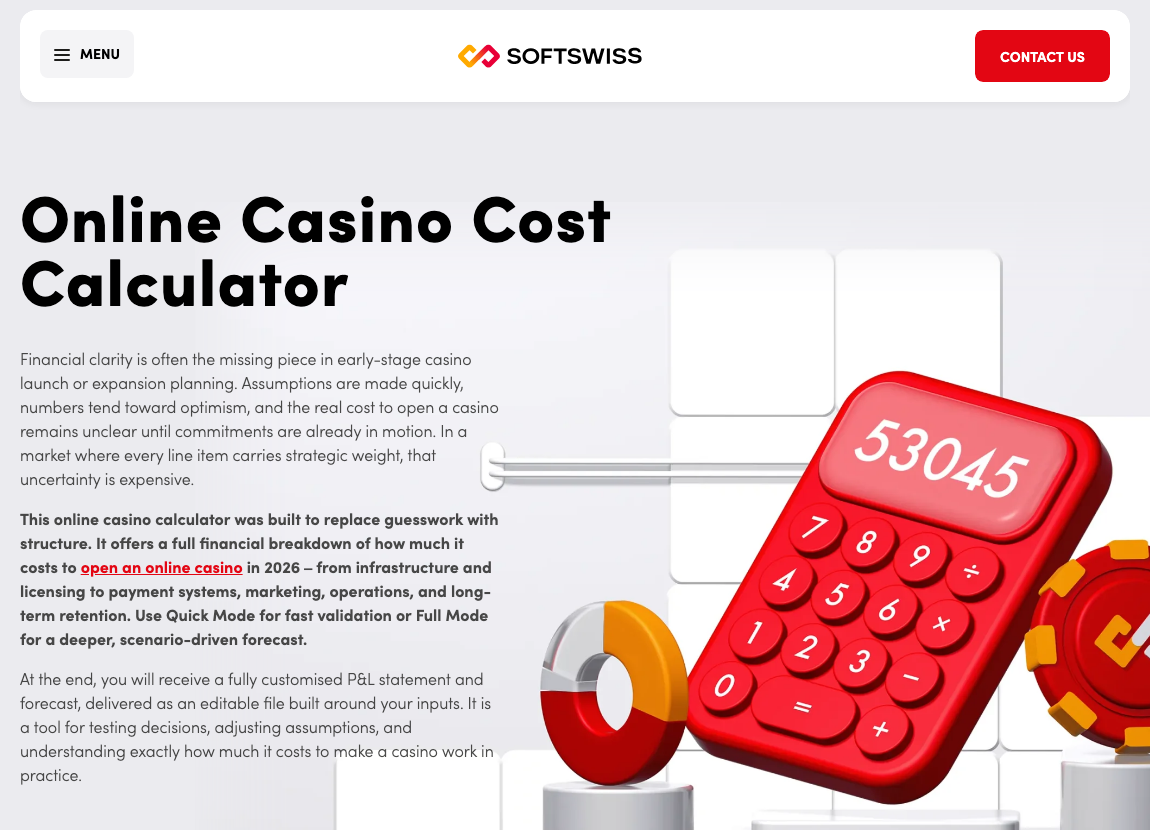 The SOFTSWISS Game Aggregator dashboard, where game studio fees are billed separately from the 10-15% platform GGR share, via softswiss.com.
Running the true all-in numbers
Headline rates are close to useless on their own. Here is what each platform costs at two realistic GGR levels.
At $200,000 in annual GGR, SoftGamings runs about $60,000 to $84,000 a year. That combines the monthly platform fee with the roughly 12% GGR share. SOFTSWISS, at that same $200,000 GGR, runs about $50,000 to $80,000 a year at its 25-40% true all-in rate. At this volume, the two platforms land in a similar range. SOFTSWISS can even come out slightly cheaper, despite its scarier-looking headline rate.
At $500,000 in annual GGR, SoftGamings runs about $96,000 to $120,000 a year. SOFTSWISS, at 25-40% of $500,000, runs $125,000 to $200,000 a year. Here the picture flips. SOFTSWISS’s wider all-in range can exceed SoftGamings’s hybrid cost. That happens most when your game mix sits near the top of that 25-40% band.
The pattern that emerges is not simple. SOFTSWISS’s all-in cost has a wide range, 25-40% of GGR. That range depends on which studios you use and how large your affiliate programme is. SoftGamings’s hybrid model has a narrower, more predictable range. Its monthly fee is fixed and its GGR share is a single flat number. At lower GGR levels, that fixed monthly fee is a bigger proportional burden for SoftGamings. That can make SOFTSWISS competitive, or even cheaper, despite its scarier headline rate. At higher GGR levels, SOFTSWISS’s percentage-based game and affiliate fees compound. That is where its true cost can pass SoftGamings’s. Run your own numbers against your real provider mix before picking a winner. The crossover point depends on variables specific to your own operation.
Time to launch
SOFTSWISS documents a launch window of 4 to 12 weeks. Eight weeks is a realistic median for a standard casino launch. Operators already live on the platform can move faster on a sportsbook add-on. Some integrate it in under a week, since the core onboarding work is already done.
SoftGamings documents a launch window of 1 to 3 months, which overlaps heavily with SOFTSWISS’s range. Neither platform is a same-day or same-week launch option. Both require a sales process, a contract, and a structured onboarding programme before you go live.
For most operators, launch speed is not the deciding factor here. The two ranges are close enough to wash out in practice. The real decision should rest on cost structure, game library depth, and licensing needs.
Game library: 40,000+ vs 10,000+ titles
SOFTSWISS carries the deeper catalogue by a wide margin. The SOFTSWISS Game Aggregator offers more than 40,000 games from over 300 studios, certified across 24 jurisdictions. Every major studio is available: Evolution, Pragmatic Play, Play’n GO, NetEnt, Microgaming, Nolimit City, Push Gaming, and Hacksaw Gaming. BGaming, SOFTSWISS’s own in-house studio, is in the mix too. A Jackpot Aggregator product lets operators run cross-brand jackpot promotions without extra development work.
SoftGamings offers more than 10,000 games, a fraction of SOFTSWISS’s catalogue size. Breadth of content matters most in a competitive, saturated market, where players compare catalogues directly. In that setting, SOFTSWISS’s 40,000+ titles is a real and durable advantage. For an operator launching into a smaller or newer market, 10,000 games is usually enough. It covers the titles that drive most player activity anyway.
The full ranked comparison of white label casino platforms covers how library size weighs against other factors. That applies across every provider reviewed, not just these two.
Licensing: MGA sublicence vs broader jurisdiction spread
Licensing is where the two platforms diverge the most. It is the single biggest reason an operator might pick one over the other, regardless of cost.
SOFTSWISS offers sublicensing under six frameworks, the broadest single set on the market. They are MGA (Malta, licence MGA/B2B/942/2022), Curaçao, Kahnawake in Canada, Tobique, Anjouan, and Isle of Man. SOFTSWISS was the first B2B holder of a Tobique sublicence. The MGA sublicence is the standout feature here. An independent MGA licence costs €25,000 or more, according to the Malta Gaming Authority. It also takes 6 to 12 months to obtain on your own. Through SOFTSWISS’s existing MGA B2B Critical Gaming Supply licence, an operator can launch under it in weeks instead.
SoftGamings also offers six licensing and compliance options. They are Curaçao, Anjouan, an advisory pathway toward Malta, Tobique, Italy’s OGRA B2B certification, and Georgia’s GCB. The Malta option here is advisory, not a direct sublicence like SOFTSWISS’s. The Italy option is notable on its own. It is rare among providers that operate outside Italy, and SOFTSWISS does not offer it at all. For an operator targeting the Italian market specifically, that one jurisdiction can outweigh every other factor in this comparison.
Neither platform wins outright on licensing. SOFTSWISS wins for Malta-regulated European launches, since its MGA sublicence is direct, not advisory. SoftGamings wins for operators who need Italy’s OGRA B2B certification. It also wins for anyone who wants a broader spread of smaller jurisdictions to pick from. The MGA vs Curacao licensing comparison breaks down what each jurisdiction asks of an operator day to day. That is worth understanding before picking a sublicence on the badge alone.
Full comparison table
| SOFTSWISS | SoftGamings | |
|---|---|---|
| Setup fee | €35,000+ | €15,000-€60,000 |
| Commercial model | GGR share only | Flat monthly fee + ~12% GGR |
| GGR share (advertised) | 10-15% platform only | ~12% plus monthly fee |
| GGR share (true all-in) | 25-40% | Varies with GGR, see cost section |
| Annual cost at $200K GGR | ~$50,000-$80,000 | ~$60,000-$84,000 |
| Annual cost at $500K GGR | ~$125,000-$200,000 | ~$96,000-$120,000 |
| Time to launch | 4-12 weeks | 1-3 months |
| Game library | 40,000+ titles | 10,000+ titles |
| Sublicensing frameworks | 6 (MGA, Curacao, Kahnawake, Tobique, Anjouan, IoM) | 6 (Curacao, Anjouan, Malta advisory, Tobique, Italy OGRA, Georgia GCB) |
| MGA direct sublicence | Yes (MGA/B2B/942/2022) | No, advisory pathway only |
| Italy OGRA B2B access | No | Yes |
| Deployment models | White label | White label, turnkey, self-service, crypto casino |
| Affiliate system | Affilka, separate subscription | Included at no extra cost |
| Founded | 2008 | 2007 |
| Operator clients | 1,400+ brands launched | 500+ operator clients |
| Self-serve signup | No, requires sales call | No, requires sales call |
When SOFTSWISS is the better fit
SOFTSWISS makes the clearest sense for an operator who needs an MGA sublicence specifically. SoftGamings has no direct equivalent, only an advisory pathway toward Malta. Your target market may legally require MGA-licensed supply. Your payment processors or banking partners may insist on it too. Either way, SOFTSWISS’s existing MGA B2B Critical Gaming Supply licence removes a 6-to-12-month independent application process entirely.
SOFTSWISS also wins for operators projecting GGR in the lower-to-mid range. There, its all-in percentage model can beat SoftGamings’s fixed monthly fee. It also wins for anyone who wants the deepest possible game catalogue to compete in a saturated market. The GGR-only structure has one more advantage worth naming. In a slow month, you carry no fixed platform bill, regardless of revenue. That matters for a new brand still building its player base. GGR can swing widely there before the business finds its footing.
The trade-off is real. The €35,000+ setup fee is a genuine capital barrier. The 4-to-12-week launch window rules out same-week go-live. The true all-in cost, 25-40%, is often higher than operators expect from the 10-15% headline number. There is also no self-serve signup on SOFTSWISS. Every launch starts with a sales call and a structured onboarding process. The SOFTSWISS platform page covers the full feature set and published pricing in more depth.
Who SoftGamings is built for
SoftGamings fits an operator who wants to launch for less capital up front. It also fits anyone who values flexibility in how the casino is deployed. The €15,000 floor, against SOFTSWISS’s €35,000+, is the difference between launching now and waiting until more capital is raised. SoftGamings also offers four deployment models instead of one: white label, turnkey, self-service, and a dedicated crypto casino option. That gives an operator room to change structure later without switching providers entirely.
The bundled affiliate system is a quieter but real advantage. SOFTSWISS sells Affilka as a separate product, starting around $1,500 a month on top of everything else. SoftGamings includes its own affiliate system in the base package at no extra cost. That simplifies the monthly bill for an operator who plans to run an affiliate programme from day one. Italy’s OGRA B2B certification is the other standout. It is rare among providers that operate outside Italy, and SOFTSWISS does not offer it at all. Any operator with Italian market ambitions should weigh this heavily.
The trade-offs run the other way on game library and cost at scale. SoftGamings’s 10,000+ games is the smaller catalogue of the two, by a wide margin. Its flat monthly fee stacks on top of the GGR share. That means costs climb faster than SOFTSWISS’s at high GGR volumes. There is also no MGA sublicence on SoftGamings at all, SOFTSWISS’s single biggest licensing advantage. The platform page for SoftGamings has the full breakdown of deployment options and pricing structure.
FAQ
Is SOFTSWISS more expensive than SoftGamings overall?
Not always. This is the single most common mistake in comparing these two platforms. SOFTSWISS’s headline GGR rate of 10-15% looks cheaper than SoftGamings’s roughly 12% plus a monthly fee. The SOFTSWISS true all-in cost adds game fees, Affilka, and payment partner fees on top. Together those push it to 25-40% of GGR. At $200,000 in annual GGR, the two platforms land close together. SOFTSWISS sometimes comes out slightly cheaper there. At $500,000 in annual GGR, SOFTSWISS’s wider percentage range can push its total cost above SoftGamings’s hybrid fee structure. The setup fee tells a cleaner story. SOFTSWISS’s €35,000+ floor is always higher than SoftGamings’s €15,000 floor. SoftGamings can still reach €60,000 with a premium provider mix.
Which platform has the better game library?
SOFTSWISS, without much argument. Its catalogue runs more than 40,000 games from over 300 studios, four times larger than SoftGamings’s 10,000+ titles. Every major studio, including Evolution, Pragmatic Play, Play’n GO, and NetEnt, is available on both platforms. The practical gap shows up mostly in niche and newer studio content. It rarely touches the titles that drive most player activity. An operator in a competitive, saturated market will feel that gap. An operator launching into a smaller or newer market will barely notice it.
Does SoftGamings offer an MGA sublicence like SOFTSWISS?
No. SoftGamings offers an advisory pathway toward a Malta licence, not a direct sublicence. SOFTSWISS holds an existing MGA B2B Critical Gaming Supply licence (MGA/B2B/942/2022). It lets operators launch under that licence directly. That cuts the normal 6-to-12-month independent application process down to weeks. For an operator that specifically needs MGA-licensed supply, this is SOFTSWISS’s clearest advantage over SoftGamings. No amount of cost or deployment flexibility on the SoftGamings side changes that.
What does SoftGamings offer that SOFTSWISS does not?
Three things stand out. First, a lower setup floor at €15,000 versus SOFTSWISS’s €35,000+, which matters for operators with limited starting capital. Second, four deployment models (white label, turnkey, self-service, and crypto casino) instead of SOFTSWISS’s single white label structure. Third, Italy’s OGRA B2B certification. That is rare among providers operating outside Italy, and SOFTSWISS does not offer it at all. SoftGamings also bundles its affiliate system into the base price, while SOFTSWISS sells Affilka as a separate subscription.
How do I decide which platform fits my situation?
Start with licensing. Your market may legally require MGA-licensed supply. Or you may have Italian market ambitions that need OGRA B2B access. Either requirement picks the platform for you before cost even enters the conversation. If licensing is not a forcing factor, look at your starting capital and projected GGR instead. Operators with less than €35,000 to deploy up front have a real path on SoftGamings and none on SOFTSWISS. Operators projecting high GGR volumes should model both cost structures at their own expected revenue. Do not trust either platform’s headline rate on its own. The crossover between the two cost models depends on your provider mix and affiliate programme size.
About the Author
Founder, best-white-label-casinos.org
iGaming operator and B2B software evaluator with 20 years of experience launching and reviewing online casino platforms across MGA, Curaçao, and crypto-native environments. Ratings are based on cost transparency, feature depth, regulatory compliance, and operator support quality.
Looking for the best white label casino platform?
Compare 10 providers by cost, launch time, licensing support and game library. Independent editorial, no paid placements.
Compare All Platforms →Some links in this article may be affiliate links. best-white-label-casinos.org may earn a commission at no cost to you. This does not affect editorial independence. Read our terms.
← Previous
SOFTSWISS vs NuxGame 2026: Enterprise Licensing vs Crypto-Native Speed
SOFTSWISS vs NuxGame compared on setup cost, true all-in GGR share, launch speed, crypto infrastructure, and licensing. Based on published pricing and verified platform data.
Next →
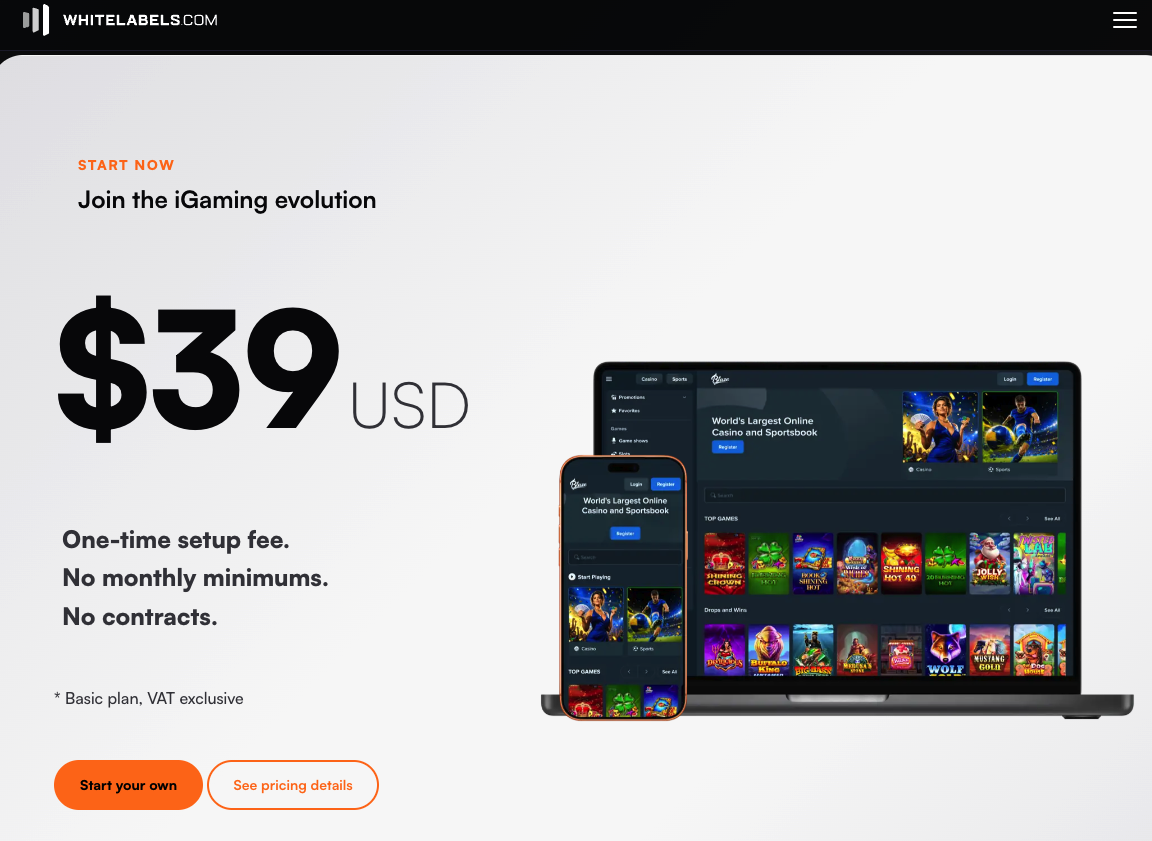
White Label Casino Cost in 2026: Setup Fees Ranked From $99 to $150,000+
The real white label casino cost and white label casino price for all 11 platforms we review, ranked cheapest to most expensive by setup fee and fixed monthly cost.