SOFTSWISS vs EveryMatrix 2026: Two Paths to Regulated Markets Compared
SOFTSWISS sublicenses operators into six legal frameworks, including Malta’s MGA. An operator never needs to hold a licence first. EveryMatrix works the opposite way. An operator needs a national licence, a UKGC account or an MGA grant, before EveryMatrix is even an option. That one fact matters more than the €35,000 SOFTSWISS setup fee or the $50,000 to $150,000 EveryMatrix quote.
- The licensing divide
- Licensing: sublicensing vs bring your own licence
- Setup cost and first-year spend
- Time to launch
- GGR share: headline rate vs true cost
- Game library: 40,000 vs 20,000 titles
- Full comparison table
- When SOFTSWISS is the better fit
- Who EveryMatrix is built for
- FAQ
The licensing divide
Every other difference between these two platforms sits downstream of one choice each company made years ago. SOFTSWISS chose to become a licence holder that lets other operators launch under its own paper. EveryMatrix chose a different path. It stayed out of the licensing business and built infrastructure instead. It serves operators who already cleared that bar on their own.
A gaming licence is what lets a casino legally accept real-money deposits in most markets. Regulators treat every vendor behind that licence as part of their compliance picture. That is true whether the vendor is a sublicensor or a technology supplier working under someone else’s grant.
SOFTSWISS holds its own MGA B2B Critical Gaming Supply licence, MGA/B2B/942/2022. It also holds five more frameworks: Curaçao, Kahnawake, Tobique, Anjouan, and Isle of Man. An operator with no licence at all can sign with SOFTSWISS. That operator can launch under one of those six frameworks within weeks. EveryMatrix holds its own UKGC account and an MGA B2B/201/2011 licence too. But those licences cover EveryMatrix’s status as a supplier, not a sublicence operators can borrow.
A plain feature list can miss the point here. An operator with no licence anywhere should rule out EveryMatrix immediately, no matter the budget. For context on where both platforms land, see the site’s full ranked comparison of white label casino platforms. It covers all ten providers side by side.
Licensing: sublicensing vs bring your own licence
SOFTSWISS built its sublicensing model to remove the licence barrier completely. A first-time operator signs a contract and passes KYC. SOFTSWISS also runs its own compliance check. Then the operator launches under the SOFTSWISS MGA sublicence, the Curaçao sublicence, or one of four other frameworks. An independent MGA licence costs at least €25,000 in application fees. It also takes six to twelve months to clear. Through SOFTSWISS, an operator can trade under that same MGA framework within weeks.
Which of the six SOFTSWISS frameworks fits best depends on the target market. MGA carries more weight with European payment processors and players. Curaçao is faster and cheaper, but it carries less regulatory prestige. The MGA versus Curaçao licence comparison breaks down what each framework permits.
EveryMatrix works from the other direction entirely. An operator must already hold a licence, most often from the UKGC or the MGA. Only then does EveryMatrix’s technology become relevant. EveryMatrix itself holds UKGC account number 39383 through CoreTech Gaming Limited. Anyone can check that record on the UK Gambling Commission’s public register. EveryMatrix also holds its own MGA B2B/201/2011 licence. Those licences cover EveryMatrix’s own status as a supplier. They are not a sublicence an unlicensed operator can use to launch.
That bring-your-own-licence model is exactly what large regulated operators want. A national lottery board needs a technology partner, not a legal shortcut. It often has to prove to a regulator that every vendor is accountable on its own. The tier-1 enterprise platforms built for regulated operators piece covers why that matters most for the biggest operators.
Setup cost and first-year spend
SOFTSWISS publishes a floor of €35,000, roughly $38,000, for a white label setup. That figure is a starting point, not an average. Custom integrations or multiple regulated markets often push the real cost higher. The full breakdown sits on the SOFTSWISS platform review.
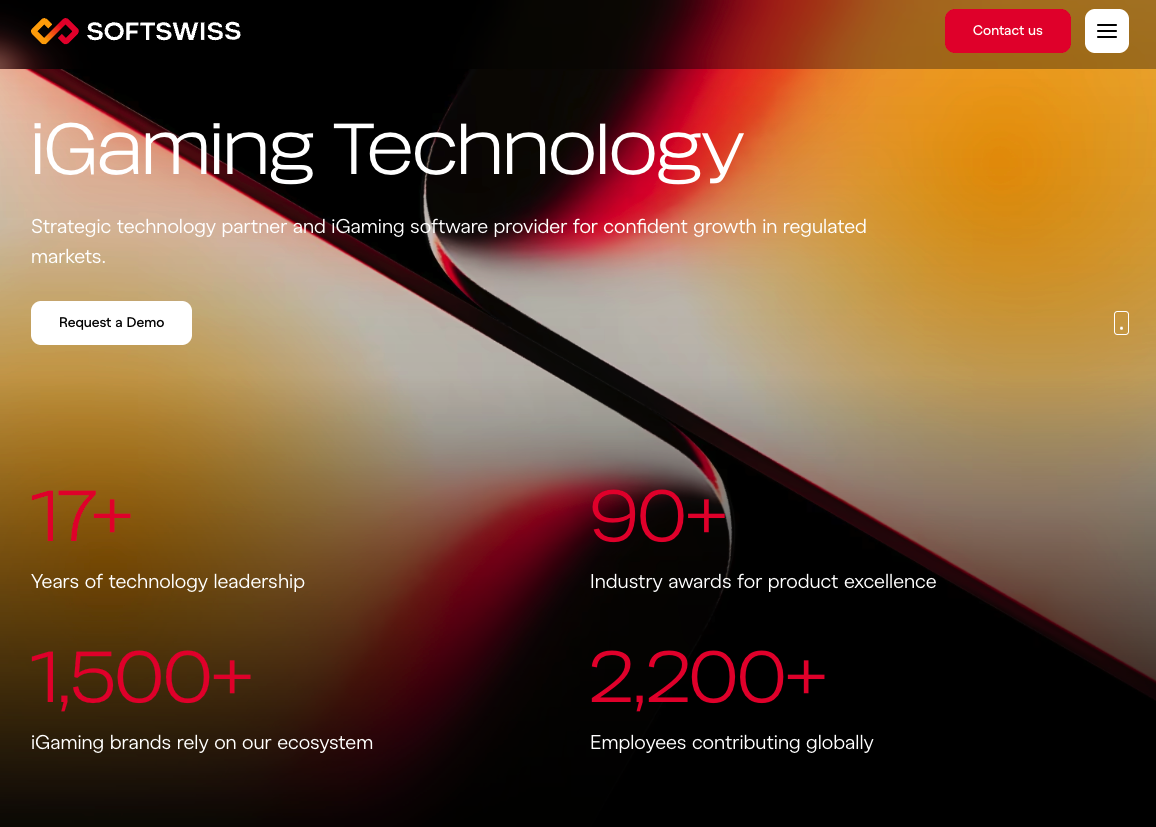 SOFTSWISS’s homepage, the enterprise iGaming platform behind more than 1,400 launched casino brands since 2008, via softswiss.com.
EveryMatrix does not publish a self-serve price at all. Setup needs a sales consultation first. Analysts place the real figure between $50,000 and $150,000, depending on the modules chosen. Those modules include CasinoEngine, MoneyMatrix, and PartnerMatrix. On top of setup, EveryMatrix charges a monthly fee of $5,000 to $15,000. SOFTSWISS carries no such recurring fee.
Stack a year of that fee onto the setup cost. A realistic first-year total for EveryMatrix runs $150,000 to $450,000. SOFTSWISS’s first-year cost is mostly the €35,000+ setup, plus a share of actual GGR. There is no fixed monthly bill regardless of performance. For an operator still deciding whether to launch, that gap alone can settle the question.
Even with the €35,000+ floor, SOFTSWISS still costs far less than EveryMatrix’s enterprise pricing overall. The gap only narrows once an operator counts every layer of SOFTSWISS’s true all-in GGR share.
Time to launch
SOFTSWISS documents a 4-12 week launch window. Eight weeks is a realistic median for a standard casino launch under one of its sublicences. A sportsbook add-on or custom payment work pushes that range toward the slower end.
EveryMatrix advertises 8-16 weeks for modular deployment. That figure assumes the operator already holds a licence and has already picked its modules. Add the sales consultation, the licence check, and multi-module integration work. Realistic end-to-end timelines land at 16-24 weeks, roughly double SOFTSWISS’s range.
The gap compounds the licensing difference instead of offsetting it. An unlicensed operator choosing SOFTSWISS can be live within two months of signing. The same operator trying EveryMatrix first needs six to twelve months to get a licence. Only then does EveryMatrix’s own 16-24 week clock start running.
GGR share: headline rate vs true cost
SOFTSWISS advertises a GGR share of 10-15%. That number is real, but it only covers the platform licence. Game aggregator fees are billed separately per studio and category. They typically add another 15-20% of GGR. Affilka, SOFTSWISS’s own affiliate and CRM product, costs roughly $1,500 a month as a separate subscription. Payment partner fees are billed per transaction on top of all that.
Add those layers together and the true all-in cost lands at 25-40% of GGR. That is not the 10-15% figure on the headline sheet. The true cost is still cheaper than EveryMatrix’s structure once its monthly fee is counted. But the headline rate alone is not the number to budget against.
EveryMatrix’s advertised GGR share is lower, at 8%. But it stacks directly on top of the $5,000-$15,000 monthly fee. It never replaces any part of that fee. A smaller operator with modest GGR can pay a higher effective rate on EveryMatrix than on SOFTSWISS. A flat monthly fee does not scale down with revenue the way a pure percentage does.
Game library: 40,000 vs 20,000 titles
SOFTSWISS runs the deeper catalogue of the two platforms, by a wide margin. The SOFTSWISS Game Aggregator carries 40,000+ games from more than 300 studios. Those games are certified in 24 jurisdictions. Every major studio is on it: Evolution, Pragmatic Play, Play’n GO, NetEnt, and Microgaming. Nolimit City, Push Gaming, Hacksaw Gaming, and SOFTSWISS’s own BGaming round out the list.
EveryMatrix’s catalogue runs 20,000+ games, half of SOFTSWISS’s count. For an already-licensed, regulated brand, that smaller number rarely changes the outcome. EveryMatrix’s typical client pays for compliance infrastructure, not an exhaustive slot catalogue. 20,000 titles from reputable studios covers most regulated-market player demand without issue.
The real gap shows up only in head-to-head competition against tier-one brands. Those brands have been live for years and have trained players to expect niche studio titles. That scenario is rare among EveryMatrix’s typical clients, lottery boards and already-licensed operators. So the smaller library is seldom the deciding factor in practice.
EveryMatrix’s technology supports 20-plus jurisdictions once an operator’s licence is already in place. SOFTSWISS’s 24 certified jurisdictions come bundled with the sublicence itself.
Full comparison table
The numbers below put every factor from this comparison side by side.
| SOFTSWISS | EveryMatrix | |
|---|---|---|
| Setup fee | €35,000+ (~$38,000+) | $50,000-$150,000 (consultation required) |
| Monthly platform fee | None | $5,000-$15,000/month |
| GGR share (advertised) | 10-15% | 8% |
| GGR share (true all-in) | 25-40% | 8% plus the monthly fee, effective rate varies with volume |
| Realistic first-year cost | Setup fee plus GGR share on actual revenue | $150,000-$450,000 |
| Time to launch | 4-12 weeks, 8 weeks median | 16-24 weeks realistic |
| Game library | 40,000+ games, 300+ studios | 20,000+ games |
| Licensing model | Sublicenses operators under 6 frameworks | Requires the operator’s own independent licence |
| Licensing frameworks | MGA, Curaçao, Kahnawake, Tobique, Anjouan, Isle of Man | UKGC, MGA, held by EveryMatrix only, not sublicensed |
| Jurisdictions supported | 24 certified | 20+ once the operator is licensed |
| Founded | 2008 | 2008 |
| Scale | 1,400+ casino brands launched | 1,500+ employees, 15 offices, around $750M revenue |
| Notable clients | BitStarz, PlayAmo, mBit Casino, 7Bit Casino, Shuffle | Flutter/Betfair, Tipico, OPAP, Norsk Tipping, Veikkaus, BetMGM, Pinnacle |
| Best fit | Unlicensed operators entering regulated markets fast | Already-licensed operators needing enterprise infrastructure |
When SOFTSWISS is the better fit
SOFTSWISS is the right call for an operator with no gambling licence yet. It also fits an operator who wants to skip the six to twelve month independent application. The sublicensing model removes that barrier completely. Pair that with the 40,000-game library and a 15-year track record. SOFTSWISS has launched 1,400+ brands under that track record, among them King Billy Casino and N1 Casino. That combination covers most of what a new operator needs, in one contract.
SOFTSWISS also suits operators who want GGR-only pricing. There is no stacking monthly minimum sitting on top of the revenue share. The true all-in cost of 25-40% of GGR is a wide range. But it scales with actual revenue, not a fixed bill regardless of performance.
What SOFTSWISS cannot offer is an independently held national licence. The MGA sublicence is fast and legitimate. But it remains a sublicence, not a licence the operator holds in its own name. Some institutional partners and payment processors require the operator’s own licence, not a borrowed one. No amount of contract language changes that for SOFTSWISS.
Who EveryMatrix is built for
EveryMatrix is built for an operator that already holds a UKGC, MGA, or other national licence. That operator needs enterprise infrastructure a compliance team can defend to a board or a regulator. The full breakdown of its modules, CasinoEngine, MoneyMatrix, and PartnerMatrix sold individually, sits on the EveryMatrix platform review.
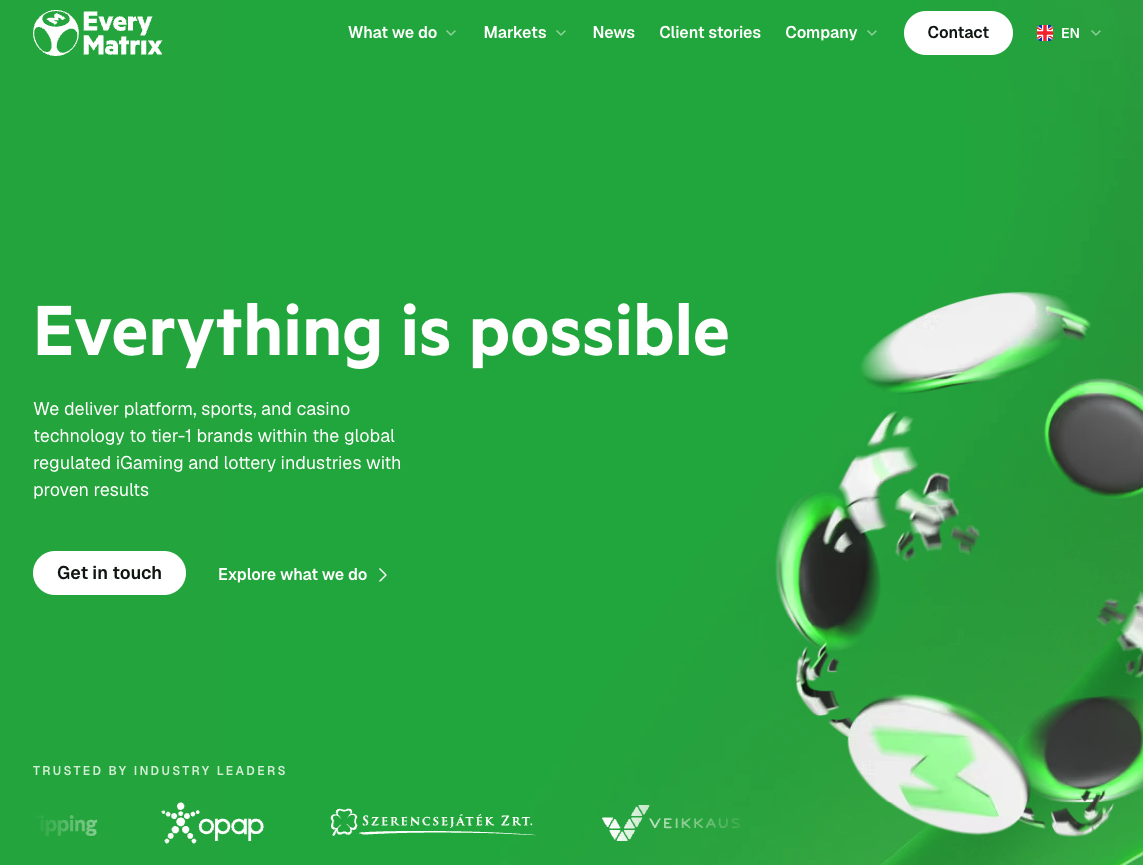 EveryMatrix’s homepage, the enterprise platform behind tier-one clients like Flutter Entertainment and BetMGM, via everymatrix.com.
Its client list makes the fit obvious. Flutter Entertainment’s Betfair brand, Tipico, OPAP in Greece, Norsk Tipping, and Finland’s Veikkaus are on it. BetMGM, Pinnacle, and the National Lottery of Malta round out the list. None of those organizations needed a sublicence. Each one walked in with a licence already in hand. Each needed a vendor that could meet its own compliance bar. That is also why EveryMatrix became the first WLA Safer Gambling Certified platform provider, in 2023.
EveryMatrix started small, in a Shoreditch garage, founded by brothers Ebbe and Stian Hornsletten. It has since grown into a 1,500-plus employee company across 15 offices. Its revenue reached around $750 million in 2025, up 75% year on year. That scale is part of why tier-one operators trust it with core infrastructure.
The tradeoff is real for an operator with a licence but a tighter budget. EveryMatrix’s enterprise pricing and 16-24 week timeline make sense for a lottery board or a tier-one operator. That same cost and timeline is a poor match for an operator that just wants to launch quickly. That is precisely the gap SOFTSWISS’s sublicensing model fills instead.
FAQ
Can an operator without any gambling licence use EveryMatrix?
No. EveryMatrix requires the operator to already hold a national licence, typically from the UKGC or the MGA. Only then does its technology become relevant. SOFTSWISS solves that exact problem by sublicensing operators under six frameworks. That includes its own MGA B2B Critical Gaming Supply licence. So an operator with no licence at all can still launch legally within weeks.
Is SOFTSWISS’s MGA sublicence the same as holding an MGA licence directly?
No, and the distinction matters for some operators. SOFTSWISS’s sublicence lets an operator trade under the SOFTSWISS MGA/B2B/942/2022 licence without applying independently. That route is faster and cheaper than the six to twelve month independent application. Some institutional partners and payment processors still require the operator’s own independently held licence. Only a direct application can satisfy that requirement.
Which platform costs less in the first year?
SOFTSWISS, in almost every case. Its setup fee starts at €35,000+, and its true all-in GGR share runs 25-40%. That includes game fees, Affilka, and payment costs. EveryMatrix’s realistic first-year cost runs $150,000 to $450,000. That adds its $5,000-$15,000 monthly fee to its $50,000-$150,000 setup. EveryMatrix’s advertised 8% GGR share looks lower on paper. But it never has to carry the scale of that monthly fee.
Does the smaller EveryMatrix game library matter for a regulated operator?
Rarely. EveryMatrix carries 20,000+ games against SOFTSWISS’s 40,000+. EveryMatrix’s typical client is a national lottery board or an already-licensed operator like Tipico or BetMGM. That client pays for compliance infrastructure and enterprise support, not an exhaustive slot catalogue. The gap mainly matters for an operator competing directly against tier-one brands. Those brands have trained players to expect niche studio titles.
Can an operator switch from SOFTSWISS to EveryMatrix later?
Yes, but only once that operator holds its own national licence. EveryMatrix does not accept operators relying on a sublicence. An operator can launch fast on SOFTSWISS under an Anjouan or Curaçao sublicence. Later, that operator can obtain a UKGC or MGA licence directly, in its own name. At that point, it can weigh EveryMatrix’s enterprise modules on their own terms. Real player and revenue data from the SOFTSWISS launch can support that decision.
About the Author
Founder, best-white-label-casinos.org
iGaming operator and B2B software evaluator with 20 years of experience launching and reviewing online casino platforms across MGA, Curaçao, and crypto-native environments. Ratings are based on cost transparency, feature depth, regulatory compliance, and operator support quality.
Looking for the best white label casino platform?
Compare 10 providers by cost, launch time, licensing support and game library. Independent editorial, no paid placements.
Compare All Platforms →Some links in this article may be affiliate links. best-white-label-casinos.org may earn a commission at no cost to you. This does not affect editorial independence. Read our terms.
← Previous
SoftGamings vs NuxGame 2026: Established Breadth vs Crypto-First Speed
SoftGamings vs NuxGame compared on setup cost, commercial model, launch speed, game library, and licensing. Based on published pricing and verified platform data.
Next →
SOFTSWISS vs NuxGame 2026: Enterprise Licensing vs Crypto-Native Speed
SOFTSWISS vs NuxGame compared on setup cost, true all-in GGR share, launch speed, crypto infrastructure, and licensing. Based on published pricing and verified platform data.