NuxGame vs EveryMatrix 2026: Crypto-Native Startup vs Enterprise Compliance
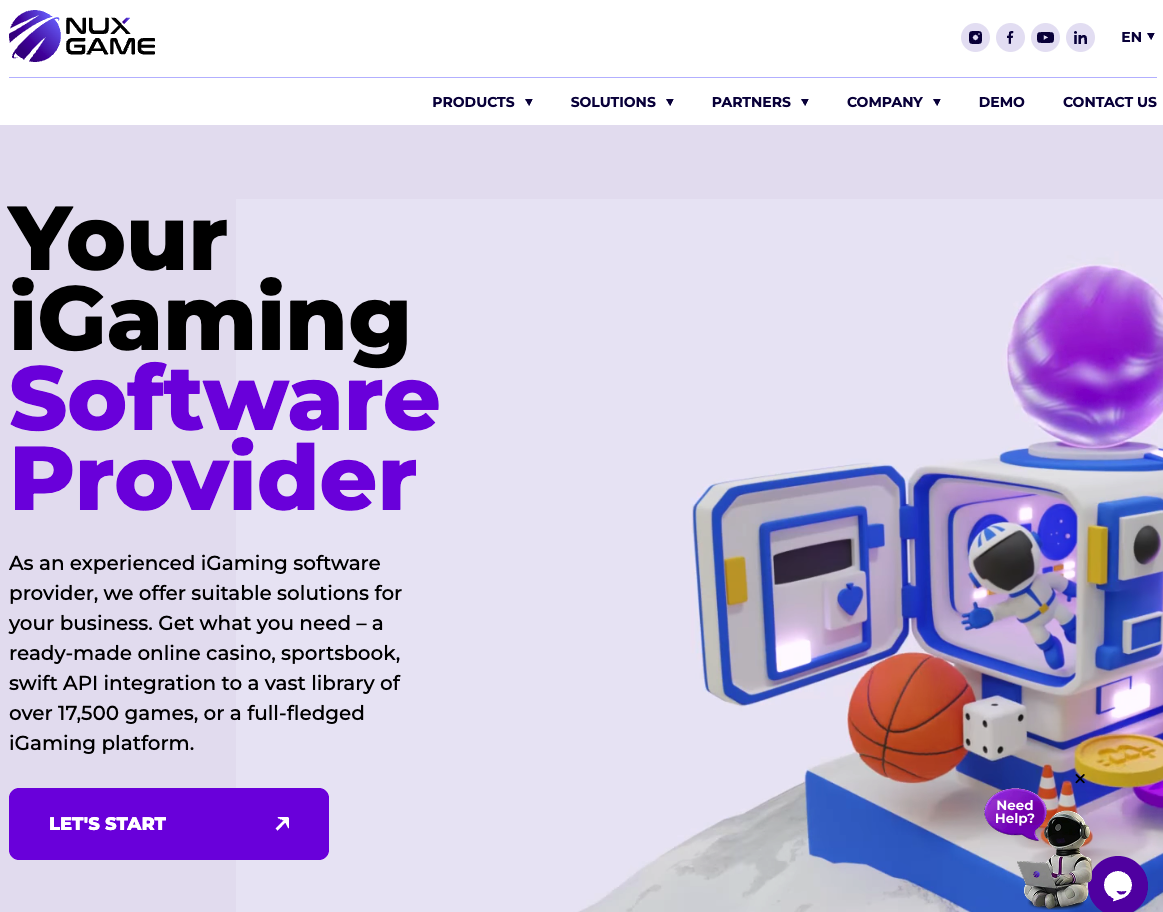
NuxGame can put a crypto casino live under its own Curaçao licence in as little as 24 hours. EveryMatrix will not even start the conversation until the operator already holds a national gaming licence of their own. That one fact separates these two platforms more than any price sheet or game count ever could.
- The core difference in one sentence
- Setup cost and first-year total
- Time to launch
- Licensing: sublicence vs bring-your-own
- Game library and crypto infrastructure
- Full comparison table
- When NuxGame is the better fit
- Who EveryMatrix is built for
- FAQ
The core difference in one sentence
NuxGame is a Curaçao-licensed white label provider. It is built so a founder with no licence and a crypto-first audience can be live within weeks, sometimes days.
EveryMatrix is a modular enterprise platform. It is built for operators who already hold a UKGC or MGA licence. They need infrastructure strong enough to satisfy a regulator, a national lottery, or a listed parent company’s compliance team.
These are not two versions of the same product at different price points. NuxGame removes the licensing barrier entirely by sublicensing operators under its own Curaçao authorisation. EveryMatrix requires the operator to clear that barrier on their own, first, before EveryMatrix becomes relevant at all. Once that split is clear, most of the rest of this comparison follows from it.
Full detail on NuxGame as a standalone option lives on the NuxGame platform review. That page includes its scoring against every other platform ranked on this site. This article focuses on where the two platforms genuinely overlap for an operator weighing both. It also covers where the comparison does not apply, because the operator’s licensing status already rules one side out.
Setup cost and first-year total
NuxGame does not publish a fixed setup fee. Quotes are built per project, based on the modules and customisation an operator needs. Independent industry reviews, including coverage from btcgosu.com and iGamingX, put typical setup costs in the $15,000 to $35,000 range. That is a small fraction of what EveryMatrix charges to get started.
EveryMatrix sits at the enterprise end of the market and has no self-serve price list at all. A consultation is required before any number appears. Industry analyst estimates place the setup fee between $50,000 and $150,000, depending on which modules the operator selects. EveryMatrix sells its casino engine, payment system, and affiliate platform as separate products. An operator can buy them together, or buy only the pieces needed.
The monthly cost structure diverges just as sharply. NuxGame has no published monthly platform fee on top of its revenue share. EveryMatrix charges $5,000 to $15,000 per month on top of its setup fee. NuxGame does not carry that recurring cost at all.
On revenue share, NuxGame’s published commercial structure runs at approximately 10% of GGR. The company also offers commercial models with no revenue share at all, for operators who prefer a flat fee. That option is unusual among white label providers. EveryMatrix advertises a lower headline rate of 8% GGR. But that lower percentage stacks on top of the $5,000 to $15,000 monthly fee, a cost NuxGame does not have. The two headline numbers are not directly comparable on their own.
Add it all up, and a realistic first-year all-in cost for NuxGame runs $40,000 to $150,000. That range depends on volume and customisation. EveryMatrix’s realistic first-year total runs $150,000 to $450,000, several times higher at every point in the range. Neither figure is a trick. They reflect two platforms built for operators with very different balance sheets.
Time to launch
NuxGame quotes a standard launch window of 2 to 4 weeks for a full build. For operators who want speed over customisation, NuxGame also offers a 24-hour rapid deployment option built on pre-built templates. It launches under NuxGame’s own existing Curaçao licence, so there is no licensing wait to factor in.
EveryMatrix’s modular architecture is designed to launch in 8 to 16 weeks on paper. In practice, realistic end-to-end timelines run 16 to 24 weeks. That range accounts for module selection, integration testing, and the operator’s own licensing and compliance work. Because EveryMatrix does not sublicense, much of that timeline depends on the operator’s own licence application. How far along that application is before engagement starts changes everything.
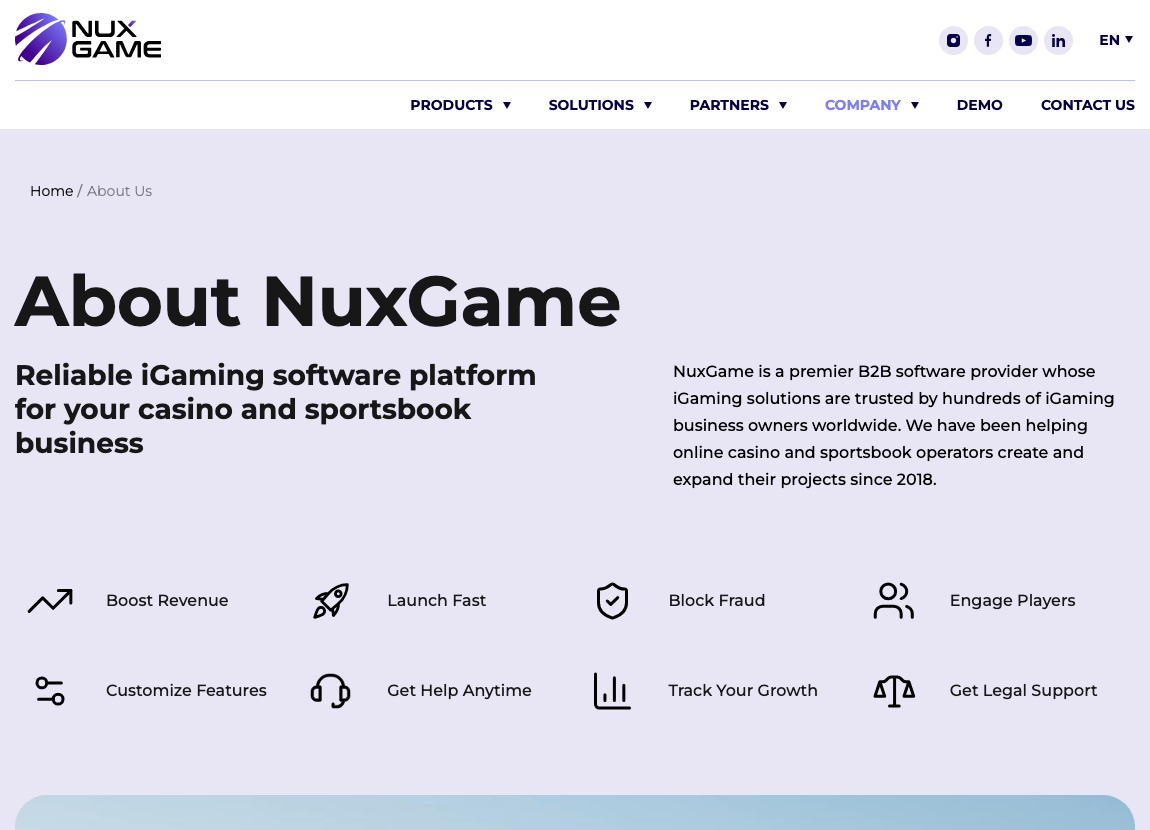 NuxGame’s back office, built for a fast signup-to-launch flow under its own Curaçao licence. A crypto-native operator can go from signup to a live casino in weeks, not months, via nuxgame.com.
Speed matters for an operator racing a market window or a TikTok audience ready to convert. For a crypto community asking where to play now, 4 weeks beats 6 months every time. The main white label platform ranking covers how launch speed weighs against other factors, across every platform on this site.
Licensing: sublicence vs bring-your-own
This is the single biggest structural difference between the two platforms. It deserves to be stated plainly, not buried inside a feature table.
NuxGame sublicenses operators under its own Curaçao gaming licence. Anjouan is also available, plus a supported pathway into Malta for operators who want a stronger jurisdiction later. An operator with no licence of their own, no application filed, and no compliance department can still launch. They launch legally under NuxGame’s existing authorisation. There is no independent licence application required to get started.
EveryMatrix does not sublicense anyone. The operator must already hold, or independently obtain, their own national gaming licence before EveryMatrix is even a usable option. That licence is typically a UKGC or MGA authorisation, or an equivalent framework in another regulated market. EveryMatrix itself holds a UKGC account, number 39383, via its CoreTech Gaming Limited entity. Any operator can verify that licence directly on the UK Gambling Commission’s public register. It also holds an MGA B2B/201/2011 licence. EveryMatrix was the first platform provider to earn WLA Safer Gambling Certification, in 2023.
That contrast defines the entire buying decision. An operator who does not yet hold a licence cannot buy their way into EveryMatrix at any price. An operator who already holds a UKGC or MGA licence gains nothing from NuxGame’s sublicensing. They already cleared that step on their own. The crypto operator platform guide covers how sublicensing models like NuxGame’s fit into a crypto-first launch strategy specifically.
Game library and crypto infrastructure
NuxGame carries 16,500+ games, certified to the GLI-19 standard, from its aggregated supplier network. That is a real mid-tier library, smaller than EveryMatrix’s. It still covers the slots, live dealer, and table game categories most new casinos need at launch. What sets NuxGame apart is not the count, but the infrastructure underneath it. It runs a genuine Web3 and crypto-native API at the platform level, rather than a bolted-on payment gateway. That matters for operators whose entire audience transacts in crypto rather than treating it as an alternative payment method.
EveryMatrix carries more than 20,000 games, the larger library of the two. It sources that library through its CasinoEngine product and aggregated supplier relationships. EveryMatrix has no equivalent crypto-native infrastructure at the API level. Crypto payments can be added as a payment method through its MoneyMatrix product. The underlying system was not built around blockchain infrastructure the way NuxGame’s was.
 EveryMatrix’s CasinoEngine back office, built for operators running enterprise-scale compliance and reporting across modular products, via everymatrix.com.
For a crypto-first operator, the 3,500-game gap between the two libraries matters less than one question. That question, native feature or bolted-on add-on, matters more than the number. For an operator serving tier-one regulated markets where fiat payments dominate, library size matters more. Supplier depth carries more weight there too, well ahead of crypto support. The enterprise platform guide covers how EveryMatrix’s module structure compares against other enterprise-grade options for operators in that position.
Full comparison table
| NuxGame | EveryMatrix | |
|---|---|---|
| Setup fee | $15,000-$35,000 (estimated, per project) | $50,000-$150,000 (estimated) |
| Monthly platform fee | None published | $5,000-$15,000/month |
| GGR share | ~10%, or no-revenue-share models available | 8%, plus the monthly fee above |
| First-year all-in cost | $40,000-$150,000 | $150,000-$450,000 |
| Time to launch | 2-4 weeks (24-hour option available) | 8-16 weeks on paper, 16-24 weeks realistic |
| Game library | 16,500+ games, GLI-19 certified | 20,000+ games |
| Licensing model | Sublicenses under own Curaçao licence (plus Anjouan, Malta pathway) | No sublicensing; operator must hold own licence (UKGC, MGA, etc.) |
| Crypto/Web3 infrastructure | Native at the API level | Added as a payment method via MoneyMatrix |
| Founded | 2018 | 2008 |
| Headquarters | Willemstad, Curaçao | Started in Shoreditch, now 15 offices globally |
| Scale | Smaller client roster, newer track record | 1,500+ employees, roughly $750 million revenue in 2025 |
| Notable clients | Not tier-1 named accounts | Flutter Entertainment, Tipico, OPAP, Norsk Tipping, Veikkaus, BetMGM, Pinnacle, National Lottery of Malta |
| Regulatory certifications | GLI-19 | UKGC (account 39383), MGA B2B/201/2011, WLA Safer Gambling Certified (2023) |
| Best suited for | Crypto-first operator with no existing licence | Already-licensed operator needing enterprise-grade modular infrastructure |
When NuxGame is the better fit
NuxGame makes sense for an operator with no gaming licence yet. It also fits an operator unwilling to spend six months and tens of thousands of dollars on a licence first. Sublicensing under NuxGame’s Curaçao authorisation removes that barrier completely. Pair that with a crypto-native audience, a limited launch budget, and a desire to be live inside a month. NuxGame fits that brief better than almost anything else on the market.
The flexible commercial models matter here too. An operator who prefers a flat fee over a GGR share has that option with NuxGame. That flat-fee choice is unusual among white label providers. Combined with GLI-19 certification and a genuine Web3 API, NuxGame gives a startup real infrastructure. It does that without enterprise-level pricing attached.
The trade-off here is real. NuxGame cannot sublicense into tier-one Europe. UK, Germany, Sweden, and the Netherlands are all unavailable through its Curaçao authorisation. Its track record dates to 2018, far shorter than EveryMatrix’s, and its client roster does not include household names. For an operator targeting only crypto-friendly or emerging markets, none of that matters. For an operator with ambitions toward UKGC-regulated territory, it is a hard ceiling.
None of this means NuxGame is a lesser platform in some general sense. It means NuxGame was built to solve a different problem than EveryMatrix was built to solve. A founder with $30,000 and a Telegram community of crypto bettors has no interest in ever touching a UKGC application. That founder gets more usable infrastructure per dollar from NuxGame than from any enterprise platform, EveryMatrix included.
Who EveryMatrix is built for
EveryMatrix is built for an operator who already holds a UKGC or MGA licence, or is actively obtaining one. That operator needs infrastructure that can stand up to the compliance bar those regulators set. That is a different starting point from almost every other platform in this comparison set. Most competitors assume the operator does not yet have a licence at all.
The client list makes the target audience obvious. It includes Flutter Entertainment, Tipico, OPAP, Norsk Tipping, Veikkaus, BetMGM, Pinnacle, and the National Lottery of Malta. Those are not startups testing a market. They are operators who need a platform that a regulator or a state lottery board will sign off on. A listed parent company’s audit team needs to sign off too, without hesitation. EveryMatrix sells CasinoEngine, MoneyMatrix, and PartnerMatrix as separate products. That modular structure lets an operator at that scale build the exact stack their compliance needs demand. No one is forced into a single bundled package.
The cost of that infrastructure is real. A $150,000 to $450,000 first-year total puts EveryMatrix out of reach for a budget-constrained first-time operator. So does its 16 to 24 week realistic launch timeline. Its lack of crypto-native infrastructure also rules out most Web3-first brands. Those are not weaknesses in the context EveryMatrix is built for. They are the predictable cost of enterprise-grade compliance infrastructure. An operator who already holds a national licence will find the price justified. So will one who must prove that infrastructure to a regulator or a lottery board.
A full breakdown of how EveryMatrix stacks up against its direct enterprise competitors sits on the EveryMatrix platform review. That comparison is not against a crypto-native platform like NuxGame. That page is the better starting point for an operator who has already ruled out the sublicensing route. It helps compare enterprise vendors on modular depth, certification, and support structure, rather than on launch speed.
FAQ
Is NuxGame cheaper than EveryMatrix?
Yes, at every stage. NuxGame’s estimated setup cost of $15,000 to $35,000 is a fraction of EveryMatrix’s estimated $50,000 to $150,000. NuxGame also has no published monthly platform fee. EveryMatrix charges $5,000 to $15,000 per month on top of its setup cost. A realistic first-year total for NuxGame runs $40,000 to $150,000 against $150,000 to $450,000 for EveryMatrix. The gap holds even though EveryMatrix’s headline GGR share of 8% is lower than NuxGame’s roughly 10%. The monthly fee EveryMatrix charges outweighs that small difference at almost any realistic volume.
Can I use EveryMatrix if I do not have a gaming licence yet?
Not in any practical sense. EveryMatrix does not sublicense operators under its own authorisation the way NuxGame does. The operator needs to already hold, or be independently pursuing, a national licence such as UKGC or MGA. Only then does EveryMatrix become a workable option. If you have no licence yet, and do not want to spend months and dollars getting one, start with NuxGame. Its sublicensing model, under its own Curaçao licence, is the more realistic starting point.
Does NuxGame support crypto better than EveryMatrix, or is it just marketing?
The difference is structural, not just messaging. NuxGame built a genuine Web3 and crypto-native API into its platform at the infrastructure level. EveryMatrix supports crypto as a payment method inside its MoneyMatrix product. That sits on top of a system that was never designed around blockchain infrastructure. For an operator whose entire business runs on crypto, that distinction matters day to day. It is not just a line in a sales deck.
Which platform has the bigger game library?
EveryMatrix carries the bigger library, with 20,000+ games against NuxGame’s 16,500+. Both libraries cover the core categories, slots, live dealer, and table games, that drive most player activity. The 3,500-game difference matters more in competitive, tier-one regulated markets, where players expect depth across niche studios. It matters less for a new crypto-focused casino, where a smaller, well-certified library is enough to launch and grow.
Is EveryMatrix worth the higher cost for a well-capitalised operator?
Yes, for an operator who already holds a UKGC or MGA licence. That operator needs infrastructure built to satisfy a regulator, a national lottery, or an enterprise compliance team. EveryMatrix’s modular products reflect that depth. So does its UKGC account, number 39383, verifiable on the UK Gambling Commission’s public register, and its MGA licence. Its roster of tier-one clients, including Flutter Entertainment and BetMGM, operates at a level NuxGame does not reach. For an operator without that licence, or without that compliance need, EveryMatrix costs more than it needs to. The extra $100,000 or more in first-year cost buys infrastructure the business does not need yet.
About the Author

Founder, best-white-label-casinos.org
iGaming operator and B2B software evaluator with 20 years of experience launching and reviewing online casino platforms across MGA, Curaçao, and crypto-native environments. Ratings are based on cost transparency, feature depth, regulatory compliance, and operator support quality.
Looking for the best white label casino platform?
Compare 10 providers by cost, launch time, licensing support and game library. Independent editorial, no paid placements.
Compare All Platforms →Some links in this article may be affiliate links. best-white-label-casinos.org may earn a commission at no cost to you. This does not affect editorial independence. Read our terms.

← Previous
Localization: Why Games and Payment Methods Make or Break a Market Entry
From our founder's Legacy Builders podcast interview: why the same casino brand needs different games and different payment methods in every country, with real examples from Brazil, Mexico, India, and the Netherlands.
Next →
Whitelabels.com vs SoftGamings 2026: Setup Cost and Launch Speed Compared
Whitelabels.com vs SoftGamings compared on setup cost, true all-in GGR share, launch speed, licensing, and game library. Based on published pricing and verified platform data.